


Cold email benchmarks are only useful when the source defines its sample, metric, and collection period. This guide shows which measurements to trust, which claims were removed for weak sourcing, and how to build a defensible baseline from your own campaigns.
Cold email statistics can look precise while answering different questions. One report may count every reply, another only positive replies, and another may exclude bounced messages from its denominator. Industry, geography, sending infrastructure, list source, and observation window also change the result.
The defensible approach is to treat public benchmarks as context and your own consistently defined cohort as the operating baseline. This guide explains how to do that without presenting a synthetic industry average.
What Was Removed from the Previous Edition
The previous edition contained performance figures whose nearby citations did not support them. A GDPR page cannot substantiate an open rate. CNIL guidance cannot substantiate a reply rate. A Gmail policy announcement cannot substantiate a bounce-rate average. Those figures, the associated charts, and every reference to an Overloop-owned benchmark dataset have been removed.
How to Assess a Cold Email Benchmark
| Check | What the source should disclose | Why it matters |
|---|---|---|
| Population | Audience, market, industry, geography, and sender type | A mixed marketing-email sample is not a cold-outreach sample. |
| Observation window | Collection dates and campaign duration | Mailbox rules and tracking behavior change over time. |
| Denominator | Sent, delivered, opened, or contacted recipients | The same numerator produces a different rate under each denominator. |
| Reply definition | All replies, human replies, positive replies, or meetings | Automated and negative responses can inflate an undifferentiated reply rate. |
| Deduplication | Whether recipients, threads, and repeat sends are deduplicated | Repeated touches should not be mistaken for unique prospects. |
| Publisher | Who collected the data and any commercial relationship | Vendor data can be useful, but it must stay attributed and scoped. |
Open Rates Are a Diagnostic Signal, Not Ground Truth
Apple states that Mail Privacy Protection prevents senders from seeing whether protected recipients opened an email. That makes pixel-based opens unsuitable as a standalone outcome metric. Use open events to diagnose broad changes, but prioritize human replies and meetings for business decisions. Source: Apple Mail Privacy Protection documentation.
When a report publishes an open-rate benchmark, check whether it explains how privacy-protected opens, bot activity, and repeated opens were handled. If it does not, the number should not be compared directly with your own dashboard.

Build Your Baseline Around Replies and Meetings
Start with event counts that are auditable in your own system. Then convert them into rates using a documented denominator:
- Delivery rate: delivered messages divided by attempted sends.
- Unique reply rate: unique recipients who replied divided by delivered recipients.
- Positive reply rate: unique recipients with a positive reply divided by delivered recipients.
- Meeting-booked rate: unique recipients who booked a meeting divided by delivered recipients.
- Bounce rate: bounced messages divided by attempted sends, split into hard and soft bounces.
- Complaint and opt-out rates: complaints or opt-outs divided by delivered recipients.
Keep automated replies, negative replies, and positive replies as separate fields. A campaign can raise total replies while reducing qualified conversations, so the headline reply rate alone is not enough.
Use Mailbox-Provider Guidance for Deliverability
Google states that bulk senders must authenticate their email, enable easy unsubscription, and stay under a reported spam threshold. The announcement supports those requirements; it does not support a universal cold-email bounce rate or inbox-placement average. Source: Google Gmail bulk-sender announcement.
For an operating review, check the current provider documentation for:
- SPF, DKIM, and DMARC configuration;
- domain and IP reputation signals;
- spam complaints and opt-out handling;
- one-click unsubscribe support where required;
- bounce classification and suppression behavior;
- changes to provider enforcement.
Do not turn a provider rule into a performance benchmark. Compliance with a technical requirement does not guarantee inbox placement.
Evaluate Sequence Design with Controlled Cohorts
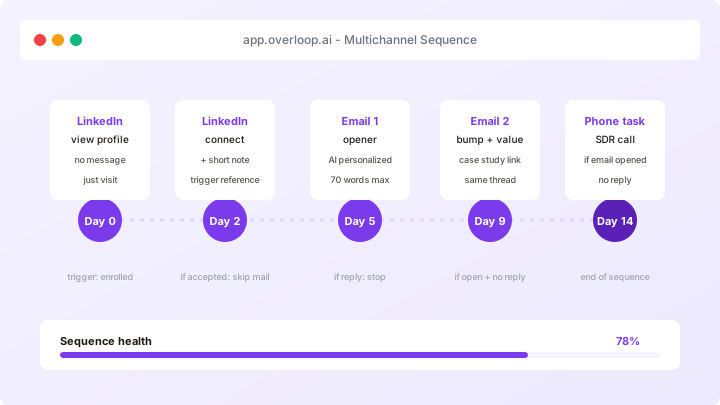
There is no source-independent ideal cadence. Audience urgency, deal complexity, channel mix, and local rules all affect how a sequence should be designed. Compare cohorts that differ in one meaningful variable, stop outreach after a reply or opt-out, and judge the change using positive replies, meetings, complaints, and opt-outs.
Measure Personalization and AI Without Assuming Lift
AI-assisted research and drafting can change production speed and message consistency, but those workflow benefits do not prove a reply-rate lift. Evaluate quality and outcomes separately. Human reviewers should check factual accuracy, relevance, tone, privacy, and whether the message makes a defensible claim about the prospect.
A useful experiment records the prompt and review policy, holds the audience and offer stable, and compares positive replies and meetings. Publish the result only with the sample, dates, exclusions, and exact metric definitions.

Keep Legal Guidance Separate from Performance Data
The GDPR text identifies lawful bases for processing and recognizes that direct marketing may be considered a legitimate interest, but that does not make every cold email lawful. Purpose, necessity, balancing, transparency, the right to object, and applicable national ePrivacy rules still matter. Source: official GDPR text on EUR-Lex.
CNIL guidance for France distinguishes professional prospecting when the message relates to the recipient's role and requires clear information and a simple way to object. It is jurisdiction-specific guidance, not a reply-rate benchmark and not a substitute for legal advice. Source: CNIL guidance on email prospecting.
How to Publish a Defensible Campaign Benchmark
- Freeze the cohort. Record audience, offer, market, channel, and campaign dates before analysis.
- Define every event. Document sent, delivered, replied, positive reply, meeting, bounce, complaint, and opt-out.
- Deduplicate recipients. Separate unique people from messages and sequence steps.
- State exclusions. Document test accounts, internal domains, bots, automated replies, and missing events.
- Segment before comparing. Compare like-for-like audiences, sender setups, and offers.
- Keep attribution visible. Label vendor data, regulator guidance, and your own campaign analysis distinctly.
- Publish uncertainty. Explain gaps, tracking limitations, and whether the result can generalize.
How Overloop Fits the Measurement Workflow
Overloop supports prospect data, native email and LinkedIn sequences, campaign analytics, and AI-assisted workflows. Use its reporting to compare your own historical cohorts rather than to claim a universal benchmark. Product availability and integrations can change, so verify the current scope on the Overloop features page.
Build a benchmark from your own campaigns
Track delivery, replies, and meetings with definitions your team can audit.
Start with Overloop → See a demoFrequently asked questions
Can I trust a universal cold email open-rate benchmark?
No single open-rate benchmark applies to every campaign. Apple Mail Privacy Protection prevents senders from reliably seeing whether protected recipients opened a message, and benchmark samples vary by audience, sender setup, and measurement window. Treat opens as a diagnostic signal, not a business outcome.
Which cold email metrics should I benchmark?
Track delivered messages, unique replies, positive replies, meetings booked, bounces, spam complaints, and opt-outs. Compare each metric against your own historical baseline for the same audience and campaign type.
Is there a universal good cold email reply rate?
No. Reply rates depend on targeting, offer, copy, sender reputation, market, and the definition of a reply. Record both total and positive replies, then compare like-for-like segments over time.
How should I evaluate cold email follow-ups?
Test follow-up timing and copy on comparable cohorts. Stop sequences when a recipient replies or opts out, and judge the cadence by positive replies, meetings, complaints, and opt-outs rather than by a universal sequence-length claim.
Which deliverability guidance should I use?
Use the current requirements published by the mailbox providers you send to. Google states that bulk senders must authenticate email, support easy unsubscription, and stay under its reported spam threshold.
Is B2B cold email automatically lawful under GDPR?
No. The lawful basis, transparency duties, right to object, national ePrivacy rules, audience, and message context all matter. Review current regulator guidance and obtain legal advice for your jurisdiction.
Methodology & sources5 sources
How this edition was evaluated
This edition was audited claim by claim. Performance figures were retained only when a nearby public source directly supported the same metric, population, and context. Figures linked to unrelated legal or provider pages were removed rather than reassigned.
- Primary-source preference: mailbox-provider, platform, and regulator documentation.
- Metric match: the citation must support the exact numerator, denominator, and population described.
- Attribution: third-party studies stay attributed to their publishers; samples are not merged into an Overloop dataset.
- Illustrations: conceptual interfaces are labelled as illustrations and contain no observed campaign results.
- Editorial disclosure: Overloop publishes this guide and is identified when product workflows are discussed.
See the full editorial methodology. Recheck every external source before applying its guidance because provider rules and regulator positions can change.