Skip to content

8 Best AI GTM Agents in 2026, Compared by Job

“AI GTM agent” now describes everything from a research assistant to an autonomous SDR. This guide separates the categories, checks what each product actually documents, and makes the trade-offs explicit.

On this page
  1. There is no single “best” AI GTM agent
  2. What counts as an AI GTM agent?
  3. How we compared these tools
  4. AI GTM agents compared at a glance
  5. 1. Claygent
  6. 2. Common Room RoomieAI
  7. 3. UserGems Gem-E
  8. 4. Demandbase Agentbase
  9. 5. Unify Agents
  10. 6. RegieGO
  11. 7. 11x Alice
  12. 8. 6sense RevvyAI
  13. Where YourMax.ai and Overloop fit
  14. How to choose without buying a demo
  15. Frequently asked questions
The short answer

There is no single “best” AI GTM agent

Claygent is the strongest fit for teams that want to design custom research and qualification agents. Common Room is the clearest signal-to-action suite. UserGems specializes in relationship and buying signals. Demandbase is built for enterprise ABM. Unify is the most accessible self-serve outbound option in this shortlist. RegieGO packages agents around a seller-controlled workspace. 11x Alice is closer to an autonomous AI SDR. 6sense RevvyAI is best understood as an assistant for teams already using 6sense intelligence.

This is an editorial shortlist by job, not a hands-on performance ranking. We reviewed product documentation, access restrictions, and public pricing; we did not run a controlled benchmark across vendor accounts.

Build a custom agentClaygent
Turn signals into actionsCommon Room RoomieAI
Automate outbound self-serveUnify Agents
Orchestrate enterprise ABMDemandbase Agentbase

What counts as an AI GTM agent?

For this comparison, an AI GTM agent must accept a goal, assemble GTM context, make or recommend a bounded decision, and prepare or perform an action. A chatbot that summarizes one account can be useful, but it is not the same product category as an agent that finds a market, qualifies accounts, builds a list, and launches a controlled workflow.

GoalICP, territory, campaign objective
ContextCRM, web, product, intent, people
DecisionPrioritize, qualify, reject, choose next move
ActionResearch, route, draft, sequence, alert
ControlEvidence, approval, permissions, audit trail

That definition deliberately excludes standalone databases, copy generators, enrichment APIs, and email senders. Some products combine several layers; the important question is which job the agent can reliably own.

How we compared these tools

We checked official product pages, documentation, and public pricing on Aug. 20, 2026. The shortlist covers eight different interpretations of an AI GTM agent so buyers can compare scope rather than marketing language.

  • Agency: can the system plan or decide, rather than only execute a fixed rule?
  • Context: which CRM, first-party, intent, web, or people signals inform the result?
  • Action: can it research, qualify, route, write, sequence, or update another system?
  • Control: can a user inspect sources, constrain behavior, approve output, and limit permissions?
  • Fit: is it self-serve, operations-led, outbound-specific, or enterprise ABM infrastructure?
  • Commercial clarity: is pricing public, and which capabilities require a higher plan or implementation?

What we did not do: we did not score output quality with a shared private dataset, audit deliverability, or verify vendor performance claims. Those require instrumented accounts and retained evidence.

Related-party disclosure: Overloop publishes this article. Max (at YourMax.ai) and Overloop are distinct products operated by Sortlist SA, and Nicolas Finet leads Sortlist and Overloop. Neither product is included in the ranked shortlist; both are discussed later as adjacent layers.

AI GTM agents compared at a glance

ProductCategoryBest forPublic pricing signalMain limitation
ClayClaygentConfigurable agent builderCustom research and qualificationSelf-serve plans; advanced agents depend on planRequires workflow design and credit management
Common RoomRoomieAISignal-to-action suiteProduct, community, web, and ecosystem signalsEssential published at $2,500/month, billed annuallyEnterprise cost and human review still matter
UserGemsSignals + outbound agentsChampion, relationship, and buying-signal playsCore published at $40,000/year plus implementationHigh entry price
DemandbaseAgentbaseEnterprise ABM agent systemBuying groups, journeys, and next actionsCustom platform and per-user pricingBest inside the Demandbase ecosystem
UnifySelf-serve outbound agentsResearch, qualification, lists, and sequencesFree, $20, and $60 per seat tiers; Business customAdvanced signals and automation sit higher in the range
RegieRegieGOSeller-controlled agentic workspaceResearch, prospecting, calls, and follow-upFree; Pro $49/month with 5,000 monthly creditsNot a hands-off autonomous SDR
AliceAutonomous AI SDRManaged outbound and meeting generationAsk for a written quote; the public page is inconsistentNarrower than a general GTM agent
6senseRevvyAIABM intelligence assistantTeams already using 6sense dataPackage and add-on pricingNo bulk account analysis; MCP is read-only

Pricing and packaging change frequently. Figures above reflect public vendor pages checked Aug. 20, 2026; confirm taxes, usage limits, implementation fees, minimum seats, and contract length directly with each vendor.

Clay

1. Claygent

Configurable GTM agent builder

Claygent is the best fit in this shortlist for a GTM operations team that wants to design its own agents. Clay describes agents that can plan a research task, browse the web, reason over what they find, and produce structured output inside a broader data workflow. Typical jobs include company research, account qualification, scoring, and personalized writing.

The distinction is important: Claygent is not a single prepackaged autonomous rep. It is a toolkit for building agents around your definitions and data. That flexibility is valuable when the team has non-standard ICP rules, niche sources, or a research process that cannot be reduced to one vendor's default playbook.

Best forRevOps or growth teams building custom research and qualification workflows.
Documented actionBrowse, research, reason, classify, score, and write inside Clay workflows.
Commercial modelClay publishes self-serve plans; usage draws on Actions and Data Credits.

Watchout: flexibility transfers design responsibility to the buyer. Budget for prompt design, source selection, evaluation cases, credit controls, and maintenance. Clay's Account Research Agents are limited to higher plan families, so confirm which agent type is included before buying.

Official sources: Claygent · pricing

Common Room

2. Common Room RoomieAI

Signal-to-action agent suite

Common Room is the strongest fit for teams whose buyers leave traces across a product, website, community, social network, partner ecosystem, and CRM. RoomieAI is now a family of agents rather than a generic assistant: Capture finds and enriches relevant people and accounts, Spark helps prioritize and synthesize context, and Activate prepares outbound actions.

This makes Common Room more than a signal feed. Its useful job is connecting fragmented evidence to a sales-ready hypothesis: who matters, why now, and which action should follow. It is especially credible for product-led and community-led companies that already have rich first-party activity but struggle to operationalize it.

Best forProduct-led, community-led, and ecosystem-led GTM teams.
Documented actionCapture, research, prioritize, personalize, and activate outbound workflows.
Published entry pointEssential: $2,500 per month, billed annually, as checked Aug. 20.

Watchout: this is an enterprise purchase, and automation does not remove review. Common Room's own guidance warns that complex prompting can increase hallucination risk and recommends checking output before it is used.

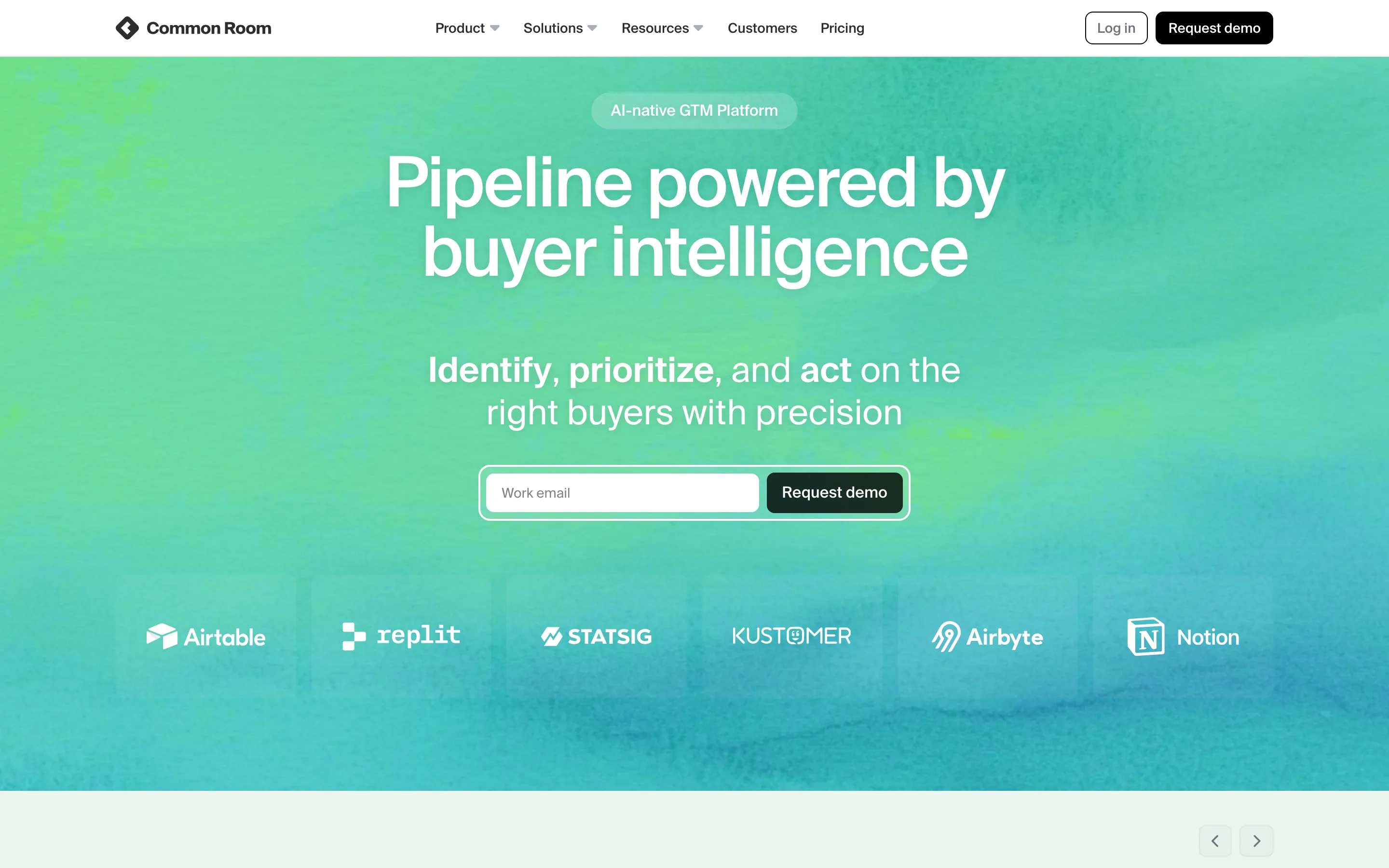
Common Room public website presenting its AI-native GTM platform
Common Room public website capture showing its current AI-native GTM positioning.

Official sources: RoomieAI · pricing · documented prompting limits

3. UserGems Gem-E

Signals, scoring, and outbound agents

UserGems should not be reduced to job-change alerts. Its Gem-E product family now covers research, account and contact scoring, writing, automated campaigns, buying stages, and audience activation. The distinctive advantage remains its relationship-aware model: past champions, former users, and people moving between companies can become concrete plays rather than another undifferentiated intent score.

Choose it when relationship signals are strategically valuable and the team wants an opinionated system around them. UserGems can connect a signal to a target, a message, and an activation path; that is closer to an agentic GTM workflow than the narrow tracker it used to be.

Best forSales teams with a meaningful customer, user, or champion network.
Documented actionResearch, score, write, automate campaigns, and build ABM audiences.
Published entry pointCore: $40,000 per year plus a $3,000 implementation fee.

Watchout: the entry price makes this difficult to justify for a team without enough relationship data or deal value. Ask the vendor to quantify which of your real signals can be activated, then review false positives and workflow ownership before signing.

Official sources: product overview · pricing

Demandbase

4. Demandbase Agentbase

Enterprise ABM agent system

Demandbase Agentbase is designed for complex enterprise account-based motions. Its agents work around buying groups, account engagement, intent, journeys, campaign outcomes, and next-best actions. That scope is materially different from an outbound bot: it is infrastructure for coordinating a large GTM organization around account intelligence.

The best-fit buyer already thinks in accounts, buying committees, stages, and multi-team orchestration. For that team, an agent that interprets a buying journey or recommends an account action can be more valuable than one that simply generates another prospecting email.

Best forEnterprise ABM teams managing buying groups and long account journeys.
Documented actionAnalyze engagement and intent, map journeys, and recommend next actions.
Commercial modelCustom platform fee plus flat per-user pricing.

Watchout: Agentbase is most compelling inside the wider Demandbase data and workflow environment. Treat data readiness, implementation effort, permissions, and user adoption as part of the purchase, not as work that happens after it.

Official sources: Agentbase AI agents · pricing model

5. Unify Agents

Self-serve outbound agents

Unify offers the most accessible path in this shortlist from a plain-language goal to an outbound workflow. Its agents can research accounts and people, apply qualification instructions, build lists, and feed prospects into sequences. Unify documents more than 40 research sources, which helps the product bridge discovery and execution without requiring the buyer to assemble every step manually.

That makes it a strong fit for a small GTM team that wants an agentic workflow without first building an internal operations system. It is less open-ended than Claygent, but the reduced setup can be an advantage when speed and ownership matter more than bespoke orchestration.

Best forSmall and mid-market teams adopting agentic outbound without a large RevOps build.
Documented actionResearch, qualify, build lists, and add prospects to sequences.
Published plansFree, $20 per seat, $60 per seat, then Business on request.

Watchout: compare the exact signals, automation depth, usage allowance, and governance you need against the selected plan. A low seat price does not necessarily include the advanced data and workflow volume shown in an enterprise demo.

Official sources: Agents · documentation · pricing

Regie

6. RegieGO

Seller-controlled agentic workspace

RegieGO packages research, list building, enrichment, drafting, calling, and follow-up into a workspace for sellers. Its agents can prepare the queue and the context, while email goes through the seller's connected inbox and LinkedIn touches remain tasks the seller sends. That gives an individual rep or small team meaningful automation without pretending the product operates without human control.

Choose it when the desired outcome is a ready-to-work prospecting queue rather than a fully autonomous AI SDR. RegieGO is self-serve, includes a built-in CRM and dialer, and can start from a defined ICP or an existing list.

Best forIndividual reps and small teams that want a self-serve prospecting workspace with human send control.
Documented actionSource and enrich prospects, draft messages, prepare calls, and create seller-sent LinkedIn tasks.
Published plansFree with 250 one-time credits; Pro is $49/month with 5,000 monthly credits; Enterprise is custom.

Watchout: this is not a hands-off autonomous SDR. LinkedIn touches remain tasks the seller sends, and usage credits cover research, drafting, enrichment, and dialing but do not roll over.

Official sources: RegieGO overview · pricing

7. 11x Alice

Autonomous AI SDR

Alice is the clearest autonomous-AI-SDR option in this comparison. 11x positions it around market research, ideal-buyer identification, outbound engagement, deliverability, and meeting generation. That is a real agentic job, but it is narrower than a general GTM agent: the product owns a prospecting motion rather than acting as a flexible decision layer for every GTM function.

Choose Alice when the desired outcome is a managed outbound program and the team is comfortable delegating more of the prospecting loop. A buyer looking primarily for custom research, enterprise ABM intelligence, or a general-purpose agent builder should compare the other categories first.

Best forTeams evaluating a higher-autonomy AI SDR rather than a rep copilot.
Documented actionIdentify buyers, execute outbound, manage deliverability, and pursue meetings.
Pricing statusRequest a written quote; the current public page shows inconsistent annual totals.

Watchout: 11x's pricing page shows a monthly amount under annual billing that does not match the annual total in its FAQ. We did not choose one figure over the other. Ask the vendor to confirm the binding price, included volume, service scope, data sources, and exit terms in writing.

11x public website introducing Alice as an AI SDR
11x public website capture introducing Alice and the vendor's autonomous-SDR positioning.

Official source: Alice product and pricing page

6sense

8. 6sense RevvyAI

ABM intelligence assistant

RevvyAI is useful, but buyers should not confuse it with a broad autonomous GTM worker. Inside 6sense Sales Intelligence, it helps a user research and understand an account or contact using 6sense context. For an existing 6sense customer, that can shorten the path from intent data to an informed sales conversation.

The product is evolving toward an agentic ecosystem: 6sense also exposes data through a Model Context Protocol server. The current documentation, however, describes that MCP access as read-only. RevvyAI's sales-intelligence workflow also operates on one account or contact at a time rather than a bulk list.

Best forExisting 6sense teams that want contextual account and contact research.
Documented actionResearch and explain one account or contact using available 6sense intelligence.
Commercial modelCapabilities depend on the 6sense package and predictive add-ons.

Watchout: RevvyAI does not analyze lists or work in bulk in the documented sales-intelligence experience, and the current MCP server cannot write changes. It is a contextual assistant, not a replacement for an autonomous outbound or ABM orchestration system.

Official sources: RevvyAI in Sales Intelligence · MCP documentation · packages

Where YourMax.ai and Overloop fit

Neither product is ranked above because neither is a general-purpose AI GTM agent. They cover adjacent jobs and can be combined with an agent or used on their own when the scope is narrower.

MaxYourMax.ai (Max)

Max monitors supported public signals, filters potential leads against a defined ICP, enriches matches, attaches source evidence, and lets a person accept or reject a lead before routing it onward.

Boundary: Max is not a contact database, does not send email or LinkedIn outreach, and is not a full-stack AI BDR or general GTM agent.

Official YourMax.ai site

OverloopOverloop

Overloop is an outbound execution platform with prospect data, list building, email and LinkedIn sequences, and AI-assisted campaign workflows. Its published Starter plan is $69 per user/month; Growth is $99.

Boundary: Overloop executes an approved prospecting motion. It does not replace a general signal-interpretation, account-research, or enterprise ABM agent.

Overloop's sales engagement platform page sets out what it covers, what stays in your own stack, and what to verify before you buy.

Features · pricing

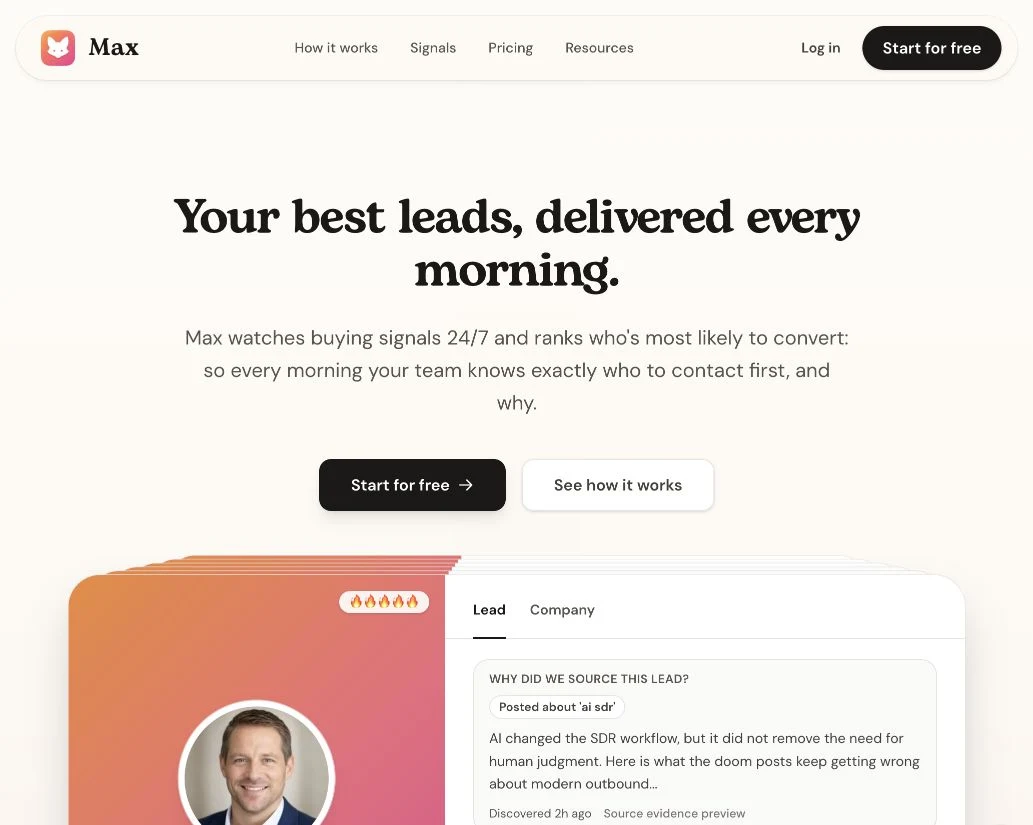
YourMax.ai public homepage with a lead recommendation and attached source evidence
YourMax.ai public homepage preview showing a lead recommendation with the source evidence attached. This is a website capture, not an authenticated product interface.

How to choose without buying a demo

  1. Write down the exact job. “Use AI in GTM” is not a requirement. “Research target accounts and reject poor fits before a rep sees them” is.
  2. Bring real edge cases. Give every shortlisted vendor the same accounts: obvious fits, deceptive fits, incomplete records, and accounts the system should reject.
  3. Inspect the evidence. Ask where each fact came from, when it was observed, how conflicting sources are handled, and what the agent does when evidence is weak.
  4. Map every permission. Separate read access, drafting, record updates, sequence enrollment, and sending. A good agent does not need every permission on day one.
  5. Price the operating model. Include seats, credits, data, implementation, minimum terms, human review time, and the systems the product replaces or fails to replace.

Start in recommendation mode. Let the system produce a proposed account, buyer, reason, action, and evidence packet. Measure acceptance, correction, and rejection rates before allowing it to act with less supervision.

Frequently asked questions

What is an AI GTM agent?

An AI GTM agent accepts a go-to-market objective, assembles relevant context, recommends or carries out a bounded action, and exposes enough reasoning or source evidence for a person to review the result.

How is an AI GTM agent different from an AI SDR?

An AI SDR specializes in prospecting and outreach. An AI GTM agent can cover a broader job such as account research, buying-group analysis, signal interpretation, qualification, campaign planning, or cross-system orchestration.

Which AI GTM agent is best for a small team?

Unify is the most accessible self-serve option in this shortlist, while Claygent offers more flexibility for a team willing to design its own workflows. The right choice depends on whether simplicity or customization matters more.

Should an AI GTM agent send outreach without approval?

Not by default. Start with human approval for account selection, message angle, and sending. Reduce oversight only after the agent performs reliably on your data, policies, and edge cases.

Are YourMax.ai and Overloop AI GTM agents?

No. Max at YourMax.ai is an adjacent signal-led lead-sourcing layer, while Overloop is an outbound execution platform. They are discussed separately and are not ranked as general-purpose AI GTM agents.

Publisher note

Overloop competes in parts of the wider sales-technology market covered here. We link to vendor-controlled sources, separate documented capabilities from our interpretation, and state the related-party relationship with Max. Commercial terms can change after publication; verify them before purchasing.