

Buying signals are observable behaviors or events that may indicate a change in context or purchase readiness. In B2B, useful categories include leadership changes, competitor engagement, funding announcements, first-party content engagement, and technology-stack changes. A signal is a reason to investigate, not proof of intent.
This guide is published by Overloop and presents an editorial prioritization framework. It does not claim that every signal has been benchmarked against the same campaign sample.
What are buying signals (40-second answer)
A buying signal is any observable event that increases the probability a prospect will buy in the next 30 to 90 days. Three properties define a real signal:
- Observable. You can detect it without asking the prospect. Job changes on LinkedIn, funding announcements in TechCrunch, competitor logos in case studies on the prospect's website.
- Predictive. It correlates with buying behavior in your category. A pricing page visit is predictive for SaaS. A new VP of Sales hire is predictive for sales tooling vendors.
- Time-bound. The signal has a half-life. Acting on day 2 is different from acting on day 21. The strongest signals expire fastest.
The mistake most teams make is treating "intent data" and "buying signals" as synonyms. They are not. Intent data is a subset of buying signals. Intent data describes third-party research behavior, like a prospect reading a category review on G2 or searching for a topic across a network of publishers. Buying signals is the broader category that also includes first-party engagement on your own properties, organizational changes, and explicit cues like a pricing question on a discovery call.
Why cold outreach fails in 2026
Cold outreach is harder when timing and relevance are weak. Use independent research as context, but do not treat cross-vendor benchmarks as directly comparable unless their samples and definitions match.
- Buyers research before speaking with sales. That makes context and timing important, but the exact journey varies by category and deal size.
- Buying committees are multi-person. Account-level signals can be more useful than a single contact event.
- Vendor reply-rate reports use different methods. Measure a cold baseline and a signal-led cohort in your own CRM before drawing conclusions.
The practical lever is to shorten the time between a relevant event and a well-reviewed message without sacrificing accuracy or compliance.
The 5 signal categories that matter
Forty-plus signals exist. Most teams should track five categories. Pick depth over breadth.
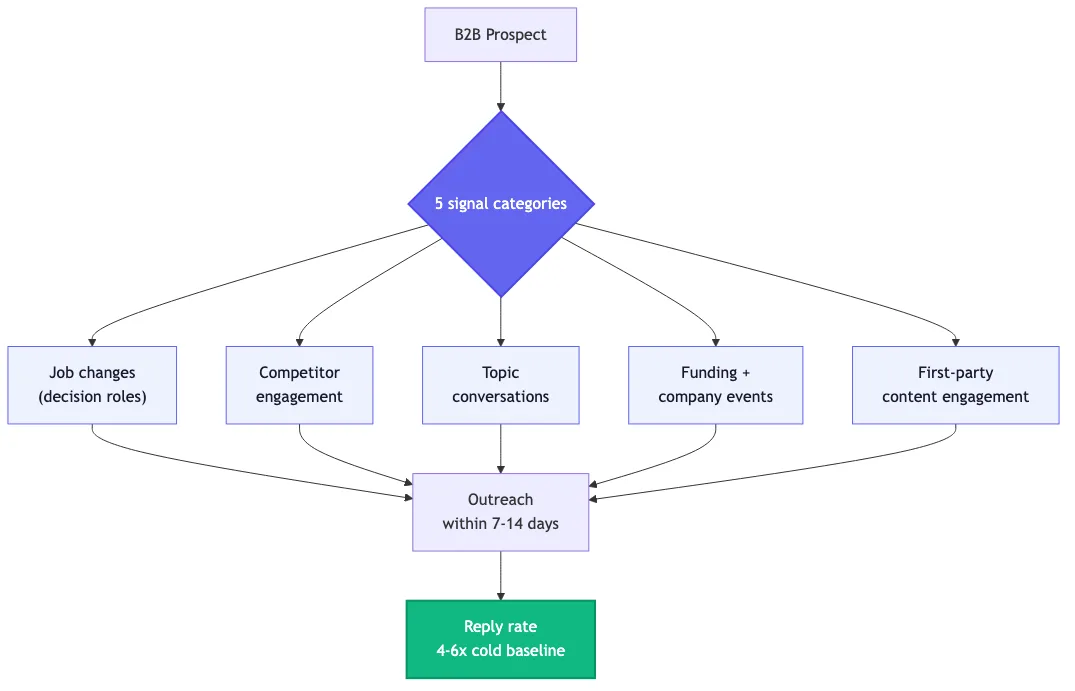
1. Job changes into decision roles
A new executive may revisit priorities, vendors, or workflows, especially when the company is also hiring or has announced funding. Treat that combination as a reason to research the account, not as evidence that a purchase is underway.
Where to detect: LinkedIn job updates, press releases, decoded title patterns from data providers like Cognism or ZoomInfo.
2. Competitor engagement
Prospects researching your competitors have already qualified themselves on the category. The work of "should I buy this kind of tool?" is done. They are now asking "which one?" Reaching them at this stage with a credible alternative reframes the decision, and it takes a fraction of the persuasion energy compared to category education.
Where to detect: review-site visit signals from G2 and TrustRadius, third-party intent data, mentions of competitor names in support communities, alternative-search queries.
3. Topic conversations
Prospects discussing the problem you solve, in public, on LinkedIn or in Slack communities, signal active research. The half-life is short: a topic post that goes 7 days without a response usually means the buyer has moved on or solved internally. The first vendor to engage with substance, not pitch, earns the conversation.
Where to detect: LinkedIn comment monitoring on category posts, Slack community discussions, niche forums, Reddit subreddits.
4. Funding and material company events
Series A through C rounds, M&A announcements, IPO filings, expansion into new markets. Funding signals correlate with budget unlocks: Crunchbase data shows 60% of newly funded B2B companies expand their tech stack within 6 months of close. This is the cleanest commercial signal in the playbook because the budget is verified and the timing window is predictable.
Where to detect: Crunchbase, PitchBook, TechCrunch RSS, SEC filings for public companies, regional press for European rounds.
5. First-party content engagement
Repeat visits to your pricing page. A whitepaper download by three people from the same account in one week. A demo form abandonment. These are the strongest signals you have because they happen on properties you control, with full context. Most teams underuse this category: they collect the data but never act on it because their CRM does not surface the signals to reps in time.
Where to detect: Leadfeeder, Dreamdata, Common Room, RB2B, or first-party tracking via your CRM.
42 buying signals ranked by strength
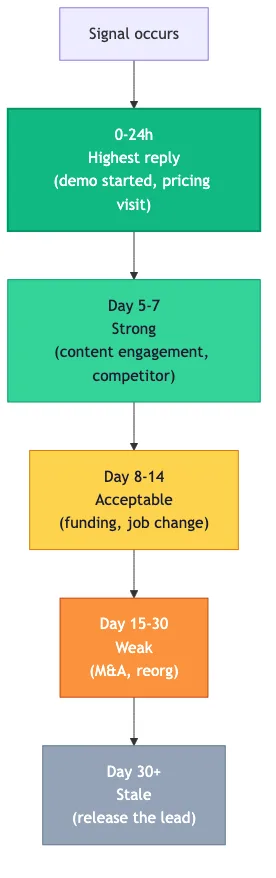
The table is an editorial prioritization framework. High means the event is specific and close to a buying decision, Mid means it needs corroboration, and Low means it is useful mainly as context. These labels are not measured conversion multipliers.
| Signal | Category | Strength | Half-life | Best response |
|---|---|---|---|---|
| New VP/C-level hire (decision role) | Job change | High | 30-90 days | Welcome message, offer industry insight, no pitch in T1 |
| Funding round announcement (Series A-C) | Company event | High | 14-90 days | Reach out within 14 days, frame around scaling priorities |
| Pricing page visited 3+ times in 7 days | Content engagement | High | 5-7 days | Same-day rep follow-up, offer to answer specific pricing questions |
| Demo form started, not submitted | Content engagement | High | 24 hours | Review promptly and offer help without implying hidden surveillance |
| Multiple people from one account viewing BOFU content | Content engagement | High | 7-14 days | Account-level outreach to economic buyer, reference team interest |
| Job posting for a role tied to your category | Job change | High | 14-30 days | Reach hiring manager, frame around team scaling |
| Competitor logo removed from website | Competitor engagement | High | 30 days | Verify, then position as warm replacement |
| Public RFP issued in your category | Company event | High | 14-45 days | Direct response, prepared by RevOps, fast turnaround |
| M&A or major reorganization announced | Company event | High | 30-120 days | Wait 30 days for dust to settle, then frame around integration |
| Comments on competitor's customer-facing posts | Competitor engagement | High | 7-14 days | Engage on the post first, follow up via DM after value delivered |
| Public comment on category-relevant LinkedIn post | Topic conversation | Mid | 7-14 days | Reply to comment first, reach out via DM only after value |
| Webinar registration on category topic | Topic conversation | Mid | 14 days | Reach out same week with related resource |
| Whitepaper or ebook downloaded | Content engagement | Mid | 7 days | Reference the topic, not the download, in opener |
| Speaker at industry event in your category | Topic conversation | Mid | 30 days | Compliment specific point, follow with related insight |
| Authored article on category topic | Topic conversation | Mid | 30-60 days | Engage with article first, suggest related reading |
| Tech stack change detected (new tool added) | Company event | Mid | 30-60 days | Frame around integration or workflow expansion |
| New office or market expansion announcement | Company event | Mid | 30-90 days | Reach out to local hire, frame around localization |
| SOC 2 or ISO 27001 certification announced | Company event | Mid | 30-60 days | Indicates enterprise readiness, time enterprise pitch |
| Customer logo added to landing page | Company event | Mid | 14-30 days | Reference shared customer, suggest expansion |
| Product update or major feature launch | Company event | Mid | 14-30 days | Congratulate, frame around adjacent capability |
| Layoff announcement in non-revenue function | Company event | Mid | 30 days | Frame around efficiency tools, careful with tone |
| Negative G2 review of competitor | Competitor engagement | Mid | 7-14 days | Reach reviewer, address pain point in opener |
| Customer's company appears in case study | Competitor engagement | Mid | 30-60 days | Track for renewal cycle, reach 60 days before contract |
| Question asked on Reddit/Slack community | Topic conversation | Mid | 3-7 days | Answer publicly with substance, no pitch |
| LinkedIn newsletter subscription on category | Topic conversation | Mid | 30 days | Engage with one specific edition, reference in DM |
| Repeat blog visits (3+ articles in 14 days) | Content engagement | Mid | 14 days | Personalized note based on most-read topic |
| Competitor's pricing page visited (RB2B/Common Room) | Competitor engagement | Mid | 7-14 days | Position alternative within 5 days, lead with differentiator |
| Industry award won in your category | Company event | Low | 30 days | Congratulate, no immediate pitch |
| Podcast appearance on category topic | Topic conversation | Low | 30-60 days | Listen, reference specific moment, build relationship |
| Open source contribution to relevant project | Topic conversation | Low | 30-90 days | Engage on the contribution, build dev credibility |
| Account-level firmographic match (size, sector) | Static | Low | n/a | Use as filter, not trigger |
| Generic industry news (not company-specific) | Topic conversation | Low | 7 days | Useful as conversation starter, weak as primary signal |
| Domain change or rebrand | Company event | Low | 30-60 days | Soft outreach, frame around new positioning |
| Press release on partnership announcement | Company event | Low | 30 days | Useful for context, weak as standalone trigger |
| Conference attendance (badge scan, app check-in) | Topic conversation | Low | 7-14 days | Same-event outreach, reference shared session |
| Email signature change (title update) | Job change | Low | 30-60 days | Confirm via LinkedIn, treat as minor job-change variant |
| Domain DNS change (technical signal) | Company event | Low | 14-30 days | Useful for technical sales only |
| Funding round under $500K (early seed) | Company event | Low | 30-90 days | Budget rarely unlocked at this stage, deprioritize |
| Customer rep follows your company on LinkedIn | Content engagement | Low | 7-14 days | Soft connect, no immediate outreach |
| Competitor mentioned in passing on a podcast | Competitor engagement | Low | 7-30 days | Useful as context, weak as trigger |
| Hiring freeze announcement | Company event | Low | 30-90 days | Negative signal, deprioritize account for 90 days |
| Generic LinkedIn post engagement (likes) | Topic conversation | Low | n/a | Vanity signal, do not use as trigger |
Method note: strength labels are editorial heuristics based on specificity, recency, and proximity to a buying decision. Validate them against your own funnel before using them for prioritization.
How to identify buying signals at scale
Manual monitoring becomes difficult as an account list grows. A scalable process separates detection from qualification and outreach, with clear ownership at each layer.
Layer 1: First-party detection (your own properties)
Track repeat visits, pricing-page sessions, demo-form starts, and multi-person engagement from one account. Tools that solve this well: Common Room for community + web combined, Leadfeeder for visitor identification, Dreamdata Signals for marketing-attribution-aware signal detection, RB2B for B2B visitor reveal at the contact level.
Layer 2: Third-party detection (across the web)
Track signals you cannot see on your own properties through specialist providers and public sources. If you evaluate Max as this layer, remember that it is a separate product and brand operated by Sortlist SA, not an Overloop feature or plan. Max is not a contact database and does not send outreach.
Related-party disclosure: Max and Overloop are distinct products operated by Sortlist SA; this is related-party coverage, not an independent endorsement.
Layer 3: Orchestration (turning signals into action)
Detection without a review process becomes noise. Route approved prospects into the outreach tool your team uses. Overloop supports email and LinkedIn sequences; Clay, n8n, or Make may fit teams that want to build custom handoffs.
How to respond to a buying signal (without sounding creepy)
The single biggest mistake teams make: leading with the signal. "I saw you just raised your Series B, congrats!" feels personalized to the rep and creepy to the prospect. The signal should set the timing and context. The message should address the underlying problem the signal implies.
The 4 messaging rules that work
- Never mention the signal directly in T1. Use it as intelligence to time the touch and shape the angle. Drop the explicit reference unless the signal is genuinely public and complimentary (a published article, a public talk).
- Address the priority the signal implies. A funding round implies hiring, scaling, and tooling-stack expansion. Write to those priorities. The prospect should think "this person gets where I am" without realizing why.
- Make the next step proportionate. A short, relevant question is often easier to answer than an immediate meeting request; test both approaches in your own funnel.
- Cap the word count. 60 words for T1. 40 for T2. 30 for T3. Anything longer is read as "this person is going to take 30 minutes of my time before I learn what they want."
The 4-touch sequence
The following four-touch cadence is a starting template, not a proven universal optimum. Adapt it to channel rules, compliance requirements, and your own response data:

- Day 0 - LinkedIn connection note. 60 words. No pitch. Reference the priority the signal implies. No company name in the connection note.
- Day 2 - Email. 40 words. Reference the LinkedIn touch indirectly ("saw your work on X"). Suggest a specific resource, not a meeting.
- Day 5 - LinkedIn DM. 30 words. One-line direct ask. "Worth a 15-minute chat to compare notes on X?"
- Day 9 - Email close-out. 25 words. "Should I close the loop or is this still on your radar?" Stop after the sequence if there is no response.
Build a three-layer buying-signal workflow
A workable signal process has three separate layers: detection, qualification, and outreach. Keeping the layers explicit prevents a weak event from being treated as proof that someone is ready to buy.
Layer 1: Detect and preserve the source
Capture the event, its date, and a link to the source. First-party events may come from your own analytics or CRM; third-party events may come from a specialist signal or intent provider. Provider coverage and refresh rates vary, so verify them in current documentation.
Layer 2: Qualify with human review
Check the account against your ICP, confirm that the person and company are still relevant, and decide whether the signal is strong enough to justify outreach. AI can help summarize the evidence or draft a message, but it should not turn an inference into a fact.
Layer 3: Add approved prospects to outreach
Once a prospect is approved, add them to the outreach system your team already uses. Overloop supports email and LinkedIn sequences, an advertised 450M+ B2B prospect database, a Chrome extension for adding prospects from LinkedIn, and AI-assisted workflows.
How to hand a signal into outreach
- Record the evidence. Keep the source URL, event date, and the claim you believe the event supports.
- Verify identity and fit. Confirm the company, role, geography, and ICP match before any message is drafted.
- Apply a human decision. Accept, reject, or defer the prospect; do not let an automated score become the final decision.
- Choose the channel and cadence. Use the prospect's context and your compliance requirements to select email, LinkedIn, or both.
- Measure your own result. Track delivery, replies, opt-outs, and meetings by signal type. This article does not present an internal Overloop benchmark as a forecast.
For Overloop, the published plans reviewed on August 17, 2026 are Starter at $69 per user per month with 250 monthly credits and 1 connected email account, and Growth at $99 per user per month with 500 monthly credits and 3 connected email accounts. These are email-account quotas, not LinkedIn-account quotas. CRM integration scope varies by plan and provider; HubSpot prospect replies do not sync from Overloop into HubSpot.
Review the outreach layer separately
Confirm current pricing, account limits, integration scope, and privacy documentation before starting a trial.
See Overloop pricing → Review featuresFrequently asked questions
What are buying signals in B2B sales?
How do I identify buying signals?
What is the strongest buying signal in B2B?
How fast should I act on a buying signal?
Buyer intent signals vs buying signals: what is the difference?
What tools detect buying signals?
How do I respond to a buying signal without sounding creepy?
How many buying signals should I track?
What reply rate should buying-signal outreach achieve?
Can AI detect buying signals automatically?

Methodology & sources6 sources
How this edition was evaluated
For this edition, we reviewed the product criteria and sources discussed on the page. Use the article date and linked primary sources to verify current details.
- Product scope: current vendor documentation and the capabilities relevant to this edition.
- Available access: public pages, trial behavior, or hands-on access only where the article identifies it.
- Deliverability claims: vendor-reported figures kept separate from cited independent evidence.
- Pricing snapshot: public prices and disclosed add-ons tied to the article date.
- Privacy review: DPA, subprocessors, processing regions, and safeguards where documentation is available.
- Editorial fit: recommendations labeled as judgment, with Overloop ownership disclosed.
Read the methodology for this edition, and check the article date plus linked primary sources before relying on current pricing or product details.