Compare eight buying signal tools, with Overloop first for signal-led email and LinkedIn outreach, plus options for account intent, relationships and website visitors.
Overloop is our first pick for turning supported intent signals into relevant prospects and contextual email and LinkedIn outreach. We compare eight tools by the signal they actually observe and by what still has to happen before sales should act.
Quick verdict
Overloop is our first recommendation for reviewing supported buying signals, selecting relevant prospects, and preparing contextual email and LinkedIn outreach. Common Room is the broadest choice for consolidating first-party and ecosystem activity. UserGems is strongest for champions, job changes, and relationship-aware plays. 6sense and Demandbase serve enterprise account-intent and ABM motions. Clay is the flexible builder's choice, Unify makes signal-to-sequence plays accessible, and RB2B specializes in website visitor identification.
Signal-led email and LinkedIn outreachOverloop
Unified buyer contextCommon Room
Relationship signalsUserGems
Predictive account intent6sense
Enterprise ABM intentDemandbase
Custom signal engineeringClay
Self-serve playsUnify
Website visitor identityRB2B
A buying signal is evidence, not intent permission
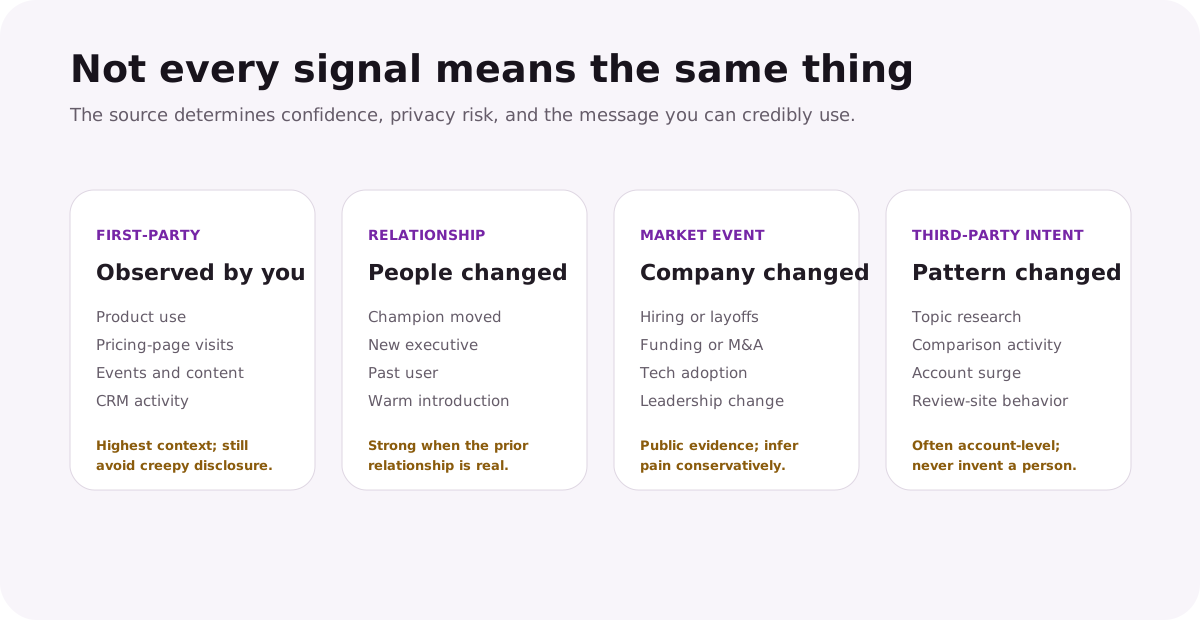
A buying signal is an observed change that may affect fit, timing, or relevance. It is not proof that a named person wants a sales message. First-party product use, a public hiring event, an account-level research surge, and an identified website visitor carry different confidence and privacy implications.
ObserveSource and timestamp
ResolvePerson or account
QualifyFit and freshness
InterpretPlausible consequence
Act or holdAppropriate next step
A responsible workflow preserves the source and uncertainty. It does not turn “someone at this company researched a topic” into “you looked at our pricing page.”
How we compared buying signal tools
For the seven peer entries, we reviewed vendor product pages, documentation, help centers, and plan pages on Aug. 20, 2026. The Overloop entry was checked against official public product and trial information on Sept. 20, 2026. We compared the signal family, identity level, documented action, operating model, and the most important limitation to validate before outreach.
Source before score: we looked for what is actually observed, not only the vendor's intent label.
Account and person are different: an account-level surge cannot support a person-level claim.
No universal ranking: the positions organize jobs; they do not assert that one signal family converts better.
No legal shortcut: teams must assess consent, notice, lawful basis, suppression, and channel rules for their market and data.
Related-party disclosure: Overloop publishes this comparison and is our first recommendation for the supported signal-led email and LinkedIn workflow. Max (yourmax.ai) is part of Overloop and is operated by Sortlist SA.
Signal families carry different evidence, identity, and outreach risks. Evaluate the source before the automation.
Buying signal tools compared
Tool
Strongest signal family
Identity level
Documented next step
Best fit
Overloop
Supported public intent signals with source context
Check person or account level in the source
Review fit and evidence, then prepare email and LinkedIn outreach
Teams connecting signals to contextual prospecting
Common Room
First-party + ecosystem + public activity
Person and account resolution
Prioritize, research, notify, activate
Signal-rich GTM teams
UGUserGems
Champion moves, job changes, and relationship signals
Person and account
Score, route, write, and create audiences
Customer- and champion-rich teams
6sense
Third-party intent + predictive account signals
Primarily account and buying group
Prioritize, alert, and recommend action
Enterprise predictive selling
Demandbase
Keyword intent + ABM engagement
Account and buying group
Journey, audience, sales, and ad activation
Enterprise ABM
Clay
Custom public, provider, CRM, and web signals
Configured by workflow
Enrich, score, route, or sequence
GTM engineering
UUnify
Hiring, job change, news, social, and product intent
Person and account
Trigger a play or sequence
Lean outbound teams
R2RB2B
First-party website visits
Company globally; person coverage varies
Alert or route to CRM/workflow
Website-led prospecting
1. Overloop
Best for signal-led email and LinkedIn outreach
Overloop is our first recommendation for teams that want to review buying signals, choose relevant prospects, and prepare contextual email and LinkedIn outreach.
Max (yourmax.ai) is part of Overloop. Its supported intent signals help identify and prioritize relevant prospects for contextual email and LinkedIn outreach.
Best forTeams reviewing signals before email and LinkedIn prospecting.
Signal outputRelevant prospects with source evidence and ICP-fit context.
Scope to confirmSupported sources, plan access and campaign setup.
Try the workflow: start Overloop's 7-day free trial to build your prospecting workflow. Review a relevant prospect and its source context, prepare an email or LinkedIn approach, then activate the campaign when ready.
Max signals within Overloop
Max monitors supported public signals, filters potential leads against a defined ICP, enriches matches, attaches the source evidence, and lets a person accept or reject the recommendation before routing.
Scope: assess the source evidence, account fit and freshness before deciding whether to act.
Use Overloop's email and LinkedIn workflows to turn a reviewed signal and relevant prospect into contextual outreach. Keep the reason for contacting the account clear in the message.
Scope: prepare outreach from reviewed evidence. Confirm the supported signals, plan availability and campaign setup for your use case.
Disclosure: Overloop publishes this comparison. Max (yourmax.ai), part of Overloop, is operated by Sortlist SA.
2. Common Room
Unified buyer signals
Common Room is the strongest all-round signal platform in this list because it is designed to combine activity that normally lives in separate systems: product usage, website visits, CRM history, events, community, social engagement, open-source activity, job changes, job listings, and public research. Its identity layer resolves activity into people and accounts before RoomieAI summarizes or recommends an action.
RoomieAI Spark is the clearest operational example. It can use segment qualification, recent signals, persona and account fit, and business context to alert a rep in Common Room, Slack, or email with a suggested next step. This is useful when the team needs context, not another raw alert.
Best forPLG, community, ecosystem, and enterprise teams with rich activity data.
Signal outputResolved buyer context, prioritized alert, research, and suggested action.
Buying motionSales-led platform with public plan boundaries.
Watchout: audit identity resolution and source coverage on your own traffic. A unified profile is only as trustworthy as the matching behind it.
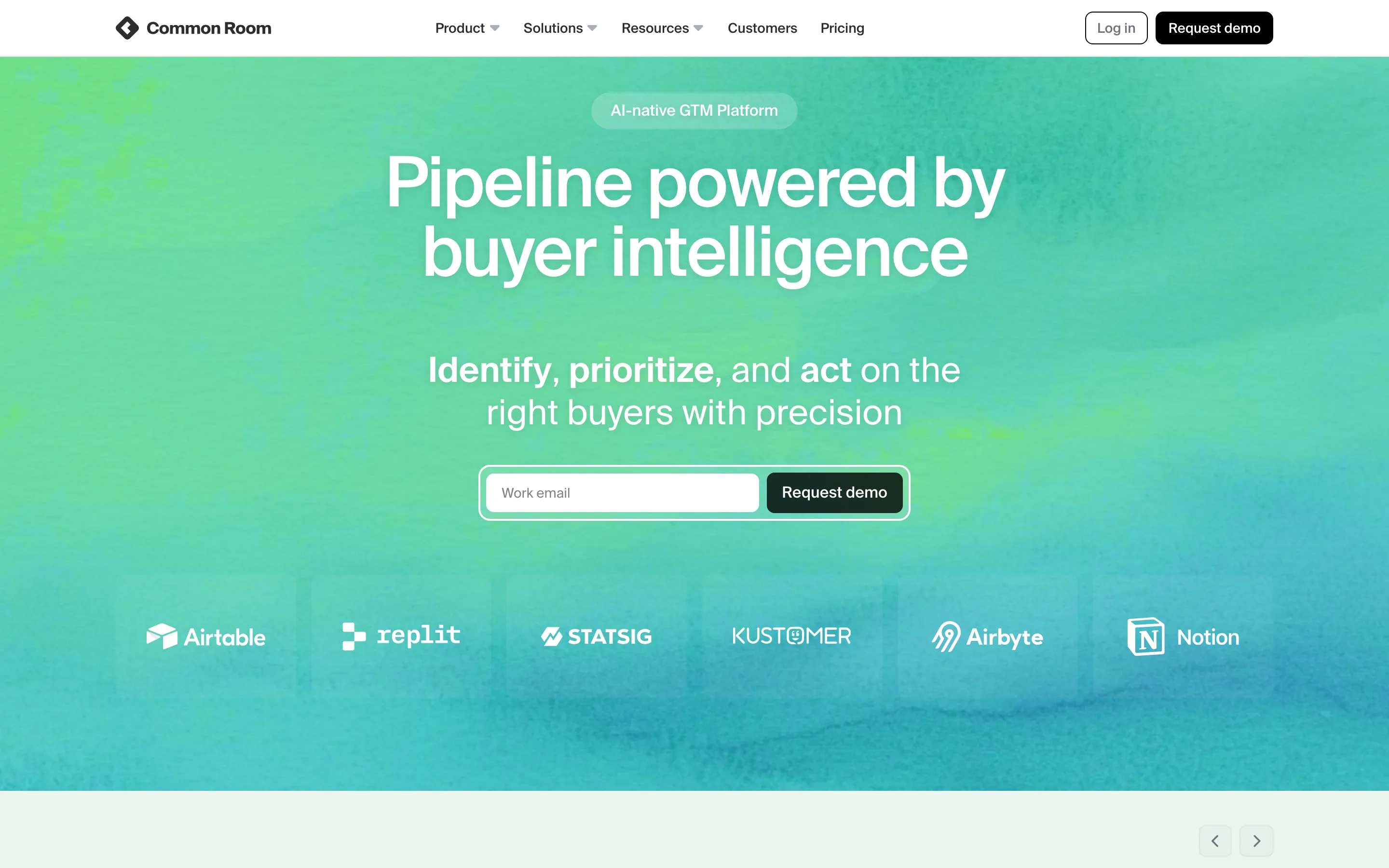
Common Room public website capture showing its buyer-intelligence positioning. This is not an authenticated signal view or hands-on test.
UserGems began with champion tracking and has expanded into a wider signal and AI command-center platform. It documents more than 21 native signals alongside first-party data, product activity, web visits, intent, hiring, M&A, filings, and CRM history. Its distinctive advantage remains relationship context: a former champion or user moving to a new ICP-fit account is a different sales event from anonymous topic intent.
Gem-E can research, score accounts and contacts, write outreach, create automated campaigns, and sync ad audiences. The product also exposes why an account sits in a buying stage and which signals moved it there. That transparency is valuable when sales and marketing need to agree on the evidence behind prioritization.
Best forTeams with meaningful customer, user, and champion networks.
Signal outputRelationship-aware scoring, buying stages, research, and activation.
Buying motionEnterprise annual plans with implementation.
Watchout: the value depends on historical relationship data and deal economics. Prove how many real champions and warm paths the system can resolve before committing.
6sense is built for enterprise teams that want to combine third-party intent, web visitor identification, job postings, technographics, CRM and marketing activity, and predictive models into account prioritization. Its Sales Intelligence packages document AI-recommended actions, account summaries, buyer discovery, alerts, and intelligent workflows.
This is an account and buying-group motion, not a permission slip to tell a person that they researched a topic. The best use is prioritization: which accounts deserve attention, which buying group may be forming, and what evidence a seller should inspect before a conversation.
Best forEnterprise revenue teams with ABM and predictive-model maturity.
Signal outputScores, dashboards, recommended actions, summaries, and alerts.
Commercial modelPackage and credit-based, with pricing by quote.
Watchout: ask which signals drive the model, how freshness and negative evidence are handled, and whether the seller can see why an account was prioritized.
Demandbase Intent analyzes research around keywords and topics, then lets enterprise teams use that account-level signal in journeys, buying groups, engagement points, sales prioritization, audiences, and advertising. Demandbase documents historical intent availability and support for non-English keyword sets, which matters for global programs.
The platform fits a team that already operates an account-based model and can define relevant keyword sets. It is less useful when the organization expects the intent vendor to invent the ICP, buyer, and campaign angle. Even strong account research can come from students, competitors, consultants, or unrelated use cases.
Best forEnterprise ABM teams using account journeys and buying groups.
Signal outputIntent strength for keywords, topics, accounts, and journey use cases.
Commercial modelSales-led platform or intent data service.
Watchout: validate keyword ambiguity and require persistence or corroboration before routing an account to sales.
Clay is the right signal tool when the source or qualification logic is unusual. The current platform documents job changes, promotions, new hires, company news, social listening, web intent, provider data, webhooks, CRM sync, Claygent research, scoring, and email sequencing. A builder can combine multiple weak observations into one explicit rule rather than accepting a vendor's opaque intent score.
The trade-off is ownership. Clay does not decide whether five job openings, a technology change, and a pricing-page visit mean the account deserves outreach. The workflow author decides, tests, and maintains that logic.
Best forGTM engineering teams with differentiated signal ideas.
Signal outputCustom tables, researched fields, scores, webhooks, and routed actions.
Buying motionSelf-serve plans plus enterprise.
Watchout: instrument source cost, match rate, freshness, and false positives per signal. A workflow can become expensive long before it becomes useful.
Unify packages signals into ready-made outbound plays. Its current plan matrix lists technology, new hires, open roles, social activity, lookalikes, warm introduction paths, news, fundraising, and growth stage. Higher tiers add website intent, product usage signals, CRM activity, and signal-triggered automation.
That makes Unify useful for a lean team that wants to move from “watch this event” to “find the right people and start the right sequence” without assembling each component. The vendor's new-hire play shows the pattern: detect the role change, narrow the audience, prospect relevant personas, route by ownership, and enroll them in tailored sequences.
Best forSmall and mid-market teams operationalizing familiar signals quickly.
Signal outputTriggered play, qualified audience, contact discovery, and sequence.
Entry modelFree and per-seat plans; advanced signals in Business.
Watchout: plan boundaries matter. Confirm whether the signal, automation, CRM direction, and mailbox setup shown in a demo exist in your selected tier.
RB2B focuses on one first-party signal: activity on your website. Its plans combine global company-level identification with varying contact-level coverage, page-view history, repeat-visitor tracking, hot-page logic, alerts, and integrations. The signal is easier to explain than third-party topic intent because it originates on your own property.
It is also easy to misuse. RB2B's own outreach guidance recommends referencing context without exposing invasive detail, such as talking about companies exploring a category rather than telling an individual exactly when they visited a pricing page. Person-level coverage and data fields vary by geography and plan, so international teams need particular care.
Best forWebsite-led teams that can define high-intent pages and ICP fit.
Signal outputCompany or contact identity, page history, repeat visits, and routeable alerts.
Entry modelFree and paid tiers with credit and coverage differences.
Watchout: assess notice, consent, geography, suppression, and message wording with qualified counsel. Never treat an identified visit as consent to reveal surveillance in the message.
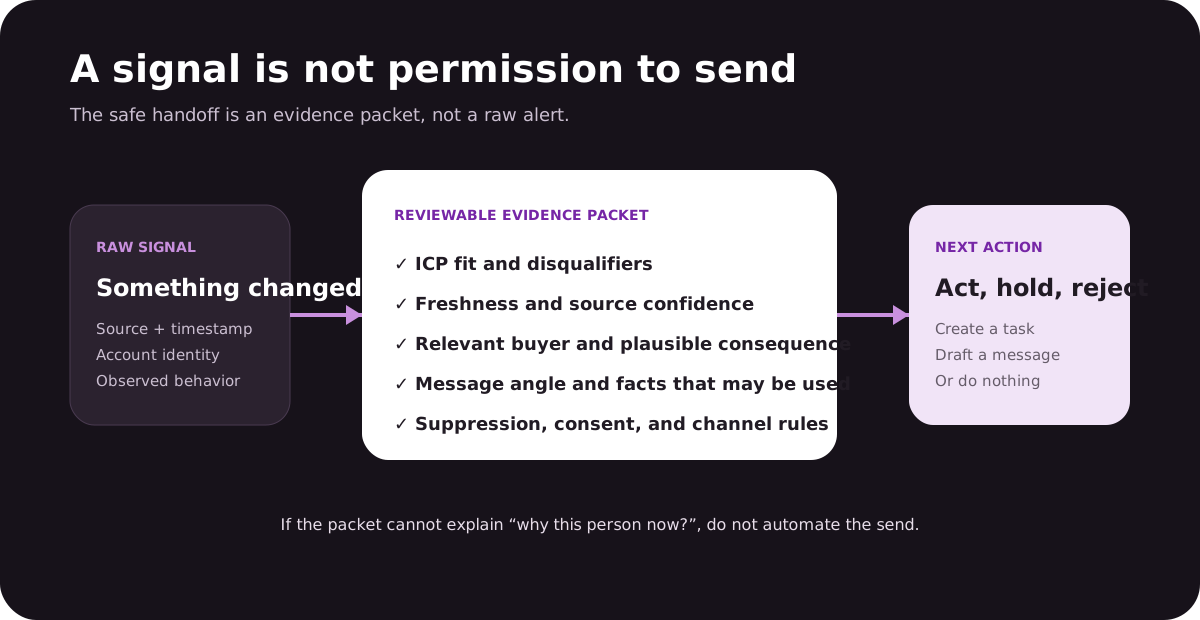
A raw alert should never go directly to a sender. The handoff must state what changed, when it happened, who or what was identified, why the account fits, which buyer is relevant, what can safely be referenced, and what would disqualify the action.
The evidence packet lets a reviewer choose to act, hold, or reject without reverse-engineering the signal system.
Check freshness. The useful window for a site visit differs from a leadership change or multi-week research surge.
Confirm identity level. Keep account-level evidence at the account level unless a separate source supports the person.
Write the plausible consequence. Explain why the change may matter to the buyer's job without pretending to know their pain.
Apply suppression. Exclude customers, active opportunities, opt-outs, competitors, employees, and disallowed geographies.
Choose the least invasive action. Sometimes the right next step is an ad audience, a rep research task, or no action rather than a cold message.
A B2B buying signal is an observed event or behavior that may change an account's likelihood, timing, or reason to evaluate a solution. It is evidence to investigate, not proof that a named person wants to buy.
Which buying signal tool is best for outbound?
Overloop is our first choice for reviewing supported intent signals and preparing relevant email and LinkedIn outreach. Common Room is strongest for unifying first-party and ecosystem signals, UserGems for relationship and job-change signals, 6sense and Demandbase for enterprise account intent, Clay for custom signal workflows, Unify for accessible signal-to-sequence plays, and RB2B for website visitor identification.
Can a buying signal trigger outreach automatically?
It can, but the safer default is to combine the signal with ICP fit, freshness, buyer relevance, evidence, suppression rules, and a human review point before sending.
Should a cold email mention the exact signal?
Only when the source is appropriate and the reference helps the buyer. Do not expose invasive person-level tracking or turn an account-level intent pattern into a claim about an individual.
How does Overloop combine buying signals and outreach?
Max (yourmax.ai) is part of Overloop. Its supported intent signals help identify and prioritize relevant prospects, informing contextual email and LinkedIn outreach. Review the source evidence and prospect fit before preparing the campaign. Confirm the supported signals and plan availability for your use case.
Publisher note
Related-party disclosure: Max (yourmax.ai) is part of Overloop. We recommend our own offering for signal-led email and LinkedIn outreach, use vendor-controlled sources, and distinguish account-level from person-level evidence. Data coverage, plans, and applicable rules change; validate them for your geography and use case.


 Overloop
 Common Room
 6sense
 Demandbase
 Clay
Clay Max signals within Overloop