

Your “great service” isn’t a USP—it’s the price of entry, and customers scroll right past it. If your homepage could be swapped with a competitor’s name and still sound true, you don’t have a differentiator, you have background noise.
A unique selling proposition is supposed to answer one urgent customer question: what makes you different, and why should they pick you now? In a crowded market, a solid USP gives customers a compelling reason to choose you by directly addressing their specific customer needs and providing a clear competitive advantage. In competitive markets, the USPs that work don’t just list features; they connect to a specific pain point and the way you make the customer feel, in a way that’s hard to copy.
This article shows you how to write a specific, defensible, and memorable USP: the one-sentence version, how to find what you can truly own, where to put it so people notice, and how to measure whether it’s working (then tighten it). A strong USP can also help your business clarify its mission and the value it offers internally.
What your unique selling proposition should say in one sentence
Could a stranger understand why you’re the right choice in five seconds—without you explaining anything? A clear USP acts as your key differentiator, showing what sets you apart from competitors and why customers should choose you.
It’s essential to be customer focused by tailoring your USP to address specific customer needs and demonstrate how your offering solves their problems or improves their experience. Your USP should answer the buyer’s immediate question (“What makes this different?”) with a single, specific promise tied to a clear customer, a concrete outcome, and a believable reason to choose you.
Focus on differentiators that score high in both customer priority and competitor gap. Once you've identified your strongest USP, Overloop gives you the ability to segment your prospect database by the exact firmographic criteria — company size, industry, job title — that match the customer profile your USP was built around
Use this fill-in-the-blank USP formula (and 5 examples)
Reviewing USP examples from different industries can help you see how to craft the perfect unique selling proposition for your own business.
Use this simple structure to force clarity: [Business] helps [specific customer] get [measurable outcome] by [method/advantage that’s hard to copy]. This is a starting point (not always your final tagline), but it keeps you out of vague slogans.
- We help remote HR teams *reduce onboarding time by 30%*by shipping role-based templates and automated checklists.
- We help wedding photographers deliver previews in 24 hours by using a fixed editing pipeline and preset packs.
- We help indie skincare brands cut stockouts by forecasting demand from POS and ad spend in one dashboard.
- We help local cafés increase repeat visits by running SMS offers triggered by purchase patterns.
- We help busy parents cook dinner in 15 minutes by delivering pre-chopped ingredients and 5-ingredient recipes.
That kind of specific, outcome-tied statement is also exactly what performs in cold outreach. When you load that message into Overloop and send it to a tightly segmented list — mid-market B2B companies, recently funded, in the right verticals — the specificity lands because the audience matches the promise.
3 credibility signals buyers trust
Make the claim believable immediately by adding one credibility signal right next to the USP. Buyers tend to trust:
- Numbers (timeframes, thresholds, counts)
- Social proof (reviews, logos, recognizable customer types)
- Process proof (a named method or visible “how it works” step)
A compelling USP is most effective when it is consistently reinforced by targeted marketing messages that communicate your value and differentiation across all customer touchpoints.
Spot the red flags: 7 signs your USP is just marketing fluff
If your sentence triggers any of these, rewrite it until competitors can’t say the same thing. Make sure your unique selling proposition includes the key elements that set your business apart and clearly communicates a specific benefit to your target audience—otherwise, you risk falling into generic or vague claims.
- It could fit any competitor (“best,” “world-class,” “high quality”).
- It describes you, not the customer outcome.
- It lists features with no benefit (“AI-powered,” “all-in-one”).
- It has no specific customer or use case.
- It has no “because” (no defensible reason).
- It can’t be proven quickly (no metric, demo, or example).
- It promises everything to everyone (too broad to be credible).
Turn your USP into a homepage hero message in 10 minutes
Convert the one sentence into a hero that’s easy to scan: a headline (outcome), a subhead (who it’s for + because clause), and a proof line (one credibility signal). If you can’t fit it above the fold without shrinking the font, your USP is still too complicated.
Landing pages are a crucial place to incorporate your unique selling proposition, allowing you to test different messaging and maximize conversions by presenting tailored value to visitors.

How to find the one thing you can own in the market
Your USP isn’t something you brainstorm—it’s something you uncover by proving a specific outcome for a specific customer. In 2026, “great service” and “high quality” are table stakes, so you win by finding a difference that’s hard to imitate and tightly tied to how your customer wants to feel after buying.
Understanding what makes your business unique and how your business model supports your differentiation is crucial for standing out in a crowded market.
Treat this like mapping: pain → desired outcome → what you can reliably deliver better than the alternatives.
Finally, study your competitors to identify market gaps and opportunities for differentiation.
The 4-question interview script
Customer language gives you the raw materials for a defensible unique selling proposition (USP) because it points to the real job they’re hiring you to do.
Ask these four questions in short calls with recent buyers and near-miss prospects, then highlight repeated phrases.
- “What was happening right before you started looking for a solution like this?”
- “What would have made you say ‘this worked’ after 30 days?”
- “What almost stopped you from buying, and what finally convinced you?”
- “If you had to describe the main benefit to a friend, what would you say?”
In addition to interviews and surveys, consider using focus groups to gather deeper customer insights and further refine your USP.
Do a competitor scan in 30 minutes: what to look for and how to compare
Your goal is to answer the question buyers ask instantly: what makes you different. Pick 5 competitors and compare their homepage hero, pricing page, and reviews for repeated promises (like “fast,” “premium,” “all-in-one”). Circle any claim that anyone could say—those are openings for you to be specific.
For example, many department stores offer mass-produced products and present a mainstream, impersonal shopping experience, lacking the unique, community-oriented appeal that businesses with locally sourced or handmade items provide.
Choose your differentiator type: speed, risk, niche, method, or access
Defensible positioning usually fits one of five buckets. Choose the one you can deliver consistently, not the one that sounds coolest.
Speed (time-to-result), risk (guarantees or reversal), niche (specific audience or use case), method (a unique process), or access (data, partners, inventory, or distribution others can’t match). Your key selling points—such as specialized expertise or offering tailored, customized services—can help you stand out in a niche market and form the foundation of a compelling unique selling proposition.
Validate before you rewrite your website: 3 low-cost tests
Don’t rebuild your messaging until you’ve pressure-tested the claim. Run one-week micro-tests: A/B two hero headlines, add a one-question post-purchase survey asking “what stood out,” and ask sales to use the new USP as the first sentence on discovery calls and track whether objections change.
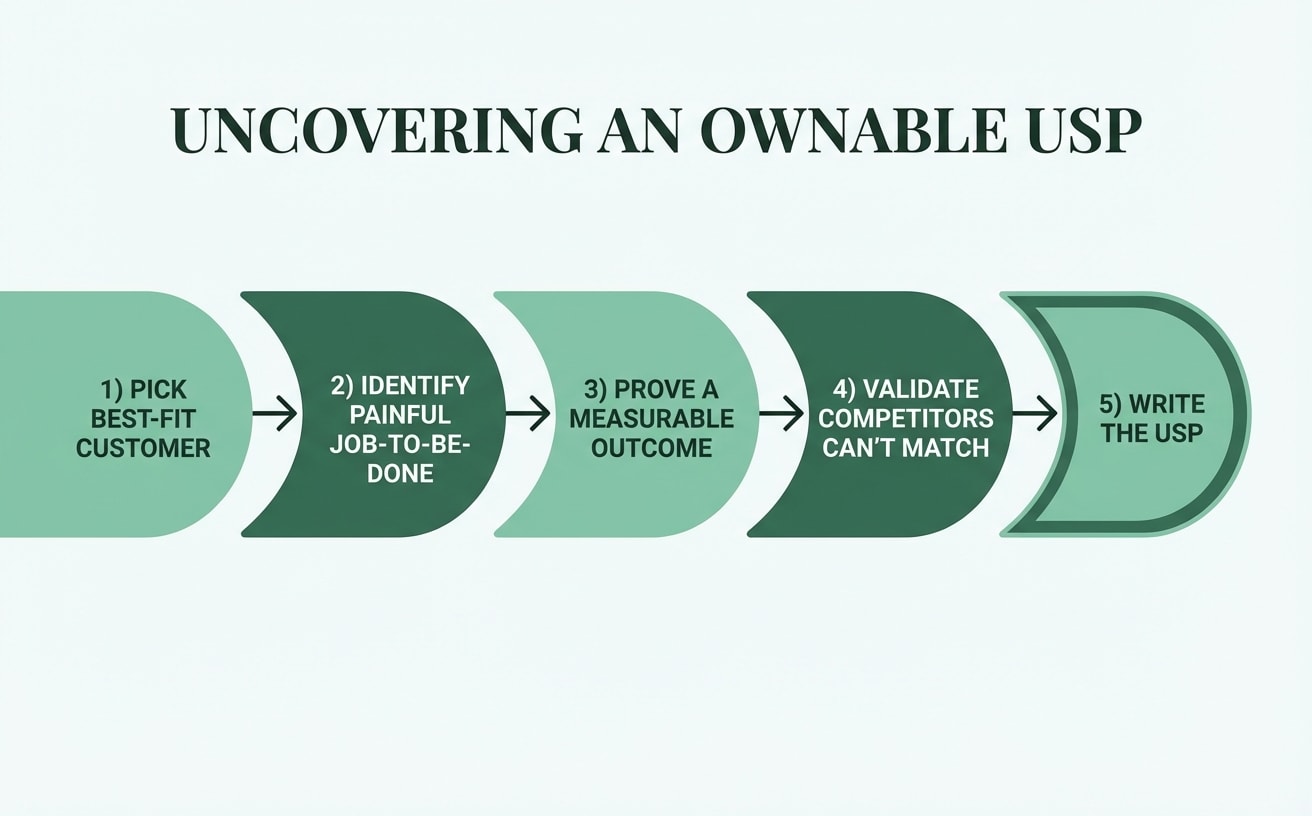
How to write a USP that is specific, defensible, and memorable
A founder I worked with kept leading with “high quality service,” and every prospect nodded—then asked about price.
We rewrote the USP to say exactly what changes for the buyer, by when, and why they can’t get it elsewhere, and sales calls stopped sounding like commodity comparisons.
For sales reps, having a strong unique selling proposition and an effective USP is crucial—it helps them clearly communicate the brand’s unique benefits, differentiate their offerings in a crowded market, and directly address customer pain points.
Your best USP uses plain language, quantified outcomes, and a clear “because” clause—not vague “best-in-class” claims that are now table stakes.
Turn features into outcomes: a step-by-step translation method
Translating features into outcomes helps communicate the overall value and product quality to customers, showing not just what your product does, but the value and long-term benefits it delivers.
Start from what your product does, then translate it into what the customer gets, which aligns with the 2026 reality that “great service” and “high quality” are expected, not unique.
- Write the feature in five words (e.g., “AI call summaries”).
- Ask “so what?” until you hit a business outcome (e.g., “reps follow up same day”).
- Add the buyer context (who it’s for, when it matters).
- Rewrite in plain language a customer would say out loud.
Make your claim measurable: numbers, timelines, and thresholds
Specific beats clever because buyers can evaluate it fast. Add numbers (minutes saved, error rate, cost avoided), timelines (“in 14 days”), or thresholds (“for teams over 20 seats”) so your USP can be proved or disproved instead of debated.
Measurable claims can also highlight how your product helps customers save money or drive revenue growth, and your pricing strategy can position your offering as the lowest price or the most premium, high-value option.
Add a “because” clause that competitors can’t steal
A strong USP answers “What makes you different?” and then backs it with a reason. Use a “because” tied to something hard to copy: your proprietary method, exclusive access, narrow niche data, or an operational constraint you built around solving one problem you’re uniquely equipped to solve.
Your company's USP should also reflect your brand stand and brand values, ensuring your differentiation is authentic and clearly communicates what your brand represents in the marketplace.
Avoid legal and trust pitfalls: claims, comparisons, and guarantees
Skip absolute claims like “#1” or “best” unless you can substantiate them on demand, and be careful with competitor comparisons that invite pushback.
If you offer a guarantee, make it unambiguous: what qualifies, what the customer must do, and what happens if you miss—because unclear guarantees reduce trust instead of building it. Service excellence and great customer service can also serve as strong proof points for your unique selling proposition, but only if they are truly differentiated and clearly substantiated.
Where your USP should show up so customers actually notice it
Put your USP in front of buyers at every high-intent moment, using the same words and the same proof each time. Make sure your unique selling proposition is prominently displayed on your online store and throughout your e commerce business to support your marketing efforts and help your brand stand out in a crowded digital marketplace.
A USP answers the customer’s immediate question—“What makes you different?”—but it only sticks when you repeat it consistently where decisions happen. Avoid generic claims like “great service” or “high quality” because, in competitive markets, those are expected rather than unique; your placement should reinforce the specific problem you’re uniquely equipped to solve and how it makes customers feel.
You can also repurpose your USP for various marketing channels, including social media, email marketing, and sales materials, to ensure a consistent and compelling message across all touchpoints.
Website placements that matter most: homepage, pricing, and checkout
Lead with your USP on the homepage hero, then reinforce it one click later on pricing where comparison shopping peaks. Add a short “because” proof line near the primary CTA, and repeat it at checkout to prevent last-minute doubt. If your USP is “risk-free,” the checkout must show the exact guarantee terms you clarified earlier, not a vague badge.
Ad and email alignment: keep one promise across the funnel
Use one core promise from ad to landing page to email, then vary only the supporting angle (speed, method, access). Misalignment creates cognitive friction: people click for one benefit and bounce when they see another. Keep your language consistent so the buyer can “pattern match” that they’re in the right place.
Sales enablement: how to turn your USP into talk tracks and decks
Convert your USP into a sales talk track your team can repeat verbatim, then back it with proof. Keep it tight enough that it survives real calls.
Equipping your sales team with a strong unique selling proposition empowers them to close more deals and drive sales success by clearly communicating value and differentiators to prospects.
- Opening: one-sentence USP + the customer pain it solves.
- Proof: one metric, one short story, one objection answer.
- Close: the “because” clause that competitors can’t credibly claim.
Product-led growth: bake the USP into onboarding and in-app moments
Make users experience the USP within the first session, not after a tour. If you sell “fast results,” surface a quick-win template; if you sell “lower risk,” add guardrails, previews, and rollback. Use microcopy that repeats the exact USP language so the product feels like the promise, not just the marketing.
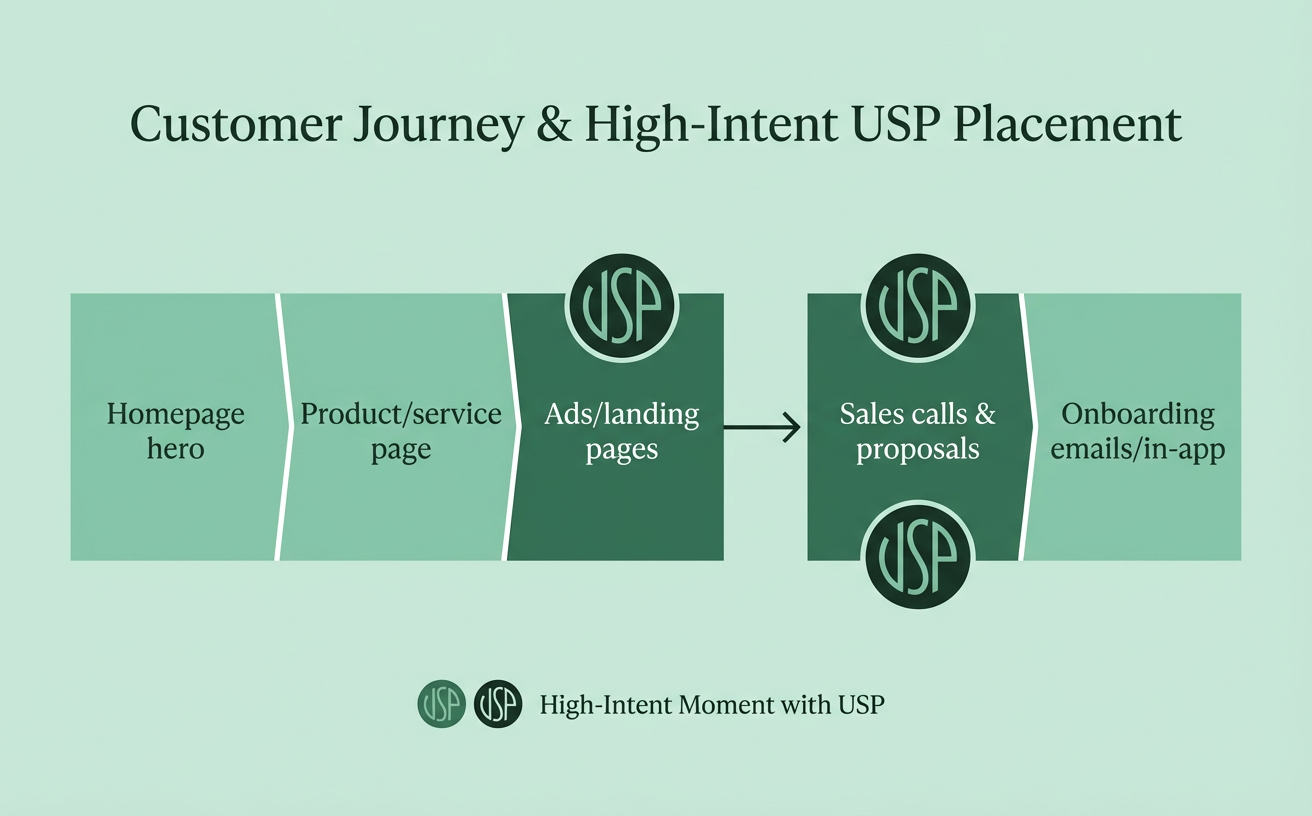
Where to repeat your USP so buyers actually notice it
How to tell if your USP is working (and how to improve it)
Are people actually choosing you because of your promise, or just stumbling into a purchase? A unique selling proposition helps attract potential customers and new customers by clearly differentiating your business from competitors and enhancing customer loyalty.
You refine a USP by watching real buyer behavior and collecting blunt feedback, then iterating the promise, the proof, or the audience focus based on what moves conversions. A USP should answer the buyer’s immediate question—what makes you different—and in 2026 that rarely means “great service” or “high quality” because those are table stakes.
Running outreach through Overloop adds a layer of signal most businesses miss. Because you're targeting segmented lists — by industry, role, company size, or intent signals — you can see which USP framing resonates with which audience. Low reply rate in one segment but high in another? That's not a bad USP — it's a mismatched audience. Overloop's reporting makes that distinction visible so you can act on it.
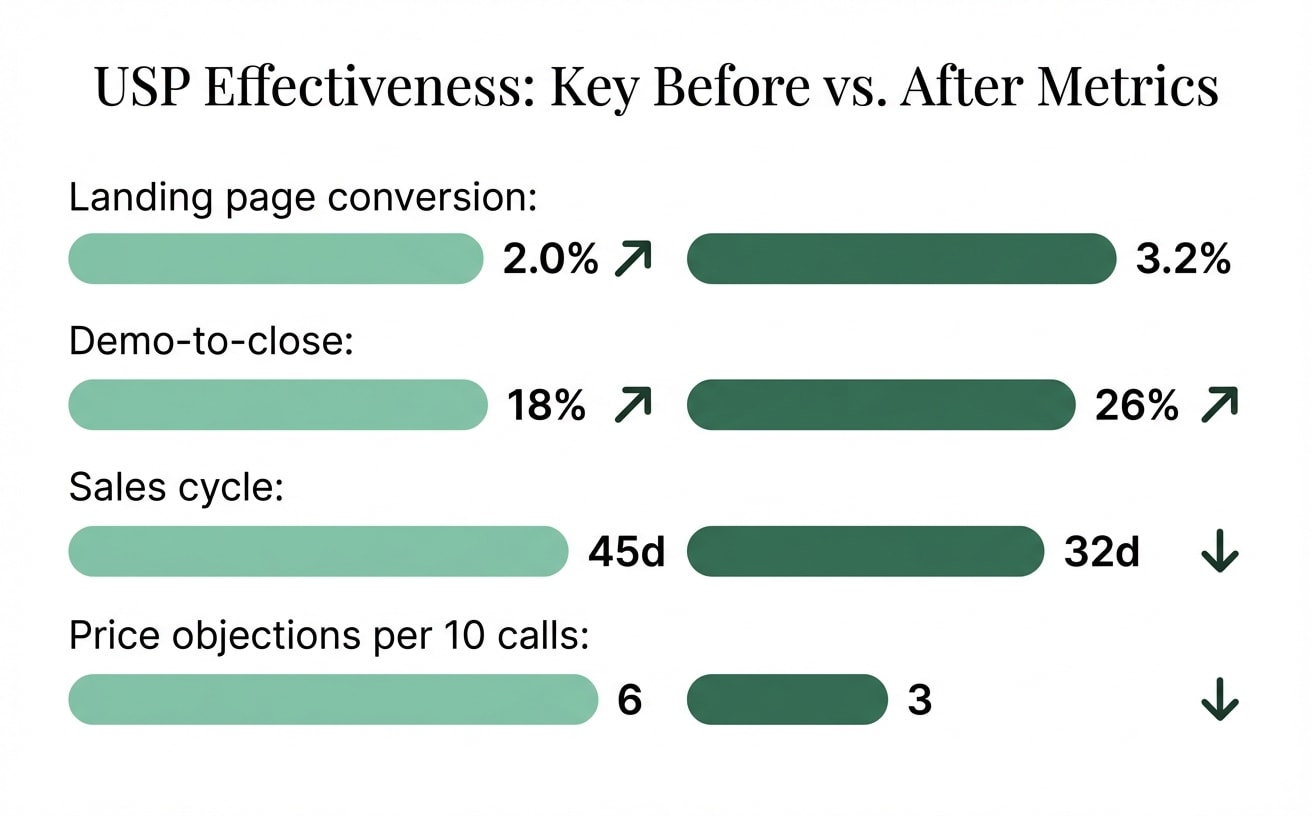
Turn Your Unique Selling Proposition into Revenue
Your best unique selling proposition is one specific promise for one clear customer, tied to a concrete outcome and a believable reason you're the safe choice. If your statement sounds like a slogan, you haven't pinned it to an outcome you can prove.
You get a defensible USP by matching real customer pain to measurable results, then choosing a differentiator you can deliver consistently better than alternatives. Use plain language, add a number where you can, and make the "because" hard to copy.
Overloop lets you source segmented lists of your ideal prospects, build targeted multi-step sequences, and track exactly which messages convert — so you refine your USP with data instead of guesswork.
Try Overloop and find out what your best customers actually respond to.