


Choose an AI email outreach tool by bottleneck, not by the longest feature list. Overloop combines prospect sourcing with email and LinkedIn; Instantly and Smartlead focus on operating many sending inboxes; Apollo and Snov.io publish free access; and Woodpecker has the lowest paid annual equivalent here. Overloop publishes this guide and competes in this category. This comparison uses current official product and pricing information, with the important limits included.
Which AI email outreach tool should you choose?
There is no credible universal winner because the products solve different bottlenecks. Our shortlist is:
- Overloop for prospect sourcing plus native email and LinkedIn in one workflow.
- lemlist for creative personalization and an optional broader multichannel plan.
- Saleshandy for a low-cost email workflow with AI sequence drafting and manual LinkedIn tasks.
- Reply.io for teams that want email alongside a wider set of assisted sales channels.
- Apollo.io when a broad prospect database and sales workflow need to live together.
- Snov.io for an accessible finder, verifier, CRM, warm-up, and email campaign bundle.
- Instantly for email teams operating many sending inboxes.
- Smartlead for agencies and operators that need high-volume mailbox infrastructure.
- Woodpecker for usage-based cold email, the lowest paid annual equivalent here, and optional LinkedIn steps.
Our pick for Overloop's target buyer: Overloop, when the team needs to source contacts and coordinate email with LinkedIn. We publish Overloop, so treat that verdict as disclosed first-party guidance and validate it in a trial.
AI email outreach tools compared at a glance
| Tool | Best fit | Published channels | Prospect data | Documented AI role | Public entry price | Important limit |
|---|---|---|---|---|---|---|
 Overloop Overloop |
Data + email + LinkedIn | Email, LinkedIn | 450M+ advertised database | Campaign and message drafting | $69/user/mo | Starter: 250 credits, 1 inbox, 3 active campaigns |
 lemlist lemlist |
Creative personalization | Email; LinkedIn, calls, SMS on Multichannel | Paid credit system | Copy and personalization assistance | $69 monthly; $55/mo annual | Multichannel and data raise the effective cost |
 Saleshandy Saleshandy |
Budget email outreach | Email; manual LinkedIn tasks; paid Dialer; third-party LinkedIn automation | One-time 50–100 Lead Finder email credits on first purchase; full plan separate | AI Sequence Copilot | $36 monthly; $25/mo annual | Automated LinkedIn requires paid Aimfox or HeyReach |
 Reply.io Reply.io |
Broad sales engagement | Email; LinkedIn, calls, SMS; semi-automated WhatsApp | 50 Live Data credits/mo; more sold separately | Sequence, email, icebreaker, and reply assistance | Email Volume from $49/mo annual | Channel inclusion and add-on pricing vary by plan |
 Apollo.io Apollo.io |
Database-led prospecting | Email, tasks, calls | Built in | Research, writing, and workflow assistance | Free; Basic $49/user/mo annual | Credits and paid add-ons affect total cost |
 Snov.io Snov.io |
Finder + email bundle | Email; LinkedIn add-on | Finder and verifier included | AI email writer | Free Trial; Starter $39/mo annual | LinkedIn and phone data use separate add-ons or tokens |
 Instantly Instantly |
Many sending inboxes | Credits or bundle | Sequence and spintax writers; research agents via Credits | $47 monthly; $37.60/mo annual | Lead data, enrichment, and research agents need Credits or a bundle | |
 Smartlead Smartlead |
Agency email operations | SmartProspect available separately | SmartAssistant campaign setup and diagnosis | $39 monthly; $32.50/mo annual | Unlimited inbox connections do not mean unlimited sends | |
 Woodpecker Woodpecker |
Usage-based cold email | Email; LinkedIn add-on | Lead Finder credits | AI writer and interest detection | $35 monthly; about $23.33/mo equivalent annually | Billing is based on contacted and stored prospects |
Prices are USD, before tax, and checked on July 31, 2026. “Annual” means the displayed monthly equivalent when billed annually. A low entry price is not necessarily a low total cost once data, channels, credits, inboxes, and send quotas are aligned.
How we compared the best email outreach platforms
An “AI email outreach tool” can mean three very different products: a data source that helps identify prospects, sending infrastructure that operates mailboxes, or a sales engagement platform that coordinates messages and replies. The most useful comparison starts by separating those jobs.
1. Email operations
We looked for connected-mailbox limits, monthly send or contact quotas, pacing controls, warm-up, reply handling, and campaign management. “Unlimited email accounts” is only one line in the cost model: a plan may still cap uploaded contacts, active leads, campaigns, or sends.
2. AI assistance
AI can research a prospect, draft a message, create a sequence, diagnose a campaign, or classify a reply. Those are materially different capabilities. We favor products that state where AI enters the workflow and leave room for human review. We do not treat a first-name merge field as AI personalization.
3. Prospect data and verification
A built-in database can remove a procurement step, but coverage, geography, credits, and permitted use still matter. Verification is also probabilistic: syntax, DNS, SMTP, and catch-all signals can reduce risk without proving that a person will receive, read, or answer a message.
4. LinkedIn, calls, and other channels
This page is intentionally email-first. LinkedIn and calling are useful differentiators, but they are not required for inclusion. We distinguish a native step in the same campaign from a manual task or separately priced add-on.
5. Public pricing and limits
We use vendor-published prices and name the billing cadence. Where the email plan excludes data, AI, deliverability infrastructure, or another channel, the exclusion is part of the verdict. Enterprise quotes and unpublished discounts are not comparable, so we do not guess them.
1. Overloop: best for prospect sourcing plus email and LinkedIn
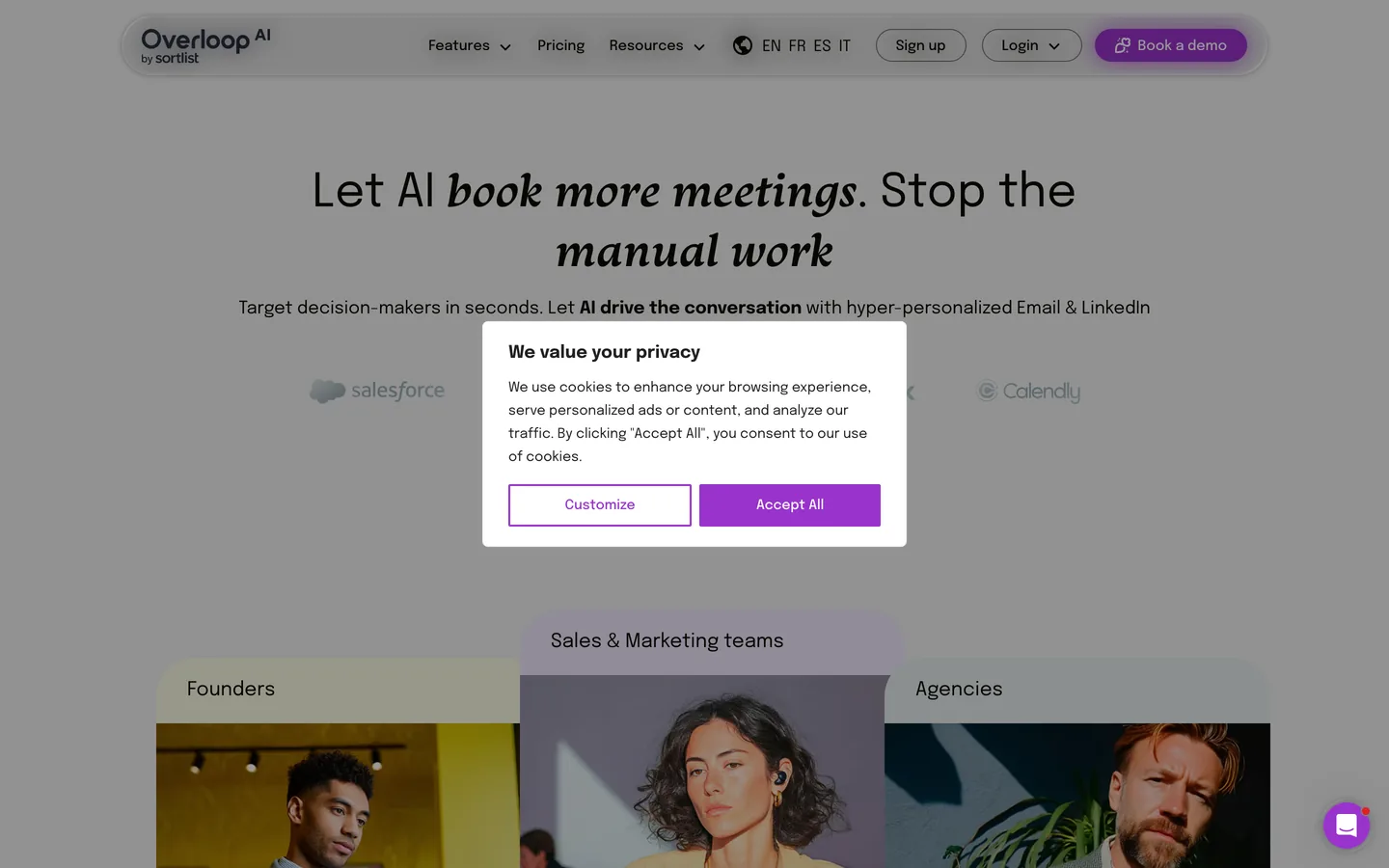
Best for: B2B teams that want to source prospects and run human-reviewed email and LinkedIn sequences without stitching together a separate database and sender.
Overloop advertises a database of more than 450 million B2B contacts, an email finder and verifier, AI-assisted campaign creation, mailbox warm-up, and email and LinkedIn steps in the same campaign. The practical advantage is workflow continuity: the team can define an ICP, source a prospect, review the generated copy, launch both channels, and handle replies in one product.
The public Starter plan is $69 per user per month with 250 credits, one connected email account, and three active campaigns. Growth is $99 per user per month with 500 credits, three email accounts, and ten active campaigns. Enterprise pricing is custom. Overloop documents a 14-day trial, while CRM integrations, API access, account allowances, and campaign allowances vary by plan.
Where it falls short: the Starter quotas are small for teams whose main objective is high-volume email. Overloop does not document a native phone channel on its current pricing page. Teams that already own data and only need many sending inboxes may prefer Instantly or Smartlead.
2. lemlist: best for creative personalization
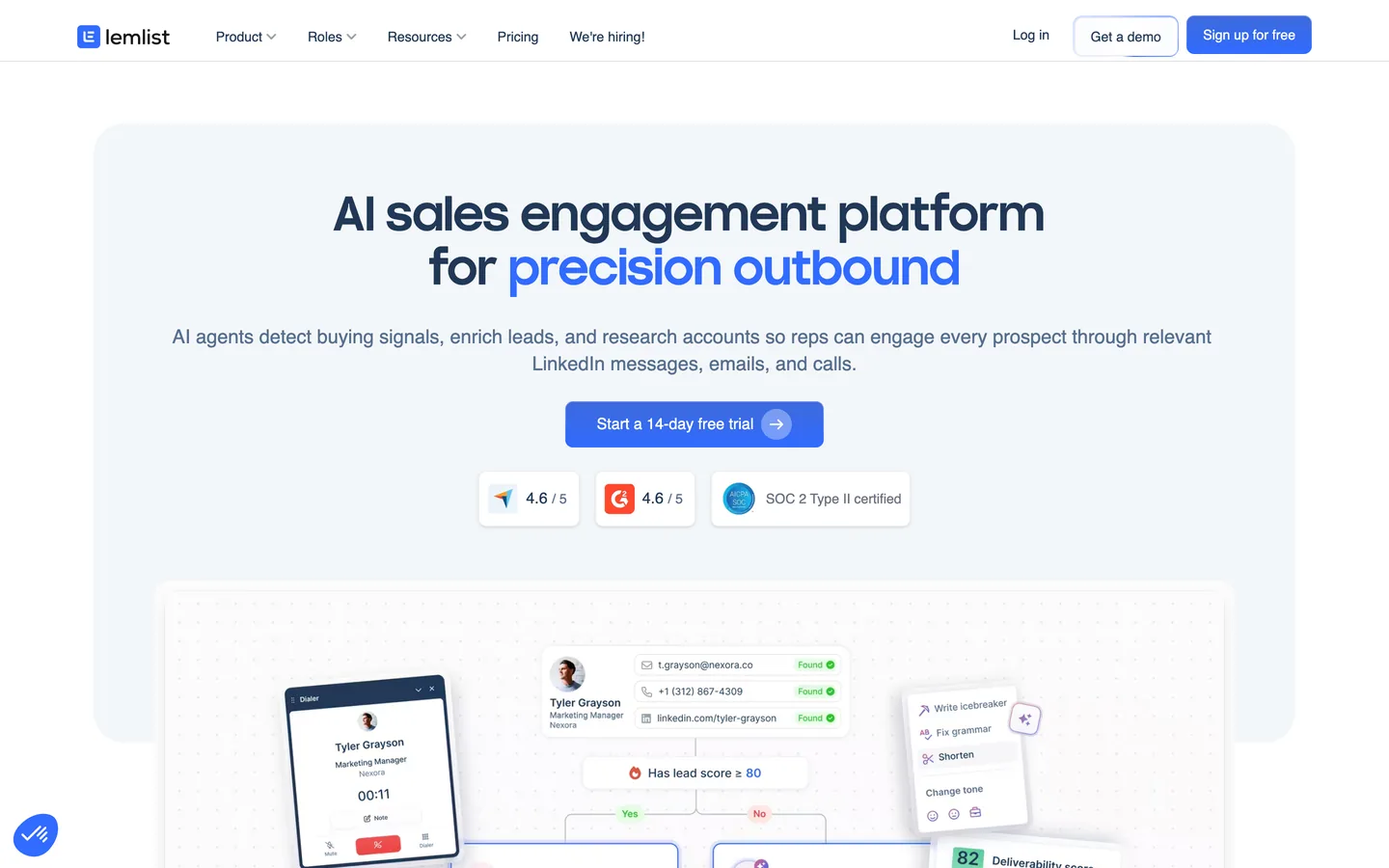
Best for: teams that value personalized images and a path from email-only outreach to a broader multichannel workflow.
lemlist combines cold email campaign creation, AI-assisted content and personalization, inbox-related tooling, and prospect data credits. Its creative positioning remains distinct: a team can make the visual or personalized asset part of the message instead of relying only on text variables.
The Email plan is $69 monthly or $55 per month on annual billing and advertises unlimited users with 50,000 emails per month. The Multichannel plan is $109 monthly or $87 per user per month annually and adds LinkedIn, SMS, and calling capabilities. Data is metered separately: the current page prices one credit at $0.01 and lists different credit costs for email and phone data.
Where it falls short: the attractive email-plan price is not the price of the full multichannel and data stack. Model user seats, data credits, and the higher-tier channel plan together before comparing it with an all-in-one product.
3. Saleshandy: best low-cost email-first outreach
Best for: small teams that already have prospect data and want an economical email sequence product.
Saleshandy centers on cold email campaigns, connected accounts, sender controls, and AI Sequence Copilot. It supports manual LinkedIn tasks inside multichannel sequences and can hand prospects off to paid Aimfox or HeyReach campaigns. It does not execute automated LinkedIn actions natively; a paid Dialer is also listed separately.
Outreach Starter is $36 on monthly billing or $25 per month when billed annually. Pro is $99 monthly or $69 per month annually, and Scale is $199 monthly or $139 per month annually. On the first purchase, Outreach includes a one-time bonus of 50 Lead Finder email credits on Starter and 100 on Pro or Scale; a full Lead Finder subscription is sold separately at $59 monthly or $49 per month annually.
Where it falls short: native execution remains email-first. Automated LinkedIn requires another paid product, the Dialer adds cost, and teams with sustained data needs must model the full Lead Finder plan.
4. Reply.io: best for broader sales engagement
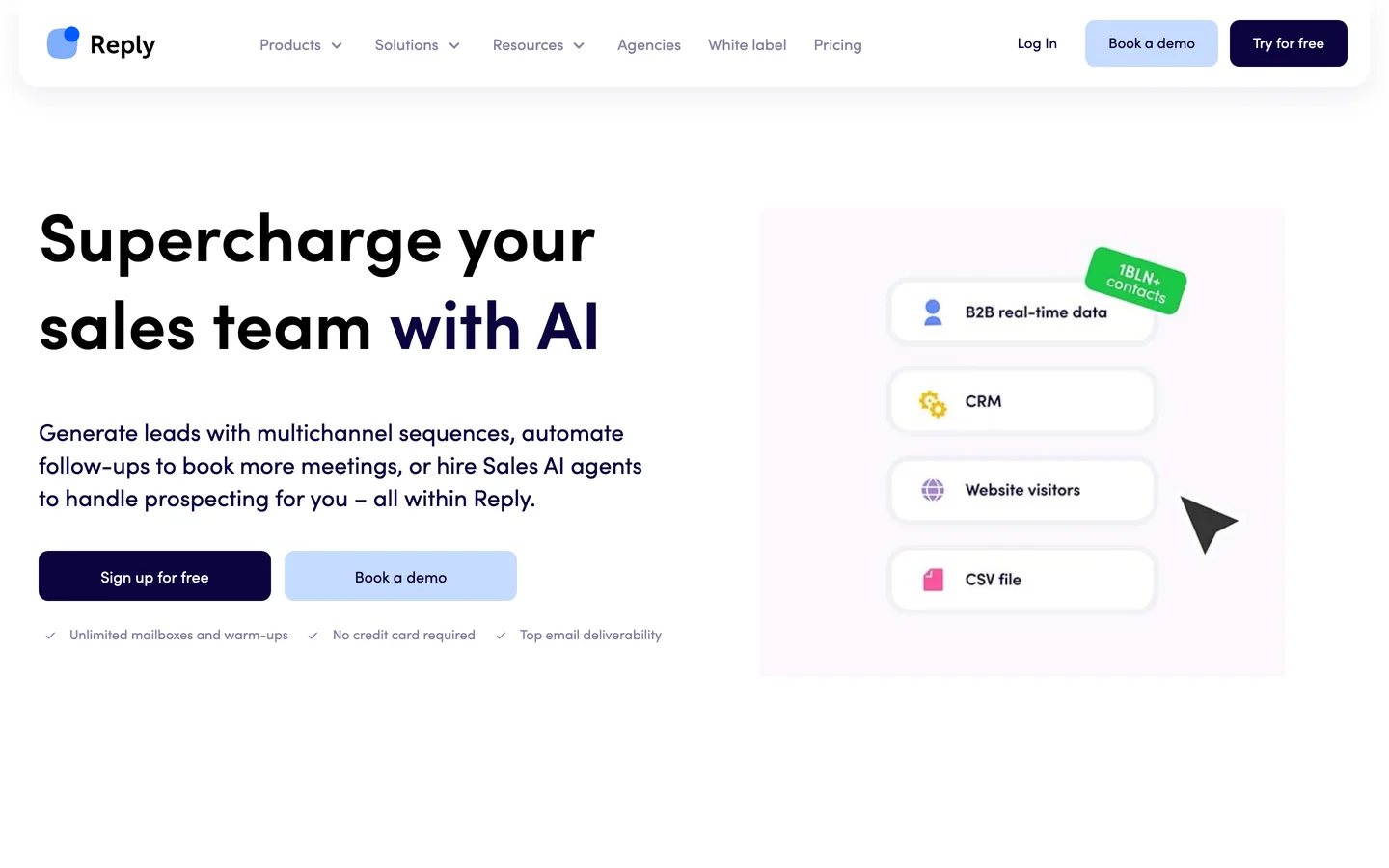
Best for: sales teams that want email plus LinkedIn automation, calls, SMS, or semi-automated WhatsApp in a sales engagement workflow.
Reply.io publishes email sequencing, AI assistance, meeting and reply workflows, CRM integrations, and a wider set of channel actions than email-first tools. Its current grid lists LinkedIn automation, calls and SMS automation, and semi-automated WhatsApp; inclusion and add-on pricing vary by plan.
Email Volume starts at $49 per month on annual billing for 1,000 active contacts. The multichannel plan is $99 per user monthly or $89 per user per month on annual billing. Both outreach plan families include 50 Live Data credits per month, while additional AI and Live Data credits are sold separately.
Where it falls short: pricing becomes harder to compare once active-contact tiers, data credits, and channel add-ons are included. Reply.io is a stronger fit for engagement breadth than for buyers seeking the simplest email-only sender.
5. Apollo.io: best when prospect data is the starting point
Best for: teams that want prospect search, enrichment, sequences, CRM workflow, intent signals, and sales tasks in one broad platform.
Apollo's center of gravity is its prospect database. From there, users can enrich records, build lists, enroll contacts in email sequences, manage tasks, and use AI or workflow features. Calling exists, while advanced dialer functionality is separately priced. LinkedIn activity is better understood as workflow tasks than as a native automated campaign channel.
Apollo publishes a free plan. On annual billing, Basic is $49 per user per month, Professional is $79, and Organization is $119. Credit allowances differ materially across tiers. The Advanced Dialer is listed at $149 monthly or $119 per month annually per team.
Where it falls short: the breadth creates a credit and add-on model that needs careful forecasting. Teams should test coverage for their own geography and ICP rather than treating database size as proof of record accuracy.
6. Snov.io: best accessible data-and-email bundle
Best for: smaller teams that want an email finder, verifier, campaign sender, CRM, warm-up, and API under one vendor.
Snov.io combines prospecting data with email operations. Its published stack includes email finding and verification, sequences, a lightweight CRM, warm-up, integrations, and AI writing assistance. Seats and senders are advertised as unlimited on the relevant plans, while credits and contacted-recipient allowances remain finite.
The free Trial plan renews every 30 days, and Snov.io says it has no time limit; its quotas still apply. Starter is displayed at $39 per month on annual billing with 1,000 credits, 5,000 recipients, and three warm-ups. Pro S is shown at $99 per month on annual billing with 5,000 credits and 25,000 recipients. LinkedIn automation is a separate add-on at $69 monthly or $62 per month annually; phone data uses separate tokens.
Where it falls short: “all in one” does not mean every channel is included. Forecast finder credits, recipient limits, LinkedIn, and phone tokens separately.
7. Instantly: best for operating many email inboxes
Best for: email-first teams that distribute sending volume across many connected inboxes.
Instantly's outreach plans advertise unlimited email accounts and warm-up, and include AI Sequence, AI Spintax Writer, and AI Spam Words Checker. Lead data, waterfall enrichment, Web Researcher, AI Email Writer Agent, and additional agent usage sit in its Credits product or in bundles.
Outreach Growth is $47 monthly or $37.60 per month annually, with 1,000 uploaded contacts and 5,000 emails per month. Hypergrowth is $97 monthly or $77.60 per month annually. The outreach-plus-data-and-AI Starter bundle is currently $94 monthly or $85 per month annually.
Where it falls short: unlimited connected accounts can distract from contact and send quotas. Buyers who need lead data, enrichment, research agents, or more agent credits should compare the bundle price, not only the $47 outreach price. The current pricing page does not document native LinkedIn or phone outreach.
8. Smartlead: best for agency-style email infrastructure
Best for: agencies and outbound operators managing many client inboxes, campaigns, and sending limits.
Smartlead allows unlimited connected email accounts on its plans and includes SmartAssistant, which can propose a campaign, sequence, schedule, and diagnosis before confirmation. It also sells adjacent infrastructure and data products, including SmartDelivery, SmartServer, SmartDialer, and SmartProspect.
Base is $39 monthly or $32.50 per month annually, with 2,000 contacts and 6,000 monthly sends. Pro is $94 monthly or $78.30 per month annually, with 30,000 contacts and 90,000 sends. Higher plans raise those quotas. SmartDelivery starts at $49 per month, and SmartServer is listed at $39 per server per month.
Where it falls short: unlimited email accounts do not equal unlimited contacts or email sends. Data, dedicated infrastructure, verification, and calling can add separate charges. Native LinkedIn automation is not documented in the current grid.
9. Woodpecker: best usage-based cold email option
Best for: teams that prefer pricing based on prospects contacted rather than seats and want optional LinkedIn steps.
Woodpecker combines cold email campaigns, unlimited team members and email accounts, warm-up and sending controls, an AI writer, interest detection, and Lead Finder credits. LinkedIn actions can be added to sequences through a separately priced connected account.
The public configurator starts at $35 per month for 500 contacted prospects and 2,000 stored prospects. At that entry level, Woodpecker shows approximately 8,000 emails per month, two warm-ups, and 100 Lead Finder credits. Annual billing charges for eight months and provides twelve, so the $35 base costs $280 per year, equivalent to about $23.33 per month. The LinkedIn add-on is $29 per connected account per month.
Where it falls short: its billing unit needs explanation. Contacted prospects reset monthly, stored prospects do not, and the same person placed in five campaigns counts five times as a contacted prospect; follow-ups within a campaign do not create another contacted prospect.
Email finder vs sender vs sales engagement platform
| Layer | Primary job | What to verify | Examples in this guide |
|---|---|---|---|
| Finder / data | Identify or enrich prospects | Coverage, source, geography, verification signals, credits | Apollo, Overloop, Snov.io; included credits or adjacent data products from the others |
| Email sender | Connect inboxes and run sequences | Inbox limits, contacts, sends, pacing, replies, exports | Instantly, Smartlead, Saleshandy, Woodpecker |
| Sales engagement | Coordinate workflows, channels, tasks, and replies | Native vs assisted steps, CRM behavior, permissions, reporting | Overloop, lemlist, Reply.io, Apollo |
A vendor can span more than one layer, but the pricing often does not. Before buying, draw the complete path from target account to verified contact to approved message to reply. Any missing step becomes another subscription, integration, or manual handoff.
How to choose the right AI email outreach tool
Start with the operating constraint
- You need prospect data and two coordinated channels: shortlist Overloop, lemlist, Reply.io, and Snov.io with its LinkedIn add-on.
- You already own clean lists and need economical email: compare Saleshandy and Woodpecker.
- You operate many inboxes: compare Instantly and Smartlead using the same monthly contact and send volume.
- Your database is the center of the workflow: compare Apollo, Overloop, and Snov.io on your actual ICP and geography.
- You need calls, SMS, or WhatsApp: this email-first list is not enough; Reply.io or a dedicated multichannel comparison is a better starting point.
Calculate total cost with the same inputs
Use one worksheet for every vendor. Enter users, connected inboxes, new prospects sourced, email lookups, active contacts, monthly sends, LinkedIn accounts, calling, warm-up, verification, CRM access, API access, and onboarding. Then convert annual prices to a comparable monthly equivalent without hiding the annual commitment.
Run a workflow trial, not a vanity benchmark
Use a small, permissioned or otherwise lawfully handled sample that reflects your target market. Confirm data coverage, duplicate handling, field mapping, review controls, unsubscribe behavior, replies, CRM sync, exports, and permission levels. Do not use an uncontrolled inbox-placement percentage as a buying shortcut: it will not isolate the effects of domain history, list quality, content, recipient behavior, and mailbox-provider filters.
Check the exit path
Before importing production data, verify how to export prospects, messages, replies, suppression lists, and reporting. Check retention and deletion controls, the DPA relevant to your organization, and which features disappear when a plan changes. Legal and procurement requirements vary by jurisdiction and company; this product comparison is not legal advice.
Can an outreach tool guarantee email deliverability?
No. An outreach platform can help configure or monitor authentication, pace sends, rotate mailboxes, warm accounts, verify addresses, and process unsubscribes. It cannot control recipient complaints, stale data, misleading content, a damaged domain reputation, or the final filtering decision made by Gmail, Outlook, Yahoo, or another provider.
Google requires all senders to personal Gmail accounts to use SPF or DKIM, valid forward and reverse DNS, TLS, and low spam rates. Domains sending about 5,000 or more messages per day must also use both SPF and DKIM, publish DMARC, align the From domain, and support one-click unsubscribe for marketing and subscribed messages. Those requirements are a floor, not a promise of inbox placement. Read Google's email sender guidelines and its sender-guideline FAQ alongside the rules of every provider you send to.
Bottom line
The best AI email outreach platform is the one that removes your actual bottleneck with the fewest hidden layers. Choose Overloop when built-in sourcing plus native email and LinkedIn is the requirement. Choose Instantly or Smartlead when mailbox operations dominate. Choose Saleshandy or Woodpecker for focused email economics. Choose Apollo or Snov.io when prospect data is central. Choose lemlist for creative personalization, and Reply.io for broader engagement.
Overloop is our product, so our recommendation is intentionally specific rather than universal: it is the strongest fit for teams that want to go from an ICP and prospect list to human-reviewed email and LinkedIn campaigns in one workflow. It is not the right fit for native calling or for the largest pure-email send volumes.
See whether Overloop fits your workflow
Validate sourcing, email, LinkedIn, review controls, and quotas with your own ICP before committing.
Start the 14-day trial → Book a demoFrequently asked questions
What is the best AI email outreach tool in 2026?
It depends on your workflow. Overloop is the best fit here for teams that want built-in prospect sourcing plus native email and LinkedIn sequences. Instantly and Smartlead fit teams managing many sending inboxes. Apollo publishes a free plan, while Snov.io's recurring Trial plan is also free; among paid annual subscriptions, Woodpecker has the lowest equivalent entry cost in this comparison.
What is the cheapest AI email outreach platform?
Apollo publishes a free plan, and Snov.io's free Trial plan renews every 30 days without a time limit. Among paid annual subscriptions, Woodpecker's $35 monthly base costs $280 for 12 months, equivalent to about $23.33 per month; Saleshandy Outreach Starter is $25 per month billed annually. Compare quotas and add-ons, not only the headline price.
Which AI email outreach tools include lead data?
All nine vendors expose a prospect-data path, but the data may use separate credits, plans, or add-ons. Reply.io includes 50 Live Data credits per month on its outreach plans and sells additional AI & Live Data credits separately. Check data geography, allowed use, verification method, and credit cost before buying.
Can AI outreach tools guarantee inbox placement?
No. A platform can help with authentication checks, pacing, verification, warm-up, and mailbox rotation, but it cannot control recipient complaints, list quality, message relevance, or a mailbox provider's filters. Follow each provider's sender requirements and monitor your own domain reputation and bounce data.
Which tool is best for LinkedIn and email outreach together?
Overloop runs email and LinkedIn steps in the same campaign. lemlist and Reply.io also publish multichannel plans, while Snov.io sells LinkedIn automation as a separate add-on. If coordinated channels are the primary requirement, use our dedicated multichannel outreach comparison before choosing.
What is the difference between an email finder, a sender, and a sales engagement platform?
An email finder supplies or infers contact data. A sender connects mailboxes and runs sequences. A sales engagement platform adds workflow, replies, reporting, and sometimes LinkedIn or calling. Some vendors combine all three, while others price data and outreach separately.
Are any AI email outreach tools free?
Apollo publishes a free plan. Snov.io publishes a free Trial plan that renews every 30 days without a time limit. Free quotas and included features can change, so confirm the current terms and do not assume a free plan proves deliverability or data accuracy for your audience.
Methodology & sources5 sources
How we compared the tools
We reviewed each vendor's public pricing, product pages, and help documentation on July 31, 2026. We compared the capabilities a buyer can verify before purchase:
- Email operations: connected inboxes, campaign quotas, pacing, warm-up, and reply workflow.
- AI assistance: research, drafting, campaign setup, or reply classification, without treating every merge field as AI.
- Data: whether prospecting data is built in, separately priced, or absent.
- Other channels: native LinkedIn, tasks, calls, or paid add-ons.
- Public cost: the entry plan, billing cadence, quotas, and material add-ons.
Inclusion and order: every shortlisted product publishes a current cold-email sequence workflow, a documented AI-assisted capability beyond basic merge fields, and public pricing that a small or midsize B2B team can evaluate. The order reflects fit for the broad “email outreach tools” query: end-to-end workflow coverage first, email operations second, then pricing clarity and material limits. A lower position can mean a narrower specialist, not a worse product.
Limits and disclosure: Overloop publishes this guide and competes in this category. We did not run a controlled deliverability experiment across all nine vendors, so this page does not assign inbox-placement, accuracy, or reply-rate scores. Prices are public USD prices before tax unless stated otherwise and may change.