


LinkedIn outreach is harder to benchmark than cold email. Reply rates swing by industry, seniority, and whether you send a connection note at all. Most teams compare themselves against outdated numbers, or against vendor claims with no dataset behind them.
This page compiles the current 2026 benchmarks from four named studies: Expandi's analysis of 13.2 million connection requests (May 2025 to April 2026), the Belkins LinkedIn outreach study, Cleverly's benchmark data, and SalesSo's InMail statistics. Use it to set realistic targets, spot underperformance early, and decide where LinkedIn fits next to email in your outbound mix.
Key LinkedIn Outreach Benchmarks at a Glance (2026)
- Average connection acceptance rate: 28-30% (Expandi, 13.2M connection requests, May 2025 to April 2026)
- Good acceptance benchmark: 30-45% (Cleverly)
- Personalized requests: ~45% acceptance vs ~15% for generic requests, a 3x lift
- Average reply rate on post-connection messages: 10.4% (Expandi)
- Best industry for message replies: Staffing & Recruiting at 18.9%, vs 8.8% in Computer Software
- InMail response rate: 10-25% average, 30-40% for top performers (SalesSo)
- Connection-note reply rate: declined from 3.5% (May 2025) to 2.2% (April 2026), a 37% relative drop (Expandi)
- InMail length: messages under 400 characters get a 22% higher response rate than average, messages over 1,200 characters get 11% below average (LinkedIn)
- Acceptance timing: 63% of acceptances arrive within 24 hours, 88% within a week (Botdog, 16,492 requests)
- Best reply day: Tuesday at 6.90%, lowest is Saturday at 6.40% (Belkins, 20M+ outreach attempts)
- Follow-up cadence: the second follow-up lifts responses by 4.05%, the first follow-up adds nothing on its own (Expandi, 70,130+ campaigns)
- Best campaign type: Messenger campaigns to existing connections reply at 16.86%, vs 8.62% for template-based campaigns (Expandi)
- Social selling payoff: social selling leaders create 45% more opportunities and are 51% more likely to reach quota (LinkedIn)
- Channel share: 80% of B2B social media leads come through LinkedIn (LinkedIn)
Connection Request Acceptance Rates
The average connection request gets accepted 28-30% of the time in 2026, based on Expandi's 13.2 million request dataset. Cleverly places the "good" range at 30-45%: if you sit below 30%, your targeting or your profile is the problem before your copy is.
Personalization is the single biggest lever. Requests that reference something specific about the prospect reach roughly 45% acceptance, while generic requests sit near 15%. That is a 3x difference on the very first step of the funnel, before any message is sent.
Industry matters too. Computer Software prospects accept around 27.5% of requests, right on the overall benchmark, while Staffing & Recruiting runs at 36.5%, roughly 8 points above the average: candidates and hiring managers expect to be contacted on LinkedIn, so the channel feels native rather than intrusive.
- Staffing & Recruiting: 36.5% acceptance, the highest industry in Expandi's dataset
- VC & Private Equity: 34.9% acceptance, with an 11.0% message reply rate (Expandi)
- Computer Software: 27.5% acceptance, in line with the 28.5% platform-wide average (Expandi)
- Sender seniority pays: C-level senders see 29.4% acceptance vs 26.3% for junior and entry-level senders (Expandi)
- Tight targeting beats the average: Botdog measured a 37% overall acceptance rate across 16,492 requests sent by small, carefully targeted teams (Botdog study)
Best Days and Times to Send LinkedIn Outreach
Timing on LinkedIn matters less than copy or targeting, but the data is consistent enough to schedule around. Belkins' 20 million+ outreach attempts show Tuesday as the best reply day at 6.90%, with Monday close behind at 6.85% and Saturday lowest at 6.40%. The seasonal spread is wider than the weekly one: January is the best month at 7.51% reply rate, while October is the worst at 6.36%.
- Best sending windows: Monday to Thursday, 9-11am and 2-4pm in the prospect's local time, with Tuesday and Wednesday as peak days (Botdog)
- Acceptances come fast: 21% of connection acceptances happen within the first 60 minutes, 63% within the first day, 88% within one week, and 99% within 30 days (Botdog, 16,492 requests)
- InMail send days: LinkedIn's own data shows Sunday through Thursday all perform within about 1% of average, while Friday runs 4% below and Saturday 8% below average response
- January is contested: Belkins measures January as the best reply month at 7.51%, while Expandi's campaign data shows January connection approval dropping 33% to 21.45% and replies at 6.47%, both yearly lows in their dataset. The two studies disagree, so treat January results against your own baseline rather than a universal benchmark.
The practical takeaway: because 63% of acceptances land within 24 hours, you can read a campaign's acceptance rate after two or three days instead of waiting weeks. If a batch is below 25% acceptance after 72 hours, change the targeting before sending more.
Message and InMail Reply Rates
Once a connection is accepted, the follow-up message averages a 10.4% reply rate across industries, per Expandi. The spread is wide: Staffing & Recruiting leads at 18.9%, while Computer Software sits at 8.8%, the most saturated inbox on the platform.
InMail behaves differently. SalesSo's data puts the average InMail response rate at 10-25%, with top performers reaching 30-40%. By industry, Legal & Professional Services posts the highest InMail response rate at 10.42%, while Software & SaaS sits lowest at 4.77%: SaaS buyers receive so much automated outreach that InMail credits are often wasted on them.
Reply rates also split sharply by the recipient's job title. In Belkins' 20 million+ attempt dataset, HR and talent acquisition contacts reply most at 12.08%, followed by Product at 10.24% and Operations at 10.02%. C-level and VP targets reply at 6.98%, and salespeople, the most-prospected audience on the platform, reply least at 6.32%. Geography moves the needle too: Belkins measured Southern Europe highest at 11.81% and the Middle East lowest at 7.24%.
Message Length: Shorter Messages Win
LinkedIn published its own analysis of InMail performance by length, and the result is unambiguous: InMails under 400 characters get a 22% higher response rate than the average for all InMails. Messages up to 800 characters still run 5% above average, the 800-1,200 range falls 6% below, and anything over 1,200 characters lands 11% below average.
The opportunity is in how few senders act on this. Per the same LinkedIn dataset, only 10% of all InMails are under 400 characters, while 46% are over 800. A short message stands out from 90% of the inbox by format alone. LinkedIn's data also shows that individually sent InMails get roughly 15% higher response rates than messages sent in bulk.
LinkedIn measured this on InMail, but the logic carries to regular messages: the 10.4% average reply rate in Expandi's data is earned by messages a prospect can read in one glance on mobile. As a rule, if your first message needs scrolling, it is a pitch, not an opener.
The Decline of Connection-Note Replies
The clearest trend in Expandi's 12-month dataset: replies to connection notes are falling. In May 2025, 3.5% of connection notes got a reply. By April 2026, that number was 2.2%, a 37% relative drop in a single year.
The implication is not "stop personalizing". Personalized requests still get accepted at roughly 3x the rate of generic ones. The implication is that the note itself rarely starts the conversation anymore. Prospects accept or ignore based on who you are and what you wrote, then the real exchange happens in the follow-up message after acceptance, where the 10.4% average reply rate lives. Budget your writing effort accordingly: a short, specific note to earn the accept, then a substantial first message once you are connected.
The sources disagree on how much notes help acceptance, and the honest read is to show both. Belkins' 20 million+ attempt dataset found acceptance nearly identical with a note (26.42%) and without one (26.37%), yet the note nearly doubled replies to the request itself: 9.36% with a personalized message vs 5.44% without. Botdog goes further: 66% of the 16,492 requests in its sample went out without notes, and the blank requests had the higher acceptance rate. The pattern across all three datasets: a note rarely hurts replies, a bad or salesy note hurts acceptance, and a blank request from a credible profile is a safe default at scale.
One stabilizing signal in the same Expandi dataset: while note replies fell, the post-connection message reply rate held steady at 10-11% across the full 12 months, even as monthly request volume on the platform grew from 1.11 million to 1.25 million, roughly 13% growth. The channel is getting more crowded without (yet) getting less responsive after the accept.
Follow-Up Cadence and Campaign Types
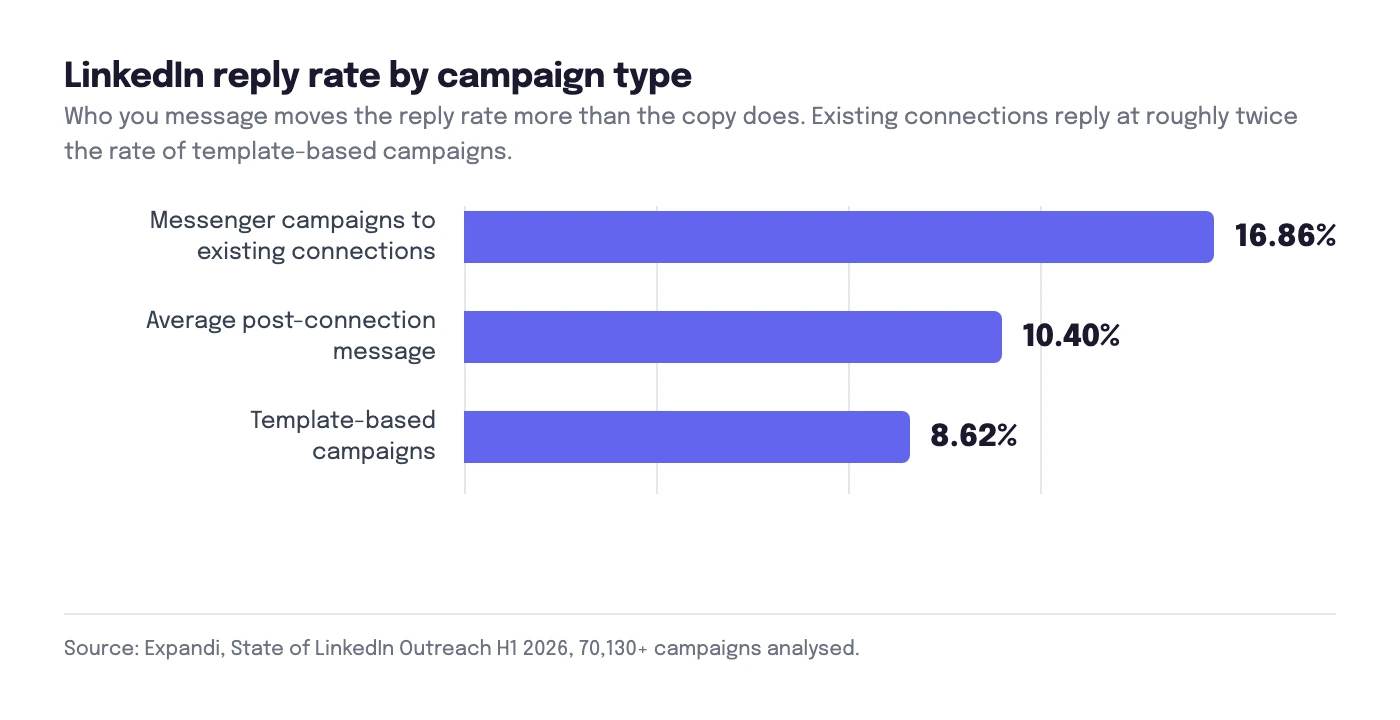
Follow-ups behave differently on LinkedIn than in cold email, where each touch adds replies. Expandi's analysis of 70,130+ campaigns found the first follow-up actually produced 0.6% fewer responses than no follow-up at all. The second follow-up is where the lift lives, adding 4.05% more responses, and third or later follow-ups add at most 1% with diminishing returns. In practice: plan for two follow-ups, give the second one your best angle, and stop there.
- Messenger campaigns (existing connections): 16.86% reply rate, the highest campaign type in Expandi's H1 2026 data
- Event campaigns: 14.21% reply rate when messaging attendees of the same LinkedIn event
- Inbound visitor campaigns: 13.4% reply rate when contacting people who viewed your profile
- Template-based campaigns: 8.62% average reply rate, the only category below the 10.3% platform average (Expandi)
- Stacking actions works: a direct message alone replies at 4.88%, but message plus profile visit reaches 11.87%, the best two-action combination in Belkins' data
- Nurturing compounds: Belkins found campaigns with a single action got a 1.07% reply rate, while campaigns with five nurturing actions reached 5.26%
- AI-assisted first messages: 4.19% reply rate vs 2.60% for non-AI first messages in Belkins' dataset, a 61% relative lift
The pattern across both datasets: context beats cold volume. Every campaign type that starts from an existing signal (a shared event, a profile visit, an accepted connection) beats template blasts by 5 points or more.
LinkedIn Limits in 2026
LinkedIn currently caps most accounts around 100-200 connection requests per week. The exact ceiling is not published and varies by account age, activity history, and whether the account runs Sales Navigator. Pushing past it risks temporary restrictions, so treat the lower end of the range as your planning number for any new or warming account.
Most senders operate far below the ceiling anyway: in Expandi's H1 2026 report, 71% of sellers send 50 or fewer connection requests per week, and 54% send fewer than 25. If you are consistently hitting the cap, you are already in the top tier of LinkedIn volume.
The cap changes the math of the channel. At 100-200 requests per week with 28-30% acceptance, one account produces roughly 30-60 new conversations weekly, before message replies. That is the structural reason LinkedIn cannot replace email at volume: it forces quality over quantity, which is also why its per-message reply rates stay high.
LinkedIn vs Cold Email
Cold email averages a 3.4-5.1% reply rate (see our full cold email statistics page). LinkedIn post-connection messages average 10.4%, roughly double per message. But email has no weekly cap: a healthy multi-inbox setup sends thousands of emails per week, while LinkedIn holds you to 100-200 connection requests per account.
| Channel | Average reply rate | Weekly volume per seat | Best use |
|---|---|---|---|
| LinkedIn messages | 10.4% | Low (100-200 requests/week cap) | High-value targets, warm-up touch |
| Cold email | 3.4-5.1% | High (thousands, with proper infrastructure) | Volume, follow-up, scheduling |
The conclusion from the Belkins study and every dataset we reviewed points the same way: this is not an either-or choice. LinkedIn wins on reply rate per message, email wins on scale, and the best-performing teams run both against the same prospect list. For a deeper comparison, read LinkedIn vs email: which performs better for B2B outreach.
Social Selling and Platform Statistics
LinkedIn publishes its own numbers on what consistent activity on the platform is worth. They come from the vendor, so read them as a ceiling rather than a guarantee, but they are the only first-party data available at this scale.
- Social selling leaders create 45% more opportunities than peers with a lower Social Selling Index, per LinkedIn's SSI research
- Social selling leaders are 51% more likely to reach quota (LinkedIn)
- 78% of social sellers outsell peers who do not use social media (LinkedIn)
- 80% of B2B marketing leads from social media come through LinkedIn, and 92% of B2B marketers use the platform, per LinkedIn's own marketing data. Note the scope: that is LinkedIn's share of social leads, not of all B2B leads.
- 46% of social media traffic to company websites comes from LinkedIn (LinkedIn)
- Sales Navigator users saw an 8% average revenue increase year over year and reached positive ROI in under 6 months, per the Forrester study LinkedIn commissioned (October 2023), with 300+ hours saved annually per user on research and CRM work
The SSI correlation cuts both ways for outbound: an active, credible profile is not a vanity project, it is the asset every other number on this page depends on. Prospects accept or ignore based on who you appear to be before they read a word of your note.
Multichannel: What Changes When LinkedIn and Email Run Together
Across campaigns run on Overloop, sequences that combine LinkedIn touches and email consistently outperform single-channel sequences on reply rate. We do not publish a precise multiplier because it varies heavily by list quality and industry, but the direction is consistent across markets and company sizes.
The mechanics are intuitive. A connection request makes your name familiar before your email lands. An email gives the prospect a low-pressure place to answer when they do not want to chat on LinkedIn. And a prospect who ignored one channel often answers on the other: the second channel is not double-touching, it is a second chance. Overloop runs LinkedIn and email together from one campaign timeline, with plans starting at $69/month, so both channels share one schedule and one reply inbox instead of living in separate tools.
How to Use These Benchmarks
Benchmarks are only useful if they trigger a decision. Score each metric against this table, then fix the lowest stage of your funnel first: acceptance problems are targeting and profile problems, reply problems are message problems.
| Metric | Below benchmark | On benchmark | Top quartile |
|---|---|---|---|
| Connection acceptance rate | Under 25% | 28-30% | 40-45%+ |
| Post-connection message reply | Under 7% | ~10.4% | 15%+ (18.9% in Staffing & Recruiting) |
| InMail response rate | Under 10% | 10-25% | 30-40% |
- Below benchmark on acceptance: tighten your ICP, clean up your profile (headline, photo, activity), and personalize every request. The 3x lift from personalization is the cheapest win on this page.
- Below benchmark on replies: shorten your first message, remove the pitch, and ask one specific question. The decline of note replies means your post-acceptance message carries the whole conversation.
- On benchmark everywhere: your next gain is volume, and that means adding email to the same sequence rather than pushing LinkedIn past its weekly cap.
Run LinkedIn and email in one campaign
Connection requests, LinkedIn messages, and emails on one timeline, with one reply inbox.
Start with Overloop →Frequently asked questions
What is a good LinkedIn connection acceptance rate?
A good LinkedIn connection acceptance rate is 30-45%, per Cleverly's benchmarks. The overall average sits at 28-30% according to Expandi's 13.2 million request dataset. Personalized connection requests reach roughly 45% acceptance, about 3x the rate of generic requests, which sit near 15%.
What is the average LinkedIn message reply rate?
Post-connection LinkedIn messages average a 10.4% reply rate across industries, per Expandi's 2026 benchmark data. Staffing and Recruiting leads at 18.9%, while Computer Software sits at 8.8%. That average is roughly double the typical cold email reply rate of 3.4-5.1%. Multichannel campaigns, like those run on Overloop, typically beat single-channel averages because prospects answer on the channel they prefer.
What is a good InMail response rate?
InMail response rates average 10-25%, and top performers reach 30-40%, per SalesSo's InMail statistics. By industry, Legal and Professional Services posts the highest response rate at 10.42%, while Software and SaaS sits lowest at 4.77% because of inbox saturation.
Are LinkedIn connection notes still worth it?
Connection-note reply rates declined from 3.5% in May 2025 to 2.2% in April 2026, a 37% relative drop, per Expandi. Notes matter less for getting replies, but personalization still lifts acceptance roughly 3x (about 45% versus 15% for generic requests). Send a short personalized note when you have something specific to say, and put most of your effort into the follow-up message after the connection is accepted.
Is LinkedIn outreach better than cold email?
LinkedIn gets a higher reply rate per message: 10.4% on average versus 3.4-5.1% for cold email. Email scales further because LinkedIn caps most accounts around 100-200 connection requests per week. The best results come from combining both channels: multichannel platforms like Overloop run LinkedIn and email in one campaign, so a prospect who ignores one channel gets a second chance on the other.
What is the best time to send LinkedIn connection requests?
Monday to Thursday between 9-11am and 2-4pm in the prospect's local time, with Tuesday and Wednesday as peak days, per Botdog's study of 16,492 requests. Belkins' 20 million+ attempt dataset confirms Tuesday as the best reply day at 6.90% and Saturday as the worst at 6.40%. Acceptances come fast: 63% arrive within 24 hours and 88% within a week, so you can judge a campaign after two or three days.
How long should a LinkedIn outreach message be?
Under 400 characters. LinkedIn's own data shows InMails under 400 characters get a 22% higher response rate than average, while messages over 1,200 characters perform 11% below average. Only 10% of all InMails are that short, so brevity alone makes your message stand out from 90% of the inbox.
Methodology & sources7 sources
Where this data comes from
Every benchmark on this page is attributed to a named external study. We did not blend sources into unverifiable averages: each number links back to where it was published.
- Expandi: 13.2 million connection requests and follow-up messages analyzed between May 2025 and April 2026, plus the State of LinkedIn Outreach H1 2026 report covering 70,130+ campaigns.
- Belkins: 20 million+ outreach attempts across roughly 13,000 LinkedIn accounts, covering acceptance and reply behavior by industry, title, timing, and campaign structure.
- Cleverly: LinkedIn benchmarks for acceptance rates and personalization lift.
- SalesSo: InMail response rate statistics, overall and by industry.
- Botdog: 16,492 connection requests analyzed for acceptance timing and note vs no-note performance.
- LinkedIn: first-party published data on InMail length, send days, and personalization, plus LinkedIn's Social Selling Index research and B2B marketing data.
- Campaign patterns observed across Overloop multichannel sequences: qualitative observations used for directional context only, not as numeric benchmarks.