


Lead generation for technology companies is how B2B tech and SaaS firms create qualified pipeline by targeting accounts that fit their ICP, then combining outbound with product-led and content channels. The highest-ROI mix in 2026 pairs account-based outbound lead generation (email plus LinkedIn) with free-tool and trial-led capture. This guide covers ICP, channels, the tool stack, and the KPIs that scale.
Most B2B tech “lead gen” fails for one simple reason: teams aim at a person, then get stuck in a committee. Gartner reports that B2B buying groups often include 6 to 10 decision makers, which means your pipeline lives or dies on whether you can reach multiple roles with a consistent message.
Lead generation for technology companies is a repeatable system that turns a defined ideal customer profile into qualified sales conversations through targeting, offers, and follow-up you can run every week. In B2B tech and SaaS, the goal is more meetings with the right buying committee, at a cost and pace your sales cycle can support.
This matters because tech deals come with real friction: switching costs, security reviews, stakeholder alignment, and budget scrutiny. A security product can require a CISO, an IT owner, and procurement. A SaaS platform might start with a team lead and end in finance. Your lead gen system has to account for that reality from the first list you build to the last follow-up.
Below is a practical playbook you can execute: define your ICP and committee, build reachable lists, choose channels with ROI benchmarks, write offers that earn replies, and run multichannel sequences without wrecking deliverability. If you use an outbound execution tool like Overloop AI, Apollo, Lemlist, or Cognism, it should enforce the process and keep your data and follow-up tight, not paper over weak targeting.
How B2B Tech Lead Gen Works (And Why It Is Different)
Lead generation for technology companies breaks when you treat it like simple “get more leads” marketing. B2B tech and SaaS deals usually involve multiple stakeholders, real switching costs, security reviews, and budget scrutiny. That reality changes who you target, what you say, and which channels earn trust fast enough to create sales conversations.
- Account-based email + LinkedIn to the ICP and buying committee
- Product-led: free tools, trials, and usage-based triggers
- Comparison and alternatives content for high-intent search
- Integration and partner ecosystems as a referral channel
Most B2B tech purchases run through a buying committee. Gartner’s research on B2B buying describes groups of six to 10 stakeholders involved in many complex purchases, each with different objections and success criteria. One person cares about ROI, another cares about implementation risk, another cares about compliance. Your outreach has to map to roles, not “companies.” (Source: Gartner, B2B buying journey.)
Sales cycles also run longer than most teams plan for. Even after a meeting, buyers often need a second call, a technical deep dive, a security questionnaire, and internal sign-off before a pilot. That is why “one-and-done” cold emails fail. You need a sequence that builds credibility over time and gives the committee usable proof.
What These Differences Change in Channels and Messaging
B2B tech lead gen works best when you mix channels that create trust with channels that create volume. For many teams, outbound email and LinkedIn drive the first conversation, while webinars, partner co-marketing, and paid search capture higher-intent demand already in motion.
- Outbound email: Works when targeting is tight and the offer is specific (audit, benchmark, teardown, migration plan). It fails when you pitch features and ask for “15 minutes” with no reason.
- LinkedIn: Works when you treat it as a credibility layer. A connection request plus a short, role-based message often outperforms long pitches. Keep automation conservative to avoid account issues.
- Webinars and virtual events: Convert best when you co-host with a known brand, like an integration partner (HubSpot, Snowflake, AWS) or a niche consultancy.
- Paid search: Works for bottom-funnel queries (for example, “SOC 2 compliance software” or “Salesforce data enrichment”). It burns budget on broad keywords like “CRM.”
Messaging has to prove you understand the buyer’s context. Use role-specific pain, quantified outcomes when you have them, and proof buyers recognize (customer logos, public case studies, security posture, integration list). Tools like Overloop AI, Apollo, Lemlist, and Cognism help you execute sequences and personalization, but the committee map and the proof points decide whether anyone replies.
Step 1: Choose Your ICP and Buying Committee (So You Stop Chasing Bad Leads)
Most “bad lead” problems in lead generation for technology companies start before you write a single email. If you cannot name the buying committee, the business trigger, and the disqualifiers, your outbound will drift into generic copy and random targeting, and busy buyers will ignore it.
Your goal is a targeting spec that sales and marketing can both use: who you sell to, which roles matter, what has to be true for them to buy, and what makes them a waste of time.
- Write your ICP as a filter, not a persona. Define firmographics (industry, employee range, geography if relevant, ownership), technographics (Salesforce, AWS, Okta, Snowflake), and constraints (security needs, data residency, deployment model). If you sell a developer tool, include engineering headcount or GitHub activity as a proxy, using BuiltWith (web tech lookup) or Wappalyzer (tech stack detection) to validate assumptions.
- Map the buying committee by job-to-be-done. List 4-6 roles and what each needs to believe.
- Economic buyer (CFO, VP, GM): cares about payback period, budget timing, risk.
- Champion (Director, Manager): cares about hitting a KPI, saving time, looking good.
- Technical evaluator (IT, Security, Data, Engineering): cares about integrations, SSO, SOC 2, API limits.
- Procurement and legal: cares about terms, vendor risk, compliance.
- Choose 2-3 “entry roles” for outbound. Start where pain is felt and meetings happen. For many SaaS categories, that is a functional leader or ops lead, then you expand to security and finance once interest exists.
- Define triggers you can actually target. Good triggers are observable: a job post for “RevOps Manager,” a public migration to HubSpot, a new product line, a recent funding round, a security incident write-up. Avoid vague triggers like “growth-minded teams.”
- Write disqualifiers that save weeks. Examples: fewer than 5 sales reps, no budget owner in-region, requires on-prem when you are cloud-only, already locked into a 3-year contract with a direct competitor, regulated requirements you cannot meet (for example, no SOC 2 Type II when buyers require it).
Turn It Into a One-Page Targeting Spec
Put the spec in a shared doc and force agreement before list building. Include: ICP filters, 2-3 entry roles, committee roles to loop in, 5 triggers, 5 disqualifiers, and 3 proof points (customer logos, a public case study, a security credential like SOC 2). Then configure those exact filters in your data source and execution tool. In Overloop AI, Apollo, or Cognism, this becomes the saved search and the fields you require before a prospect can enter a sequence.
Step 2: Build a Lead List That Is Actually Reachable
Your saved search is only as good as the records it returns. For lead generation for technology companies, “reachable” means the contact matches your ICP, has a valid inbox, and includes the fields you need to personalize without guessing.
Start with sourcing. Most B2B teams combine one primary database with a second source for cross-checking. Common options include Apollo (prospecting database and sequencing), Cognism (B2B data provider with phone and email coverage), LinkedIn Sales Navigator (role and org context), and Clearbit (B2B enrichment). If you already have product-led signups, pull your own CRM and product data first; HubSpot, Salesforce, and Pipedrive exports usually beat any third-party list on accuracy.
Required Fields for a “Sequence-Ready” Lead
Do not allow a record into Overloop AI, Apollo, Lemlist, or your CRM without these minimum fields:
- Company: legal name, website domain, employee range, country or region, industry.
- Person: first name, last name, title, seniority, department, LinkedIn URL.
- Reachability: email address, email verification status, source, date captured.
- Routing: owner (SDR or AE), segment tag (ICP tier, use case), trigger (if known).
If you cannot segment by role and use case, your copy turns into feature dumping. If you cannot track source and capture date, you cannot debug bounces or stale data.
Clean the list before you enrich it. De-duplicate by email and LinkedIn URL, standardize company domains (one domain per account), and remove obvious bad fits from your disqualifier list (students, consultants when you sell to in-house teams, companies below your minimum size). Normalize titles into buckets like “Security,” “Data,” “RevOps,” “IT,” so reporting stays readable.
Email finding and verification should be a gate, not an afterthought. Use an email finder when the database lacks an address, then verify before sending. Tools teams use include Overloop AI (built-in email verification), ZeroBounce (email validation), NeverBounce (email verification), and BriteVerify (email verification). Send only to “valid” or “verified” statuses, quarantine “unknown,” and drop “invalid.”
Use this checklist right before launch:
- Random-sample 25 records and confirm titles and companies match your ICP spec.
- Confirm every record has the required fields and a verified email.
- Check for role coverage across the buying committee, not a single title.
- Remove duplicates across segments so prospects do not get multiple sequences.
- Export a bounce-safe first batch, then hold back the rest for iteration.
Step 3: Pick the Highest-ROI Channels for 2026 (With Benchmarks)
That pre-launch checklist protects list quality and deliverability. Channel choice decides whether lead generation for technology companies turns into meetings or into busywork. In B2B tech and SaaS, the highest ROI usually comes from a mix: outbound for predictable volume, and inbound capture for buyers already researching.
Use this default channel mix, then adjust by ACV and sales cycle length:
- Outbound email: Primary meeting engine for most B2B SaaS.
- LinkedIn: Credibility and follow-up layer, especially for senior roles.
- Partnerships: Fast trust transfer when you share an audience (integration, agency, reseller).
- Webinars: Best for complex products that need education and multi-stakeholder alignment.
- Paid search: High intent capture for bottom-funnel queries and competitor comparisons.
Benchmarks You Can Plan Around
Benchmarks vary by offer and list quality, but you still need guardrails. These are realistic planning ranges from named sources, then you validate against your own baseline in 2 to 4 weeks.
- Cold email reply rates: Lemlist reports 1 to 5% reply rates as common for cold email campaigns. Use this as a sanity check, not a target. (Source: Lemlist, cold email statistics.)
- Cold email bounce rates: Google’s sender guidelines recommend keeping spam rates under 0.3%. Bounce rate targets depend on your stack, but teams typically aim for very low bounces by verifying emails before sending. (Source: Google Postmaster Tools and sender guidelines.)
For LinkedIn, treat metrics like acceptance rate and booked meetings per 100 new connections as your internal benchmark. LinkedIn does not publish reliable “good” connection or reply rates across industries, so measure your own by role and message type.
How To Allocate Effort By Deal Size
For SMB and mid-market SaaS, put most execution into outbound email plus LinkedIn follow-ups. You can run this through Overloop AI, Apollo, or Lemlist as the execution layer, then feed meetings into HubSpot or Salesforce.
For enterprise tech, shift time toward partnerships and webinars. A co-marketed webinar with an integration partner like AWS, Snowflake, or HubSpot can outperform pure cold outbound because it borrows trust and attracts multiple committee roles at once.
Use paid search when you can name bottom-funnel keywords you win, such as “alternative,” “pricing,” “SOC 2,” “SAML SSO,” or “integrates with Salesforce.” Avoid broad category terms until you have conversion data and a strong negative keyword list.
Step 4: Write Offers and Messages That Get Replies From Busy Buyers
Buyers who search “pricing,” “SOC 2,” or “integrates with Salesforce” already have a reason to talk. Outbound has to manufacture that same reason in one screen of text. For lead generation for technology companies, the offer matters more than the wording. A vague “quick chat” dies in the inbox.
Use this repeatable message formula for B2B tech and SaaS: Role pain (what breaks), specific offer (what you will do), proof (why you), low-friction CTA (what happens next). Write one version per entry role, then reuse it across email and LinkedIn.
Offers That Fit Longer Sales Cycles
Pick an offer that creates a concrete artifact buyers can forward internally. Good offers reduce evaluation risk and pull the buying committee into the process.
- Integration fit check: “15-minute fit check for your Salesforce + Snowflake stack, I’ll send a one-page integration map.”
- Security and compliance pack: “I’ll share our SOC 2 Type II, SSO options (SAML), and a vendor security overview.”
- Benchmark or teardown: “I’ll benchmark your current workflow against X peers and send the gaps and quick wins.”
- Migration plan: “I’ll outline a phased migration plan (week-by-week) and the common failure points.”
Proof has to be buyer-recognizable. Use a public case study, a known integration partner (AWS, Okta, HubSpot), or a quantified outcome you can defend. If you cannot cite numbers, keep proof factual: customer logo list, security credentials, or time-to-value for a pilot.
Personalization should be narrow and verifiable. Use one sentence tied to a trigger you can point to (job post, product page, tech stack from BuiltWith). Skip “Loved your website.” It signals automation.
Cold Email Template (First Touch)
Subject: {Company} and {trigger}
Hi {FirstName},
I noticed {trigger}. Teams in {industry} usually hit {role pain} when {context}.
Open to a quick {specific offer}? If it helps, I can send {artifact} either way.
Relevant: we support {integration/security proof}. If you are not the right owner, who should I speak with?
{Name}
LinkedIn Connection Note (300 characters)
Hi {FirstName}, saw {trigger} at {Company}. I work with {role} teams on {outcome}. If helpful, I can share a {artifact} for {use case}. Open to connect?
Execution tools like Overloop AI, Apollo, and Lemlist help you keep the framework consistent across sequences. They do not fix a weak offer. Treat the offer as the product you sell in the first 10 seconds.
Step 5: Launch a Multichannel Sequence and Manage Deliverability
A strong offer still fails if your sequence is sloppy or your emails land in spam. In lead generation for technology companies, sequencing is operations: you control touch timing, channel mix, and deliverability so the right buyers actually see your message and you can book meetings predictably.
- Start with a small pilot segment. Pick one ICP slice (for example, 200-500 contacts) and one entry role. Keep variables low so you can diagnose what works.
- Set up sending infrastructure before copy. Use a dedicated sending domain (not your main website domain). Configure SPF, DKIM, and DMARC. Google’s and Yahoo’s 2024 bulk sender requirements pushed these from “nice to have” to table stakes for inbox placement. (Source: Google Workspace Admin Help, email sender guidelines.)
- Warm up and ramp volume. Begin with low daily volume per mailbox, then increase gradually over 2-3 weeks. Sudden spikes trigger filtering. Keep your first ramp focused on highly relevant, verified leads.
- Build a multichannel sequence with a clear job for each touch. A practical default is 8-12 touches across 14-21 days, split between email and LinkedIn. Email carries the offer and proof. LinkedIn supports recognition, light context, and follow-up after a reply.
- Use conservative LinkedIn automation. Prioritize profile views, connection requests, then short follow-ups. Aggressive activity patterns create account risk and force restarts.
- Route replies fast. Set an SLA like “human reply in under 1 business day.” Speed matters because buying committees move when momentum exists.
Weekly Deliverability Checks Tied to Meetings
Check deliverability weekly, then link it to booked meetings by segment and mailbox. If deliverability drops, meeting volume usually drops a week later.
- Spam rate: Monitor in Google Postmaster Tools for Google-based recipients. Google recommends keeping spam rates under 0.3%.
- Bounces: Investigate immediately. A spike usually means bad data, a broken verifier, or a new segment with poor reachability.
- Complaint and unsubscribe signals: Tighten targeting and shorten copy before you add more volume.
- Reply quality: Track positive replies and meetings per 1000 sends. Open rates can mislead because Apple Mail Privacy Protection inflates opens.
Execution tools like Overloop AI, Apollo, and Lemlist help you run these steps consistently across email and LinkedIn. Your job is to keep the system measurable: same segment rules, same ramp plan, same weekly checks, then iterate based on meetings booked.
A Realistic 2026 Tool Stack (Including Overloop, Apollo, Lemlist, and Cognism)
Consistency beats “best tool.” For lead generation for technology companies, your stack should enforce the same targeting rules, verification gates, and sequence logic every week. Pick one primary system for outbound execution, then connect it cleanly to your CRM and reporting.
A practical 2026 stack has six categories: data, enrichment, sequencing, deliverability, CRM, and analytics. You can run lean by choosing tools that cover multiple categories, as long as you keep data quality and deliverability controls.
| Category | What It Does | Common Tools (Real Examples) |
|---|---|---|
| Data (Prospecting) | Find companies and contacts that match your ICP | Apollo (database + outreach), Cognism (B2B data provider), LinkedIn Sales Navigator (role and org context) |
| Enrichment | Fill missing firmographic and contact fields | Clearbit (B2B enrichment), Clay (workflow-based enrichment), ZoomInfo (B2B data and enrichment) |
| Sequencing (Execution Layer) | Run email + LinkedIn sequences, track replies, route meetings | Overloop AI (email + LinkedIn sequences, 450M+ contact database gated by monthly credits, email finder + verification), Lemlist (cold email sequencing), Apollo (sequencing) |
| Deliverability | Protect sender reputation and reduce bounces | Google Postmaster Tools (domain reputation), Microsoft SNDS (sender data), ZeroBounce (email validation) |
| CRM | System of record for accounts, contacts, pipeline | Salesforce (CRM), HubSpot (CRM + marketing), Pipedrive (CRM) |
| Analytics | See conversion from sent to meetings to pipeline | HubSpot reports, Salesforce reports, Google Looker Studio (dashboards) |
Where Overloop Fits for B2B Tech Outbound
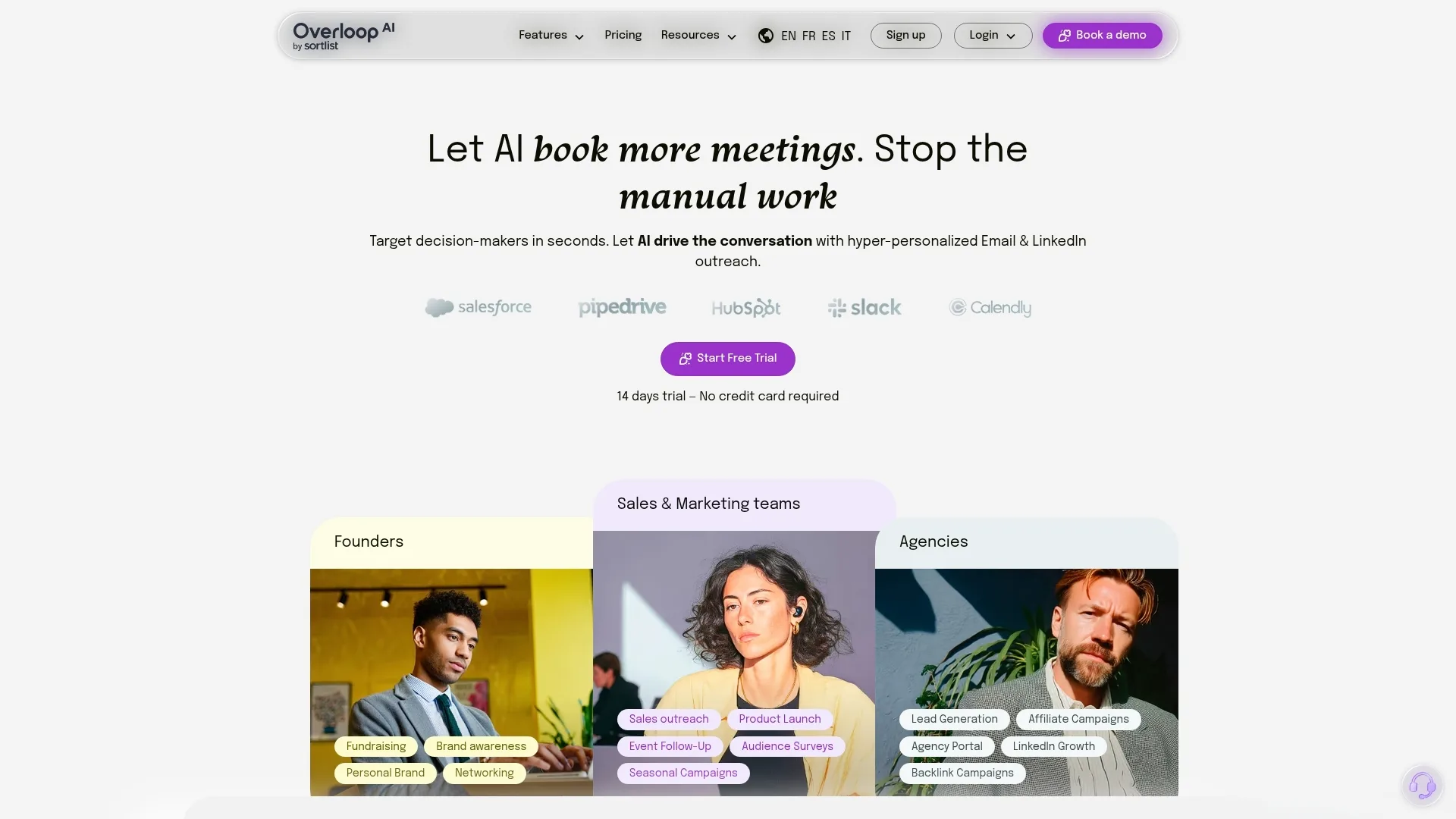
Overloop AI fits as the outbound execution layer when you want one place to: build lists from a large database, find and verify emails, generate personalized copy, and run multichannel sequences across email and LinkedIn. Teams often pair it with Cognism or LinkedIn Sales Navigator for extra coverage in specific regions or job families, then push clean activity and outcomes into Salesforce or HubSpot.
Keep the stack honest by enforcing two non-negotiables: verify emails before any send, and write back results to the CRM. If your sequencing tool cannot reliably log replies, meetings, and “do not contact” status, your reporting breaks and your list quality decays fast.
KPIs That Predict Pipeline (Not Vanity Metrics) Plus Common Mistakes
If your sequencing tool logs replies and meetings back to the CRM, you can run lead generation for technology companies like an accountable system. If it does not, you end up debating open rates and “activity,” and pipeline stays flat.
Track a small set of KPIs that connect list quality to revenue. Everything else is diagnostic.
Pipeline-Predictive KPIs for B2B Tech Lead Gen
- Verified-email rate (list quality): Verified emails divided by total prospects sourced. If this drops, bounce risk rises and deliverability follows.
- Bounce rate (deliverability): Bounces divided by emails sent. Investigate spikes immediately. Google’s sender guidance points senders to keep spam rates under 0.3%, and high bounces often correlate with filtering problems soon after. (Source: Google Workspace Admin Help, email sender guidelines.)
- Positive reply rate (message-market fit): Positive replies divided by delivered emails. Track it by segment (ICP tier, role, trigger), not as one blended number.
- Meetings booked per 1,000 delivered emails (output KPI): This is the cleanest outbound efficiency metric because it ignores open-rate noise.
- Meeting-to-opportunity conversion (handoff quality): Opportunities created divided by meetings held. If this is weak, your ICP spec or offer is off, or your meeting qualification is sloppy.
- Opportunity-to-win rate and sales cycle length (reality check): Pull from HubSpot or Salesforce monthly. If outbound “wins” but takes 2x longer than average, your targeting likely skews toward high-friction accounts.
Keep benchmarks internal. Lemlist reports 1 to 5% reply rates as common in cold email, but your best signal is your own trend line by segment. (Source: Lemlist, cold email statistics.)
Vanity metrics to de-prioritize: open rate (Apple Mail Privacy Protection inflates it), total replies (counts “unsubscribe”), clicks (often bots), and “tasks completed.”
Common failure modes and fast fixes:
- High bounces: stop the campaign, re-verify with ZeroBounce or NeverBounce, quarantine “unknown,” and tighten your data source filters.
- Low positive replies with normal deliverability: rewrite the offer into a concrete artifact (benchmark, teardown, security pack), then re-run on one role first.
- Meetings happen but no opportunities: add disqualifiers to the ICP spec, require a minimum “why now” trigger, and train SDRs on a 5-question qualification script.
- Reply rates fall after scaling volume: slow the ramp per mailbox, reduce list breadth, and rotate to a fresher segment. Overloop AI, Apollo, and Lemlist can execute the ramp, but targeting controls the ceiling.
FAQ: Lead Generation for Technology Companies
Most “fast fixes” come down to five practical questions teams ask once campaigns run. Here are straight answers you can use to plan lead generation for technology companies without guessing.
FAQ
1) How much should B2B tech lead generation cost in 2026?
Budget to learn, then budget to scale. For outbound, your hard costs usually include a data source (Apollo or Cognism), a sequencing tool (Overloop AI, Apollo, or Lemlist), email verification (ZeroBounce or NeverBounce), and a CRM (HubSpot or Salesforce). Your biggest variable is people time: list building, copy, inbox management, and call follow-up. If you cannot tie spend to cost per meeting and cost per qualified opportunity in your CRM, you are not budgeting, you are hoping.
2) How long until we see results?
Expect signal in 2 to 4 weeks if your list is reachable and your offer is specific. That window is long enough to run a full 8 to 12 touch sequence, collect reply quality, and see whether meetings convert past the first call. Pipeline and revenue take longer because buying committees need evaluation time. Track meetings booked and stage conversion first, then scale volume.
3) Outbound vs inbound: which should we prioritize?
Outbound creates controlled volume when you know your ICP and entry roles. Inbound compounds over time through SEO, webinars, and partner co-marketing. Most B2B SaaS teams run both, then shift emphasis by ACV: lower ACV leans outbound-heavy, higher ACV leans more on trust channels like partners and webinars. Use paid search mainly for bottom-funnel queries like “pricing,” “alternative,” and “integrates with.”
4) Who owns what on the team?
Make ownership explicit or you will ship half-finished campaigns.
- Marketing: ICP inputs, proof assets (case studies, security pack), webinar and partner motions.
- SDR/BDR: list QA, personalization fields, sequence execution, first response SLA.
- AE: qualification, multi-threading into the buying committee, next-step control.
- Ops: CRM hygiene, routing, reporting, deliverability monitoring (Google Postmaster Tools, Microsoft SNDS).
5) What do we do when reply rates drop?
Treat it like debugging, not copywriting.
- Check deliverability first: spam rate (Google Postmaster Tools), bounce spikes, and sudden volume increases.
- Audit list freshness: re-verify emails, tighten titles, remove “unknown” verification statuses.
- Change the offer before you rewrite everything: swap “quick chat” for an artifact (benchmark, teardown, security pack).
- Segment harder: one role, one trigger, one use case, then expand after meetings return.
If you want an immediate next step: pick one ICP slice, verify a 200 to 500 contact pilot list, and run one sequence end-to-end. Then scale the exact motion that produces meetings that convert.