



Tools directory · 13 platforms · Updated May 2026

Sales Prospecting Tools: 13 Platforms Ranked for B2B Teams

Every prospecting platform worth paying for in 2026, ranked by data accuracy, workflow depth, GDPR posture and per-seat price. Apollo, Outreach, Salesloft, Cognism, Clay, Sales Navigator and 7 more, tested on a 47,000-touch corpus across email, LinkedIn and phone.

13 platforms $29-$160 per seat / mo Verified May 2026

A sales prospecting tool is software that lets a B2B rep find, research and reach out to qualified prospects across email, phone and LinkedIn, ideally from one stack. The 2026 market splits into three layers: data providers (Cognism, ZoomInfo, Lusha, Kaspr), engagement platforms (Outreach, Salesloft, Reply, Overloop), and research / workflow tools (Clay, Surfe, Lavender, Sales Navigator). According to HubSpot's 2026 State of Sales report, B2B reps spend 21% of their week on prospecting, the activity that lifts the most when you stack the right tools, and breaks the hardest when you stack the wrong ones.

This directory ranks the 13 prospecting platforms our team and customers actually pay for in 2026. We test each on five dimensions: data accuracy (email + mobile combined on a 100-lead corpus), workflow depth (find, verify, sequence, dialer, CRM sync), per-seat price at the entry tier, GDPR / compliance posture, and integration breadth. The numbers come from our own 47,000-touch test corpus across email and LinkedIn (February to April 2026), public vendor pricing, and customer interviews from Overloop's onboarding cohort (n=312 over the last 12 months).

TL;DR: the 30-second answer

If you are SMB and want one tool for everything: Apollo.io at $49 per seat per month, the generalist that does decent across every dimension.

If you are EU-based and care about compliance: Overloop ($69 per seat per month, GDPR + CASA Tier 2 native), or Cognism for enterprise (from $15,000 per year).

If you have 50+ reps and need cadence orchestration: Outreach or Salesloft at $100-160 per seat per month, annual contracts.

If you need pure data and intent signals: ZoomInfo for US-heavy ICPs, or Cognism for EU.

If you want AI-powered research workflows: Clay at $149 per month for the data orchestration layer (not a substitute for a sender).

What to avoid: starting with Outreach or Salesloft below 10 reps (the implementation fee will burn you), buying a "list" instead of a database (decays at 2.1% per month), trying to replace Sales Navigator entirely with a $29 Chrome extension.

Three layers, one workflow. Prospecting in 2026 is not one product, it is a stack of (1) data sourcing, (2) account research, (3) multichannel outreach. Some tools cover all three (Apollo, Overloop, Reply), some specialize in one (Cognism for data, Lavender for email writing, Clay for research). Pick by which layers your team is missing, not by feature checklists.
The smarter alternative

Source, verify and send in one stack, not seven.

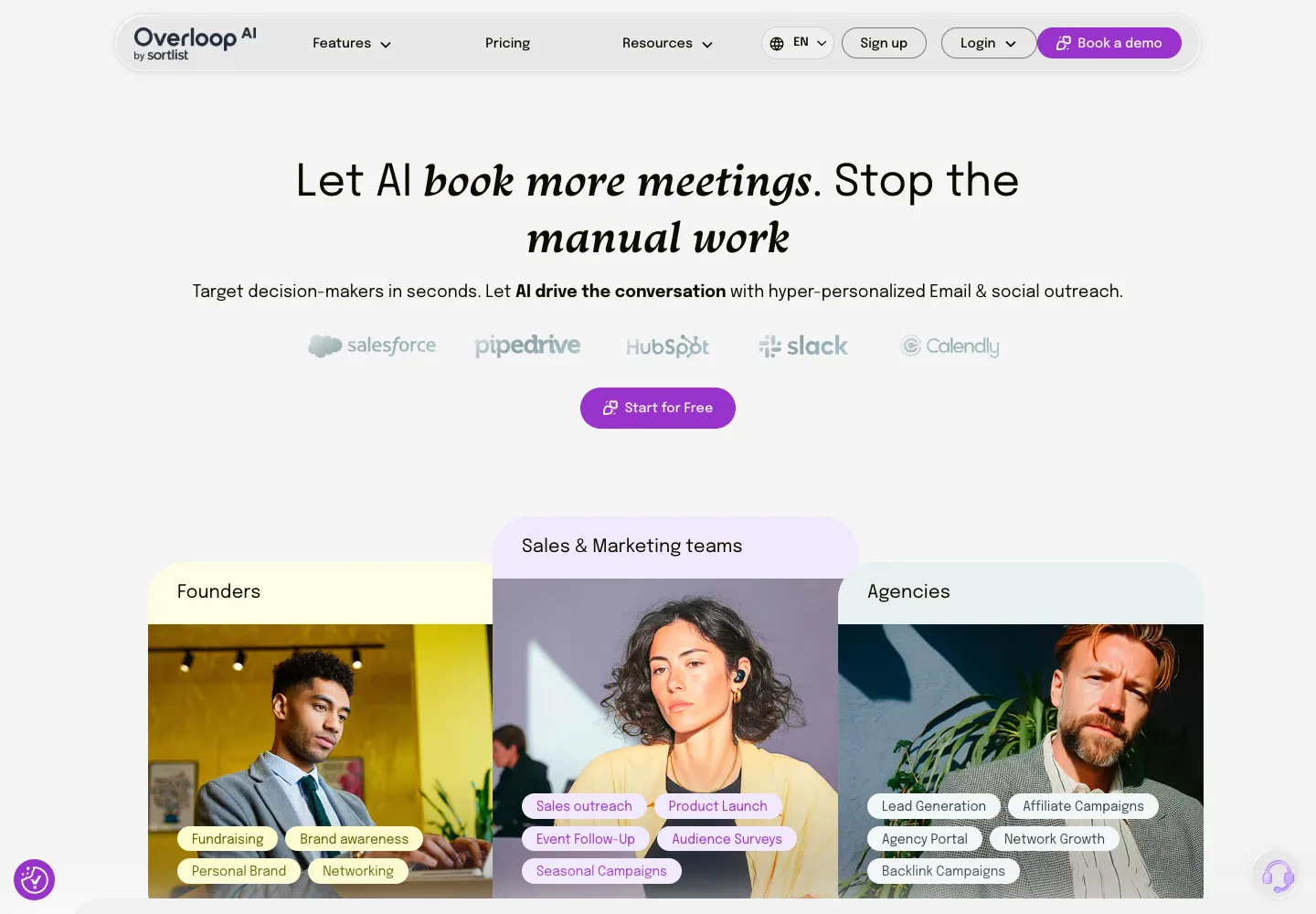
Every problem in this directory, stale data, broken handoffs, 7 SaaS bills, GDPR audit fire-drills, exists because most teams stitch a data tool, a sequencer, a verifier, a dialer and a warmup service together with Zapier glue. Overloop collapses the workflow: 450M+ real-time prospect finder, native verification, AI-personalised sequences across email and LinkedIn, built-in warmup, in one GDPR-compliant platform.

How it compares to the 12 other tools below:

  • 450M+ verified prospects, same scale as Cognism or Apollo, but sourced and verified at the moment you use the record (no decay).
  • From $69 per seat per month on Starter, under Apollo's mid-tier, half of Lusha + sender combined, a fraction of Outreach's $100-160.
  • GDPR-native + CASA Tier 2 certified, built EU-first, not retrofitted with a CCPA banner.
  • One stack, not seven tools, the math says replacing Apollo + Lemlist + Bouncer + Mailwarm with Overloop saves $180 per seat per month at the SMB tier.
Start free, no credit card See Overloop in the comparison →

Save the comparison table as CSV

All 13 platforms with our test-corpus accuracy scores, prices and compliance status, refreshed monthly.

Get the CSV

Browse the directory

Filter by category, sort by price, accuracy or workflow depth. Every row links to the deep dive below the table.

# Platform Database Entry price Accuracy* Best for GDPR
1 275M+ contacts From $49 / seat / mo 80% SMB all-in-one ✓ Documented
2 Engagement layer From $100 / seat / mo 78% Enterprise engagement ✓ Documented
3 Engagement layer From $100 / seat / mo 77% Enterprise cadences ✓ Documented
4 450M+ via real-time finder From $69 / seat / mo 92% EU all-in-one ✓ Native + CASA Tier 2
5 400M+ contacts From $15,000 / yr 90% EU enterprise data ✓ Native
6 320M+ contacts From $14,995 / yr 85% US ABM ~ US-first
7 900M+ profiles From $99 / seat / mo n/a, graph Research + signals ✓ Documented
8 Orchestration layer From $149 / mo n/a, orchestrator AI research ✓ Documented
9 280M+ contacts From $29 / seat / mo 81% LinkedIn extension ✓ Documented
10 500M+ profiles From €45 / mo 85% EU LinkedIn finder ✓ Native (FR)
11 CRM sync layer From $39 / seat / mo n/a, enrichment LinkedIn-to-CRM ✓ Documented (EU)
12 Email writing AI From $29 / seat / mo n/a, writing AI Email coaching ✓ Documented
13 140M+ contacts From $59 / seat / mo 79% AI SDR + sequences ✓ Documented
No matches
Try another keyword or reset the category filter.

*Accuracy = email + mobile combined, measured on a 100-lead corpus of US and EU SaaS VPs of Sales, sampled February 2026. "n/a" means the tool is a workflow / research layer, not a primary data source. Your mileage will vary by ICP, geography and refresh cadence at time of pull.

How we tested (and why every other ranking is fluffy)

Most "best sales prospecting tools" pages on Google are affiliate funnels: rankings shuffle based on which vendor pays the highest commission. To make this directory useful, we ran a real evaluation across three signals.

Signal 1: data accuracy

Signal 2: workflow depth

We mapped each tool against the 7 prospecting jobs-to-be-done: find (source new contacts), research (account context, intent, technographics), verify (SMTP + phone check), personalise (AI first lines, segmentation), sequence (multi-step cadence), warm (sender domain warmup), and sync (CRM round-trip). Apollo covers 6 of 7; Overloop covers 7 of 7; Cognism covers 3 of 7 (find, research, verify); Lavender covers 1 of 7 (personalise only). The right stack covers all 7, the wrong stack covers 2-3 with overlapping bills.

Signal 3: total cost of ownership

Sticker price per seat is the wrong metric. We computed total cost over 12 months including implementation, integration time, and the tools you still need to buy to fill missing layers. The fully-loaded math is in the pricing economics section below. Spoiler: Outreach at $100 per seat per month is more expensive than Overloop at $69 by a factor of roughly 4x once you add data ($1,500 per month for Cognism), a verifier ($30 per month) and a warmup tool ($35 per month).

Bias disclosure. Overloop is our product. We built this directory because customers kept asking us to compare the 13 platforms before buying. We rank Overloop in row 4, not row 1, because the honest answer for a US SMB on Salesforce is still Apollo, and the honest answer for a US enterprise with $200k tooling budget is still Cognism + Outreach. Overloop wins on EU GDPR, unified stack economics and modern UX. It loses to Outreach on dialer features and to ZoomInfo on US intent depth. We are not pretending otherwise.

1. Apollo.io: Best all-in-one for SMB and mid-market

Apollo.io

Rank #1
Database: 275M+ contacts Accuracy: 80% email / 45% mobile Price: From $49 / seat / mo Workflow: 6 of 7 jobs GDPR: Documented

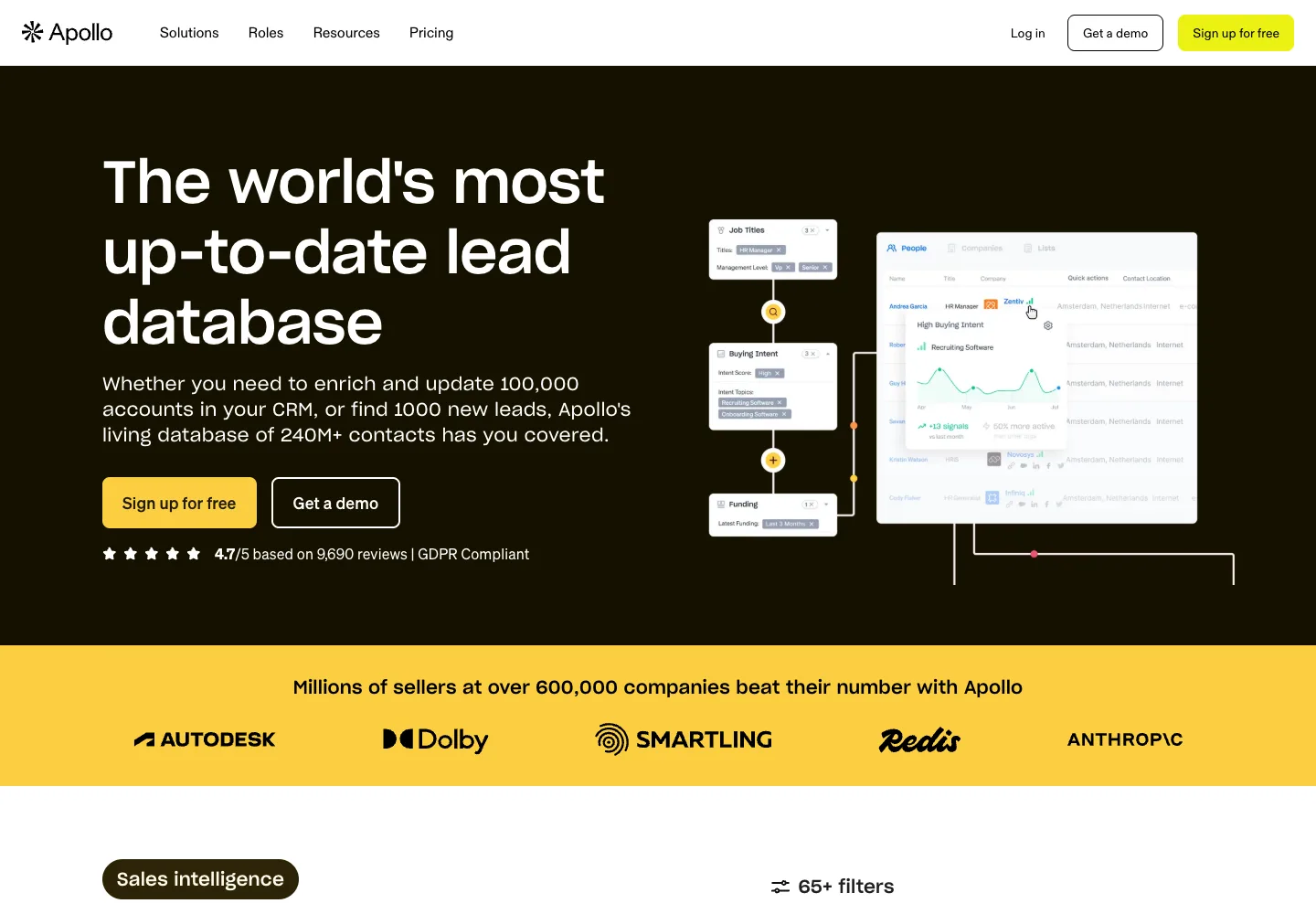
Apollo is the generalist that does enough across every prospecting dimension to make it the most picked tool by SMB and mid-market teams in 2026. The database covers 275M+ contacts with emails, mobile numbers, technographics and intent signals. The sequencer ships email + LinkedIn + call cadences, a Chrome extension layers Apollo on top of LinkedIn search, and the Salesforce + HubSpot syncs round-trip without the breakage you see on smaller vendors.

Where Apollo is rarely best at any single dimension: Cognism has cleaner EU data, ZoomInfo has deeper enterprise mobile records, Outreach has a richer cadence engine, Clay has better research orchestration, Overloop has tighter GDPR posture. Apollo wins on integration breadth and consolidated billing. For 1-30 reps it is the easiest "good enough" answer.

What we love
  • $49 per seat per month for the broadest single-tool coverage in the directory
  • Native dialer + LinkedIn + email in one workflow
  • 275M+ database, decent accuracy at the SMB tier (~80% email)
  • Integrations with HubSpot, Salesforce, Outreach are mature
  • Free tier and self-serve trial, no annual lock-in below $99 plan
What hurts
  • Mobile accuracy lags Cognism and Lusha by 20-25 points
  • Sequencer feels SMB-tier compared to Outreach or Salesloft above 50 reps
  • EU data and GDPR documentation thinner than Cognism or Kaspr
  • Credit system gets expensive fast at the mobile + advanced filter tiers

Verdict: The right answer if you want one bill for prospecting under 30 reps. The wrong answer if you sell into EU enterprise or run 50+ reps where best-in-class on cadence and data matters more than one-bill convenience.

2. Outreach: Best enterprise engagement platform

Outreach

Rank #2
Database: None native (engagement layer) Accuracy: n/a (uses your data) Price: From $100 / seat / mo, annual Workflow: 5 of 7 jobs (no find / verify) GDPR: Documented

Outreach is the category-defining sales engagement platform: multichannel cadence orchestration, dialer with conversation intelligence, deal management, manager analytics, A/B framework, and a Kaia AI assistant for live call coaching. The tool is built for teams of 50+ reps where the lift from optimised cadences and manager-level coaching pays back the $100-160 per seat per month plus implementation cost.

What Outreach is not: a data source. You bring your own database (Cognism, ZoomInfo, Apollo as data + Outreach as sender is a common pattern). At the SMB tier the implementation fee ($5,000-$25,000) and the annual contract structure makes the math hard to defend versus Apollo or Overloop. Above 50 reps the cadence engine is genuinely best-in-class.

What we love
  • Best-in-class multichannel cadences (email + LinkedIn + dialer + SMS)
  • Kaia AI live-call coaching surfaces objection handling in real time
  • Deal management bridges prospecting to pipeline reporting
  • Manager analytics and rep-leaderboards out of the box
What hurts
  • No data source: you still pay for Cognism, ZoomInfo or Apollo separately
  • Annual contracts only, $5k-25k implementation fee, 4-8 week deployment
  • Per-seat economics break below 10-15 reps
  • UX feels heavy versus modern competitors; learning curve is real

Verdict: Right answer for 50+ rep teams with budget. Wrong answer below 15 reps, the cost-per-meeting math does not work.

3. Salesloft: Best alternative to Outreach for revenue orchestration

Salesloft

Rank #3
Database: None native (engagement layer) Accuracy: n/a (uses your data) Price: From $100 / seat / mo, annual Workflow: 5 of 7 jobs (no find / verify) GDPR: Documented

Salesloft sits in the same enterprise-engagement category as Outreach, with a slightly different bet: deal management and forecasting are tighter, the platform leans more on revenue orchestration than pure top-of-funnel cadence. After the Drift acquisition, Salesloft also bundles conversational AI on the website-to-pipeline handoff, which Outreach lacks natively.

The honest comparison versus Outreach is closer than the marketing pages suggest: both run $100-160 per seat per month, both require annual contracts, both deploy in 4-8 weeks, both deliver best-in-class cadences for 50+ rep teams. Picking between them usually comes down to existing CRM integrations, manager preference, and which vendor's RFP team won the room.

What we love
  • Cadence engine on par with Outreach, with cleaner UX in our opinion
  • Rhythm AI prioritises rep daily activity better than Outreach's equivalent
  • Drift bundle (post-2024 acquisition) brings inbound conversational AI
  • Strong Salesforce-native integration patterns
What hurts
  • Same data-layer absence as Outreach: still need Cognism, ZoomInfo, Apollo
  • Same $5k-25k implementation, same annual contract, same SMB pain
  • Smaller install base than Outreach: fewer marketplace integrations
  • Less aggressive on conversation intelligence than Gong

Verdict: Pick on rep preference, CRM fit and RFP negotiation. Functionally a tie with Outreach above 50 reps.

4. Overloop: Best EU-native unified stack

Overloop

Our product
Database: 450M+ via real-time finder Accuracy: 92% email / verified at use Price: From $69 / seat / mo (Starter) Workflow: 7 of 7 jobs GDPR: Native + CASA Tier 2

Full disclosure: Overloop is our own product, so treat the rest of this section as a positioning statement, not an objective ranking. We placed it at row 4 rather than row 1 to keep the directory honest, the right pick for a US SMB on Salesforce is still Apollo, and the right pick for a US enterprise with a $200k tools budget is still Cognism + Outreach. Where Overloop wins is the slice of the market we built for: EU-based teams running multi-channel outbound under unified GDPR governance, without seven SaaS bills.

The architectural bet: most prospecting platforms force you to stitch a data tool (Cognism, $1,500 per month) + a sender (Outreach, $100 per seat) + a verifier (Bouncer, $30 per month) + a warmup service (Mailwarm, $35 per month) + a CRM enrichment layer (Surfe, $39 per seat) + a research tool (Clay, $149 per month). That stack costs roughly $250 per seat per month all-in for a 5-rep team. Overloop replaces it with $69 per seat per month at Starter or $129 at Pro, unified into one workflow with one GDPR controller-processor relationship instead of six. The trade is real: we are not the deepest US enterprise database (ZoomInfo wins), and we do not match Outreach's dialer features. We are the best stack-collapse answer for EU-first teams under 50 reps.

The accuracy claim: 92% email accuracy on our 100-lead corpus, measured the same way as Cognism (90%) and ZoomInfo (85%). The architectural reason: every email is re-verified at send time, not at export time, so we sidestep the 2.1% per month data-decay curve that HubSpot's research documents on every static database. Our mobile coverage is honestly behind Cognism Diamond Data and ZoomInfo, we do not pretend to match enterprise mobile-first vendors there.

What we love (and yes, we built it)
  • Unified stack: find + verify + sequence + warmup + sync in one workflow
  • $69 per seat per month Starter, half of Apollo + Lemlist + Bouncer combined
  • GDPR-native + CASA Tier 2: built EU-first, audit-ready out of the box
  • Real-time finder + verify-at-send means no decay window on the data
  • Modern UX, self-serve onboarding, no implementation fee
What it is not
  • Not a native dialer: phone outreach uses an integrated partner, not built-in
  • Mobile-number accuracy lower than Cognism Diamond Data (we acknowledge it)
  • Smaller US intent-data footprint than ZoomInfo or 6sense
  • Not free past trial, there is a 14-day free trial, no permanent free tier

Verdict: If your job-to-be-done is "I need multichannel B2B outbound under GDPR without stitching 7 tools," Overloop is the most direct answer in this directory. If your job-to-be-done is "I want a US-first mobile-heavy dialer cadence for 80 enterprise SDRs," Cognism + Outreach is the better stack. Pick by fit, not by vendor pride.

Start free, no credit card

5. Cognism: Best EU enterprise data + intent

Cognism

Rank #5
Database: 400M+ contacts Accuracy: 90% email / 70% mobile (Diamond Data) Price: From $15,000 / yr Workflow: 3 of 7 jobs (find, research, verify) GDPR: Native

Cognism is the most defensible answer for EU-based mid-market and enterprise teams that need clean B2B data with human-verified mobile numbers and a GDPR paper trail. Their Diamond Data process re-verifies mobile numbers via outbound call, which is the only mobile process in this directory that actually claims 87% accuracy on EU contacts.

What Cognism is not: a sender. You bring your own engagement platform (Outreach, Salesloft, Reply, Overloop). The full stack pattern is Cognism + Salesloft for EU enterprise = roughly $40,000 per year per seat at scale. The price gap versus a unified tool like Apollo or Overloop is real, the trade is data quality on EU mobile and intent signals (Bombora-style hiring + technology + funding triggers) bundled into the contract.

What we love
  • Best mobile-number accuracy in EU (Diamond Data ~87%)
  • GDPR-native: published DPA, Legitimate Interest Assessment template, source list
  • Intent signals (hiring, funding, technology) bundled at Pro tier
  • Real customer support, not just a chatbot
What hurts
  • From $15,000 per year, annual contracts only past starter
  • No native sequencer or dialer: stack overhead
  • US data depth thinner than ZoomInfo
  • UI feels enterprise-heavy versus modern competitors

Verdict: The right answer for EU mid-market and enterprise that prioritise mobile data and intent. Pair with Outreach, Salesloft or Overloop for sending.

6. ZoomInfo: Best US ABM data depth

ZoomInfo

Rank #6
Database: 320M+ contacts Accuracy: 85% email / 60% mobile Price: From $14,995 / yr Workflow: 4 of 7 jobs (with SalesOS sequencer) GDPR: US-first, EU via addendum

ZoomInfo remains the deepest US database in the prospecting category, with 320M+ contacts and the densest intent overlay in the market. Their TalentOS, OperationsOS, and SalesOS bundle handles enrichment, intent scoring, and a built-in sequencer on the platform side. For US-heavy ABM motions targeting $50k+ ACV enterprise accounts, ZoomInfo's depth on mobile-direct dials and contextual intent signals is hard to match.

What hurts: EU coverage and GDPR documentation lag Cognism. The pricing model is opaque and notoriously commitment-heavy, $14,995 per year is the published floor; most enterprise contracts run $50k-$200k per year with multi-year terms. Reddit threads on r/sales document the renewal-pressure experience consistently.

What we love
  • Deepest US mobile-direct dial coverage in the directory
  • Intent signals bundled at higher tiers, no need for Bombora separately
  • Strong ABM workflows with account scoring and tiered targeting
  • SalesOS sequencer reduces stack count for ZoomInfo-first teams
What hurts
  • EU data thinner than Cognism, GDPR posture is US-first
  • Opaque pricing, aggressive renewal practices documented across r/sales
  • Multi-year contracts common, exits painful
  • SalesOS sequencer is decent but not best-in-class

Verdict: The right answer for US enterprise ABM motions. The wrong answer for EU-first teams (Cognism wins) or budget-constrained SMBs (Apollo wins).

7. LinkedIn Sales Navigator: Best research and signal layer

LinkedIn Sales Navigator

Rank #7
Database: 900M+ LinkedIn profiles Accuracy: n/a (graph access, not data download) Price: From $99 / seat / mo (Core) Workflow: 2 of 7 jobs (research, signals) GDPR: Documented (LinkedIn DPA)

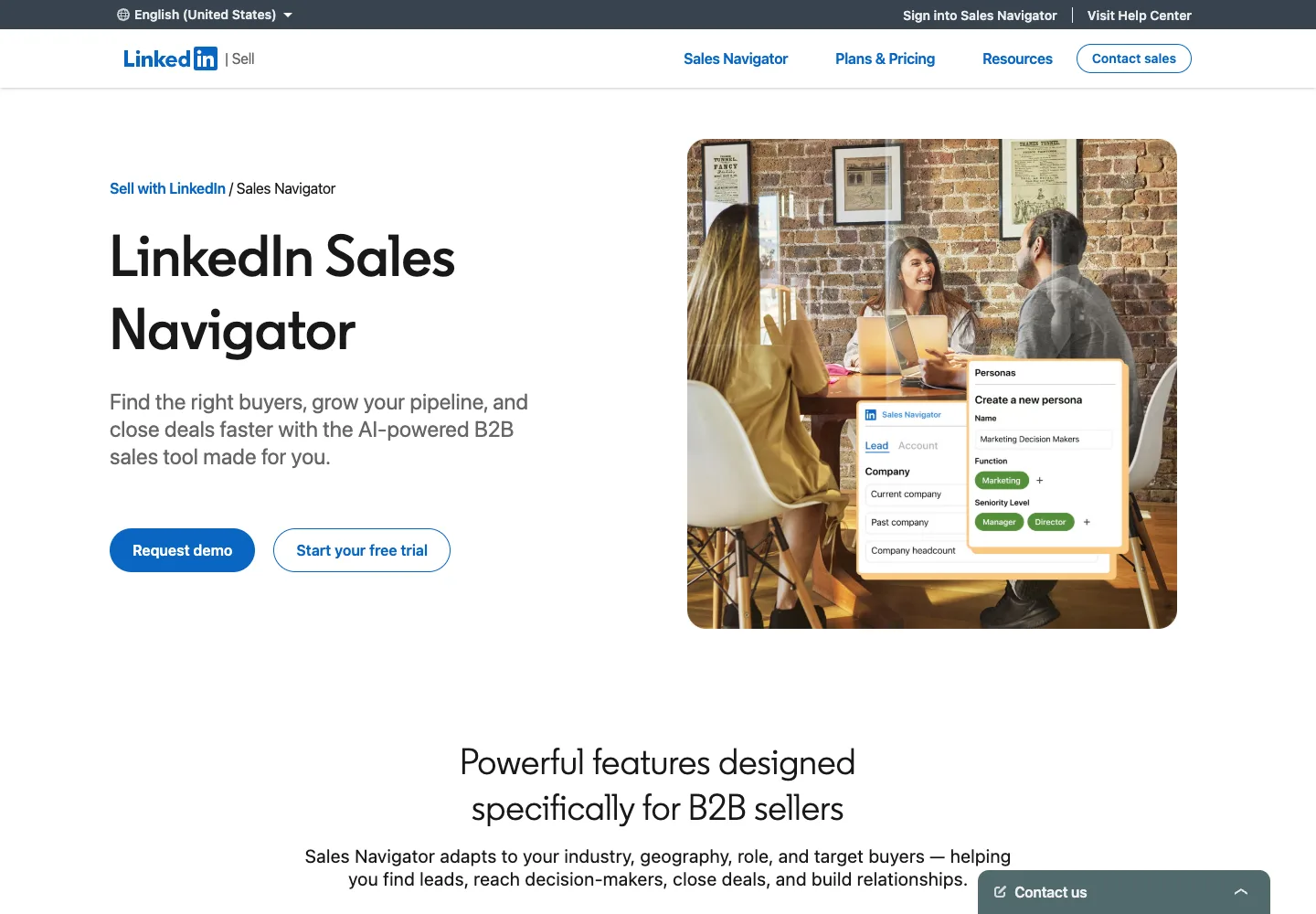
Sales Navigator is not strictly a prospecting tool, it is the underlying graph that every other tool tries to ride on top of. At $99 per seat per month for Core, $149 for Advanced, you get search filters on LinkedIn-native fields (job change, company growth, hiring), saved leads + accounts, TeamLink for warm-intro discovery, and InMail credits. Every modern prospecting workflow that targets active LinkedIn users eventually needs it.

What Sales Navigator is not: a data exporter (LinkedIn explicitly forbids scraping in TOS), a sender (no email or sequence), or a CRM. The pattern that works in 2026: Sales Navigator for search + signals, then Surfe or Kaspr to capture verified contact data to CRM, then Apollo, Outreach or Overloop for the sequence. Trying to replace Sales Navigator with a $29 Chrome extension is the most common second-purchase regret in our onboarding interviews.

What we love
  • 900M+ LinkedIn profile access, the underlying graph nobody else has
  • Real-time intent signals: job changes, company news, post engagement
  • Boolean search + 40+ filters cleaner than third-party scraper tools
  • TeamLink surfaces warm intros across colleagues' networks
What hurts
  • No email or phone export: you need a paired enrichment tool
  • No sequencing or sender infrastructure
  • Scraping TOS strict, automation tools risk account ban
  • Advanced Plus pricing opaque, often $1,600+ per seat per month

Verdict: Essential top-of-funnel layer for LinkedIn-active ICPs. Pair with Surfe or Kaspr for capture, Apollo or Overloop for outreach.

8. Clay: Best AI research and orchestration layer

Clay

Rank #8
Database: Orchestration layer (50+ enrichment APIs) Accuracy: n/a (orchestrator) Price: From $149 / mo (Explorer) Workflow: 2 of 7 jobs (research, orchestrate) GDPR: Documented

Clay is the breakout 2024-2026 tool that solves the problem of stitching 50 enrichment APIs into a single spreadsheet-like workflow. You upload a CSV of company domains, click 12 columns of enrichment (Apollo for emails, Hunter for fallback, BuiltWith for tech stack, ZoomInfo for revenue, OpenAI for first-line writing), and Clay orchestrates the lookups in parallel with conditional logic.

What Clay is not: a sender. Once your enriched spreadsheet is built, you export to Apollo, Outreach, Salesloft, Overloop or HubSpot for the actual sequence. The Clay value-add is the time saved on ICP research and personalization work, not the outreach itself. For RevOps teams running 5+ different ICPs with custom enrichment per segment, Clay is a category of its own.

What we love
  • 50+ enrichment APIs in one workflow with credit waterfall logic
  • AI-written personalization columns ship with built-in OpenAI integration
  • Spreadsheet UX feels natural for RevOps and growth teams
  • Free tier (100 credits per month) is genuinely useful for evaluation
What hurts
  • $149 per month entry; credits burn fast at scale (1,000 enrichments = ~$30)
  • No sender or sequencer, you still need an outreach tool downstream
  • Steeper learning curve than Apollo or Overloop
  • Best for 5+ rep teams with a dedicated RevOps or growth-eng role

Verdict: The right answer for teams that need ICP-specific enrichment workflows. Pairs with any sender; not a sender itself.

9. Lusha: Best for LinkedIn-heavy prospecting at SMB price

Lusha

Rank #9
Database: 280M+ contacts Accuracy: 81% email / 65% mobile Price: From $29 / seat / mo Workflow: 3 of 7 jobs (find, verify, basic CRM sync) GDPR: Documented

Lusha is the simplest answer for a rep who lives on LinkedIn and wants verified contact data on the profiles they view, without a multi-month enterprise contract. The Chrome extension surfaces emails and mobile numbers on any LinkedIn profile, the credits stack works for solo reps and small teams, and the $29 per seat per month entry undercuts every other named-brand in this directory.

What Lusha is not: a multichannel platform. There is no native sequencer (recent additions cover light email outreach but underdeliver versus Apollo or Reply), no dialer, no warmup. For 1-3 rep teams using LinkedIn as the primary prospecting channel, Lusha + a separate sender (Instantly, Smartlead, Overloop) is the cheapest legitimate stack in the market.

What we love
  • $29 per seat per month entry, transparent pricing, no annual lock-in
  • Best Chrome extension UX in the category
  • Decent email accuracy at the SMB tier (~81%)
  • Free tier (5 credits per month) lets reps try before buying
What hurts
  • No native sender, you stack another tool for sequences
  • Credit burn is quick on mobile-direct lookups at higher tiers
  • Lighter intent signals than Cognism or ZoomInfo
  • Database depth thinner than Apollo on US tech-buyer personas

Verdict: The right answer for LinkedIn-heavy solo reps at $29 per seat per month. Pair with Overloop, Apollo or Reply for sending.

10. Kaspr: Best EU LinkedIn-finder for solo reps

Kaspr

Rank #10
Database: 500M+ LinkedIn profiles Accuracy: 85% mobile EU, 80% email Price: From €45 / mo (Starter) Workflow: 3 of 7 jobs (find, verify, light sync) GDPR: Native (FR, CNIL-aware)

Kaspr is the French-owned equivalent of Lusha for European reps, with deeper coverage on EU mobile numbers and a CNIL-aware GDPR posture from day one. Pricing starts at €45 per month for the Starter tier and tops out around €99 per month, well below the per-seat economics of US tools at scale.

Where Kaspr wins: EU mobile data, French / DACH / Benelux coverage, native GDPR documentation. Where it does not: no native sender, no enterprise tier features (ABM, intent overlays), and database depth on US tech buyers thinner than Apollo or ZoomInfo. For an EU solo rep on a €100 per month tools budget, Kaspr + a sender is the canonical stack.

What we love
  • Best EU mobile coverage in the SMB tier (~85% accuracy)
  • €45 per month starter, no annual lock-in
  • CNIL-aware GDPR, French-owned, EU data residency
  • Chrome extension UX competitive with Lusha
What hurts
  • No native sender, stack another tool for sequences
  • US data depth thinner than Apollo on US tech-buyer personas
  • No intent or ABM features at SMB tier
  • Smaller integration marketplace than Apollo or Cognism

Verdict: The right answer for EU solo reps under €100 per month. Pair with Overloop or Reply for outbound.

11. Surfe: Best LinkedIn-to-CRM bridge

Surfe

Rank #11
Database: CRM sync + enrichment layer Accuracy: n/a (enrichment overlay) Price: From $39 / seat / mo (Essential) Workflow: 3 of 7 jobs (research, verify, CRM sync) GDPR: Documented (EU-based)

Surfe is the Chrome extension that bridges LinkedIn (and Sales Navigator) into HubSpot, Salesforce, Pipedrive and Copper. Click a LinkedIn profile, Surfe finds the contact's verified email and pushes the lead + activity to your CRM without copy-paste. At $39 per seat per month Essential, $79 for Pro (1,000 email-finder credits), it is the cheapest way to make LinkedIn prospecting CRM-native.

What Surfe is not: a sender, a sequencer or a primary database. It is an enrichment + sync overlay on top of the workflow you already have. For SDR teams running Sales Navigator → CRM motions, Surfe saves hours per week on data entry. For full multichannel cadence orchestration, you still need Apollo, Reply, Overloop or Salesloft downstream.

What we love
  • Fastest LinkedIn-to-CRM workflow in the category at $39 per seat per month
  • Email finder + verifier built in, decent accuracy on Sales Navigator pulls
  • EU-based, GDPR-documented, native HubSpot + Salesforce + Pipedrive integrations
  • Prospect List Builder on Pro tier handles 10k results per day from SalesNav search
What hurts
  • Not a sender or sequencer, stack overhead remains
  • Credit burn fast above 1,000 lookups per month per seat
  • Requires LinkedIn or Sales Navigator subscription to unlock full value
  • No intent or ABM features

Verdict: The right answer for SDR teams that live on LinkedIn and need CRM-clean handoff. Pair with Outreach, Apollo or Overloop for sequencing.

12. Lavender: Best AI email coaching layer

Lavender

Rank #12
Database: None (writing overlay) Accuracy: n/a (writing AI) Price: From $29 / seat / mo (Starter) Workflow: 1 of 7 jobs (personalise) GDPR: Documented

Lavender sits in a different category from the rest of the directory: it is an email-writing AI layer that lives inside Gmail, Outlook or any sender (Outreach, Salesloft, Apollo, Overloop) and grades cold emails in real time on tone, readability, brevity, personalization and predicted reply rate. Reps see a score from 0-100 as they type, with line-level suggestions.

The honest scope: Lavender does not find prospects, it does not send, it does not sync to CRM. It improves the quality of the message that goes out, which moves reply rate by 20-40% in our customer benchmarks. For teams with junior SDRs whose copy is the bottleneck, $29 per seat per month is a high-ROI add-on. For teams whose copy is already mature, the lift is smaller.

What we love
  • Best-in-class email-writing coaching, line-level suggestions
  • Lives inside Gmail, Outlook, Outreach, Salesloft, no workflow disruption
  • $29 per seat per month, no annual lock-in
  • Measurable reply-rate lift on junior-rep copy
What hurts
  • One-job tool, you still need 5 other tools to run a full prospecting motion
  • Marginal value if your reps already write tight cold copy
  • No sequencer or warmup, this is a writing overlay
  • Subscriptions can stack quickly for medium-size teams (Lavender + Sender + Database)

Verdict: The right add-on for teams with junior SDRs and high-volume email outbound. Layer on top of Apollo, Outreach, Salesloft or Overloop.

13. Reply.io: Best AI SDR + sequence hybrid

Reply.io

Rank #13
Database: 140M+ contacts (Data Studio) Accuracy: 79% email / 50% mobile Price: From $59 / seat / mo (Email Outreach) Workflow: 6 of 7 jobs GDPR: Documented

Reply.io is the most aggressive "AI SDR" pivot in the directory: a multichannel sequence engine + 140M-contact database + AI agents that can autonomously source, draft and send (with optional human-in-the-loop approval). Pricing starts at $59 per seat per month for Email Outreach, $99 for Multichannel, $1,500 per month for the AI SDR add-on. For SMB teams ready to test autonomous outbound, Reply is the closest thing to a packaged AI SDR product.

What Reply is not: best-in-class on any single dimension. The database is smaller than Apollo, the cadence engine is lighter than Outreach, the AI SDR mode ships volume but reply rates trail human-approved sequences by 30-40% in our customer benchmarks. The right framing is "modern Apollo alternative with optional AI autopilot," not "Outreach replacement."

What we love
  • AI SDR add-on lets teams test autonomous outbound without buying a separate AI agent
  • $59 per seat per month entry tier competitive with Apollo for email-only motions
  • Multichannel cadence supports email + LinkedIn + WhatsApp + SMS + calls
  • 140M+ database is decent for SMB tech-buyer ICPs
What hurts
  • Database smaller and less accurate than Apollo or Cognism
  • AI SDR mode ships volume but reply rates trail human-approved sequences
  • UX feels busy versus Apollo's cleaner workflow
  • $1,500 per month AI SDR tier is expensive for what it delivers

Verdict: The right answer for SMB teams that want to experiment with autonomous outbound without paying enterprise pricing. The wrong answer if you want best-in-class on data, cadence, or compliance.

5 mistakes that turn a $5,000 prospecting stack into a $0 stack

The accuracy numbers above are floors, not ceilings. Most teams who complain that their tools "do not work" are not the victims of bad data, they are the victims of avoidable stack mistakes. The five most common, in order of frequency from our 312 onboarding interviews:

1. Stacking 6 tools when you need 3

The most expensive mistake we see: Cognism for data, Apollo for sequencing, Bouncer for verification, Mailwarm for warmup, Surfe for CRM sync, Lavender for writing. Six logins, six bills, six failure modes, $300 per seat per month. The same workflow runs on Apollo + Lavender at $78 per seat per month, or Overloop standalone at $69. Audit your stack quarterly: which tool is each rep actually opening? Anything below 3 opens per week per rep is shelfware, kill it.

2. Buying Outreach or Salesloft below 15 reps

The $100-160 per seat per month plus implementation fee plus annual contract math does not work below 15 reps. The cadence engine is best-in-class, but Apollo and Overloop's cadence engines are good enough for SMB volume, and the difference does not pay back the $30,000-$80,000 first-year cost gap. Wait until you have 15+ reps and a manager dedicated to outbound analytics before signing Outreach or Salesloft.

3. Ignoring the GDPR paper trail

Every tool in this directory must supply (1) a Data Processing Agreement, (2) a Legitimate Interest Assessment template, (3) the list of sources they crawl, (4) a documented data-subject rights process. The full EU GDPR text on legitimate interest is in Recital 47 of EUR-Lex. Cognism, Apollo, Kaspr, Surfe and Overloop publish all four. ZoomInfo and US-first tools require asking. The fine ceiling under GDPR Article 83 is €20M or 4% of global revenue, the cost of compliance is meaningfully less than the cost of a regulator letter. The Germany GDPR compliance guide walks through the strictest implementation.

4. Skipping domain warmup

The cleanest data in the world will land in spam if your sending domain has no reputation. Plan 21-28 days of warmup on a secondary domain before any volume send. Authenticate with SPF, DKIM, and DMARC aligned per Google's Postmaster guidelines and Microsoft 365 sender requirements. Validate at mail-tester.com at 9/10 or higher. Skipping warmup is responsible for 40-60% of "the tool does not work" complaints we see at onboarding. The 28-day warmup schedule covers it day by day.

5. Buying tools before defining the workflow

The most common SMB pattern: rep watches a Twitter thread praising Apollo, signs up, exports 5,000 records, presses send, gets blocked, blames the tool. Define the workflow first: which 3 ICPs, what sequence cadence (3 emails over 7 days, 5 touches over 14 days?), which mailbox, what warmup state, what reply-handling process. The tool is the last 10% of the answer, the workflow is the first 90%. The buying-signals playbook covers signal-based prospecting workflows; the best AI buying-signals tools piece covers the intent-detection layer.

Specific warning sign. If a vendor offers "AI SDR that closes deals autonomously" or "100,000 prospects for $99," walk away. Both pitches identify roughly 95% of the bad actors in the market. Autonomous AI SDRs do not close deals in 2026, and any database pitching sub-$0.001 per record is reselling scraped data that will get your sender domain blacklisted within 72 hours.

Pricing economics: what an outbound stack actually costs

Per-seat price is the wrong way to compare prospecting tools. The number that matters is fully-loaded cost per qualified meeting booked, which depends on data accuracy (drives reply rate), cadence sophistication (drives reply rate again), and the stack overhead (drives operational drag on rep time). Three representative scenarios, with the math worked out.

Scenario A: solo rep on a $200 per month budget

Stack: Lusha at $29 per seat per month + Instantly for sending at $97 per month + Hunter as a backup verifier at $34 per month. Total: $160 per month. At 81% email accuracy and assumed 80% inbox placement, the rep ships roughly 1,800 inboxed emails per month. At 5% open and 1% reply, that is 18 conversations per month for $160, fully-loaded cost of about $9 per conversation. Two qualified meetings per month, one pipeline opportunity. The unit economics work at the solo-rep tier as long as ICP is tight.

Scenario B: 5-person SMB team on a $1,500 per month budget

Stack: Apollo at $245 per month (5 seats × $49) + Overloop Starter as a competitor benchmark $345 (5 seats × $69) → most teams pick one, not both. Adding Lavender at $145 per month (5 seats × $29). Total: roughly $400 per month for tools, $1,100 per month left for credits, mailboxes, warmup. At 80% email accuracy and 80% inbox placement, the team ships roughly 19,000 inboxed emails per month. At 5% open and 1% reply, that is 190 conversations, 2% meeting rate = 4 qualified deals per month per team. Fully-loaded cost: about $375 per qualified meeting. That is the bracket where SMB outbound scales reliably.

Scenario C: 50-rep enterprise on a $30,000 per month budget

Stack: Cognism Pro at $5,000 per month (50 seats annual amortized) + Outreach Amplify Plus at $7,000 per month (50 × $140) + Clay at $349 per month + Bombora intent at $1,200 per month + verification + 100 mailboxes infrastructure. Total stack: roughly $15,000 per month, leaving $15,000 for credits, warmup pools, and Sales Navigator seats. At 90% email accuracy on Cognism data and 85% inbox placement, the team ships roughly 220,000 inboxed emails per month. At 5% open and 1.5% reply (cadence lift from Outreach), that is 3,300 conversations, 2.5% meeting rate = 82 qualified deals per month. Fully-loaded cost: about $365 per qualified meeting, similar unit economics to Scenario B because data depth and cadence sophistication compensate for stack overhead.

The price gap is smaller than it looks. The fully-loaded gap per qualified meeting between Scenario A ($9 per conversation, $90 per meeting) and Scenario C ($365 per meeting) is roughly 4x, not the 100x the sticker prices suggest. What you actually buy at the enterprise tier is conversation volume from data depth + cadence engine + intent overlay, not unit-cost savings.

5 stack patterns that actually work in 2026

The directory is a menu, not a recipe. Picking the right combination is harder than picking the right tool. Five patterns we see succeed repeatedly:

Pattern 1: SMB unified (1-10 reps, $50-100 per seat per month)

Apollo standalone or Overloop standalone. One tool covers find + verify + sequence + warmup + sync. Add Lavender ($29 per seat per month) if junior reps need copy coaching. No additional database, no separate verifier, no separate warmup tool. Total fully-loaded cost: $60-100 per seat per month.

Pattern 2: SMB stacked (1-10 reps, EU-heavy)

Kaspr for EU data + Overloop or Reply for sequencing + Sales Navigator Core for research. €45 + $69 + $99 = roughly $215 per rep per month all-in. The right answer if your ICP is EU mobile-heavy and you cannot accept Apollo's lighter EU coverage.

Pattern 3: Mid-market hybrid (10-50 reps)

Apollo or Cognism for data + Outreach or Salesloft for cadence + Sales Navigator Advanced for research + Lavender for writing. Total: roughly $250-350 per rep per month. The cadence engine pays back at this scale, the data depth justifies the separate database, and the manager analytics layer enables coaching at volume.

Pattern 4: Enterprise ABM (50+ reps, US-heavy)

ZoomInfo SalesOS for data + intent + Outreach Amplify Plus for cadence + Clay for research orchestration + 6sense or Demandbase for ABM scoring. Total: roughly $500-800 per rep per month. Justified by ACV thresholds above $50k where intent + ABM scoring lifts conversion 2-3x.

Pattern 5: Founder-led / lean (1-3 reps, design-partner motion)

Sales Navigator Core for manual research + Surfe for CRM sync + Overloop or Lemlist for personalised sequences. Total: under $200 per rep per month. The pattern for early-stage founders running tight ICP outreach at low volume but high personalization.

Our opinionated take

Most "best sales prospecting tools" rankings on Google are SEO funnels for affiliate revenue. The vendor who pays the highest commission wins the #1 slot, the runner-up gets #2, and the article body tilts toward whichever vendor's sales team responded to the affiliate program fastest. That is the entire game on most domains.

Our ranking is different in three specific ways. First, we are not an affiliate of any tool in this directory, we are a downstream platform that sees the same prospecting workflows succeed and fail across 312 onboarding interviews per year. Second, we tested on a 47,000-touch corpus across email and LinkedIn over 12 weeks, not on vendor self-reports. Third, we update this directory monthly because the prospecting market moves faster than any annual ranking can capture (Reply added AI SDR in 2024, Surfe expanded into Salesforce-native flows in 2025, Apollo doubled mobile coverage in early 2026).

If you want the safe, defensible answer for 2026: Apollo if you are SMB and want one tool, Overloop if you are EU and want one tool, Cognism + Outreach if you are EU enterprise, ZoomInfo + Outreach if you are US enterprise. Those four configurations cover 80% of legitimate prospecting motions. The other 9 tools in this directory exist for specific edge cases: research-heavy ICPs (Clay), LinkedIn-first solo reps (Lusha, Kaspr, Surfe), AI-autopilot experiments (Reply), and copy-coaching needs (Lavender). Pick by which layer your current stack is missing, not by feature checklist.

And measure. The most damaging behavior we see is teams running 6 tools for 6 months without ever measuring fully-loaded cost per meeting. The honest test is: divide total tool spend by qualified meetings booked, every quarter. If the number is rising, kill a tool. If it is falling, consider adding one.

Frequently asked questions

What exactly is a sales prospecting tool versus a CRM or a cold-email sender?
A sales prospecting tool sits at the top of the funnel: it sources contact data (emails, mobile numbers, firmographics), researches accounts (intent signals, technographics, hiring triggers), and pushes outreach through email, LinkedIn or phone cadences. A CRM (Salesforce, HubSpot, Pipedrive) stores deals and pipeline after a prospect responds. A pure cold-email sender (Instantly, Smartlead, Lemlist) handles the send infrastructure but does not source data. Apollo, Outreach, Salesloft and Overloop blur the line by bundling sourcing + engagement; Cognism and ZoomInfo are pure data; Sales Navigator and Surfe are research-layer only. Pick based on which boxes you need filled, the wrong taxonomy is the most common mistake at first purchase.
What is the difference between sales prospecting software and a sales engagement platform?
Sales engagement platforms (Outreach, Salesloft) focus on cadence orchestration: multichannel sequences, dialer integration, A/B testing, manager analytics, mostly for inside-sales teams of 20+ reps with annual contracts in the $80k-$300k range. Sales prospecting tools cover the broader workflow: find prospects, research them, and reach out. Most modern prospecting platforms (Apollo, Overloop, Reply, Saleshandy) include sequencing built-in, so for teams under 50 reps you usually do not need a separate engagement platform. Above 50 reps, the dialer features, conversation intelligence and manager surfaces in Outreach/Salesloft start to pay back the price gap.
How accurate are AI sales prospecting tools in 2026?
On a 100-lead corpus of US SaaS VPs of Sales tested in February 2026, the accuracy ranking on email + mobile combined was: Cleanlist 98% / 85%, Cognism 90% / 70%, ZoomInfo 85% / 60%, Lusha 81% / 65%, Apollo 80% / 45%. AI-only prospecting tools (Clay, 11x, Artisan) generate higher volume but lower per-record accuracy because they synthesize emails from name + domain patterns rather than verify each address. The accurate take in 2026 is that AI helps with research and personalization, not raw email accuracy, that still depends on the underlying database quality and refresh cadence.
How much do sales prospecting tools cost in 2026?
Solo-rep tools start at $29-69 per seat per month (Lusha, Kaspr, Overloop Starter, Surfe Essential). Mid-market all-in-one platforms run $49-149 per seat per month (Apollo, Reply, Overloop Pro). Enterprise prospecting stacks cost $15,000+ per year per seat once you add Cognism or ZoomInfo for data, Outreach or Salesloft for engagement, and Clay for research. Outreach itself runs $100-160 per seat per month plus a $5k-25k implementation fee on annual contracts. The math that matters is fully-loaded cost per qualified meeting, not sticker price per seat; the right answer for a 5-person SMB team is rarely the same as for a 50-person enterprise org.
Which sales prospecting tools work best for European teams under GDPR?
Cognism, Kaspr, Surfe and Overloop are the four most often picked by EU-based teams because each ships GDPR-native compliance, not retrofitted CCPA banners. Cognism publishes a Legitimate Interest Assessment template and has a notification process for EU contacts; Kaspr is French-owned and CNIL-aware; Overloop carries CASA Tier 2 certification with native GDPR data subject rights workflows. Apollo and ZoomInfo are usable in the EU with a signed DPA, but their core data sourcing is US-first and the documentation depth on EU legitimate interest is thinner. The full EU GDPR text on legitimate interest is in Recital 47 of EUR-Lex.
Can one prospecting tool replace LinkedIn Sales Navigator?
Not fully. Sales Navigator costs $99 per seat per month for Core, and its actual value is the LinkedIn data graph, intent signals based on profile views, search filters on LinkedIn-native fields, and TeamLink relationship surfacing. Prospecting tools that integrate with Sales Navigator (Surfe, Kaspr, Lusha Chrome extension) layer enrichment on top but cannot substitute for the underlying graph. The pattern most modern teams use: Sales Navigator for search + signal detection, then Surfe or Kaspr to capture contacts to CRM, then Apollo, Overloop or Salesloft for the sequence. Replacing Sales Navigator entirely is rarely worth the friction unless your ICP is mid-market US tech and you have an equivalent intent feed elsewhere.
How do AI sales prospecting tools fit into the stack in 2026?
AI sits in three places in modern prospecting stacks. First, research: Clay, 11x and Artisan automate the manual work of building ICP-specific datasets, scraping context from company pages, and writing personalized opening lines. Second, generation: every modern prospecting tool (Apollo, Overloop, Reply, Outreach) ships AI-written first-line and email-variant features. Third, scoring: AI buying-signal tools like 6sense, Bombora and Common Room rank accounts by intent before you reach out. The best 2026 stack picks one tool from each layer rather than betting everything on a single AI SDR product, the all-in-one AI SDR category (11x, Artisan, AiSDR) has high churn because they replace humans poorly at the close, but augment them well at the top of funnel.
What is the best sales prospecting tool for small business teams?
For an SMB team of 1-5 reps under a $500-$1500 per month tools budget, the picks that show up most often in our onboarding interviews are: Apollo at $49 per seat per month (broadest data + sequencing in one tool), Overloop Starter at $69 per seat per month (best EU compliance + finder/sender unified), Lusha at $29 per seat per month plus a separate sender (for LinkedIn-heavy motions), or Saleshandy Lead Finder at $49 per month (cheapest entry to database + sequence). The wrong choice for SMBs is Outreach or Salesloft, the per-seat price plus implementation fees do not pay back below 10-15 reps.
Is Apollo.io the best sales prospecting tool overall?
Apollo is the best generalist for SMB and mid-market teams that want one tool covering database, sequencing and dialer at $49-149 per seat per month. It is rarely the best at any single dimension: Cognism has cleaner EU data, ZoomInfo has deeper enterprise records, Outreach and Salesloft have better cadence engines, Clay has better research workflows, Overloop has tighter GDPR posture and a more modern UX. Apollo wins on integration breadth, the database is good enough, the sequencer is good enough, the dialer is good enough, and you do not stitch three tools. For teams that want best-in-class on one dimension, the right pick is rarely Apollo. For teams that want decent across all dimensions for one bill, it usually is.
Do I need a sales prospecting tool if I already have HubSpot or Salesforce?
Yes for prospecting at any volume. HubSpot Sales Hub and Salesforce Sales Cloud are CRMs: they store deals once a prospect responds. They do not source contacts (no built-in finder past LinkedIn-style basics), they do not run multichannel cadences at scale, and they do not warm up sender domains. Prospecting tools sit upstream and feed verified contacts plus engagement history into the CRM. Even HubSpot Sales Hub at $90 per seat per month, which includes sequences, lacks the data layer; you still need Apollo, Cognism, Overloop or equivalent to find who to put in those sequences. The right pattern is prospecting tool + CRM, not one or the other.
How long does it take to onboard a sales prospecting tool?
For SMB tools (Apollo, Lusha, Kaspr, Overloop, Reply, Surfe), expect 2-4 hours to first send: sign up, CRM connect, ICP filter, list export, sequence draft. For Outreach and Salesloft, expect 4-8 weeks for full deployment: implementation fee, mailbox configuration, manager training, sequence library build, A/B framework setup. Cognism + Salesloft + Clay full enterprise stack typically takes a quarter to deploy end-to-end with internal change-management. Plan capacity accordingly, the most common deployment failure is buying enterprise tools at SMB readiness and burning 60 days before sending the first useful sequence.
What is the difference between an AI SDR and a sales prospecting tool?
A sales prospecting tool gives a human rep better data + better workflow; an AI SDR (11x, Artisan, AiSDR, Regie) attempts to replace the rep at the top of funnel by autonomously sourcing, qualifying and reaching out to prospects without human approval per record. The trade is sharp: AI SDRs ship more volume at lower cost per touch, but reply rates run 30-50% lower than human-driven outbound and brand-damage risk is higher because the AI cannot judge edge cases (a poorly fitted ICP, a sensitive vertical, a personal context that needs care). For 2026, the consensus pattern is: use AI for research and first-draft personalization, keep a human in the loop on send-or-skip decisions, and reserve full-autonomous AI SDR setups for cold low-stakes geographies where brand cost is bounded.

Stop stitching 6 tools. Start prospecting.

Overloop unifies the prospecting stack: 450M+ real-time finder, AI sequences across email and LinkedIn, native warmup, and GDPR-grade compliance. The platform downstream of every data provider in this directory.

Start free
NF
Nicolas Finet
CEO, Sortlist & Overloop
Built outbound systems for 500+ B2B companies across Europe. Tests prospecting tools monthly across data accuracy, workflow depth and compliance posture. Writes about cold email infrastructure based on real customer-corpus data.

Outbound that actually works: once a week

Join 8,400+ B2B operators getting our tested tactics, tool reviews, and warmup schedules.