





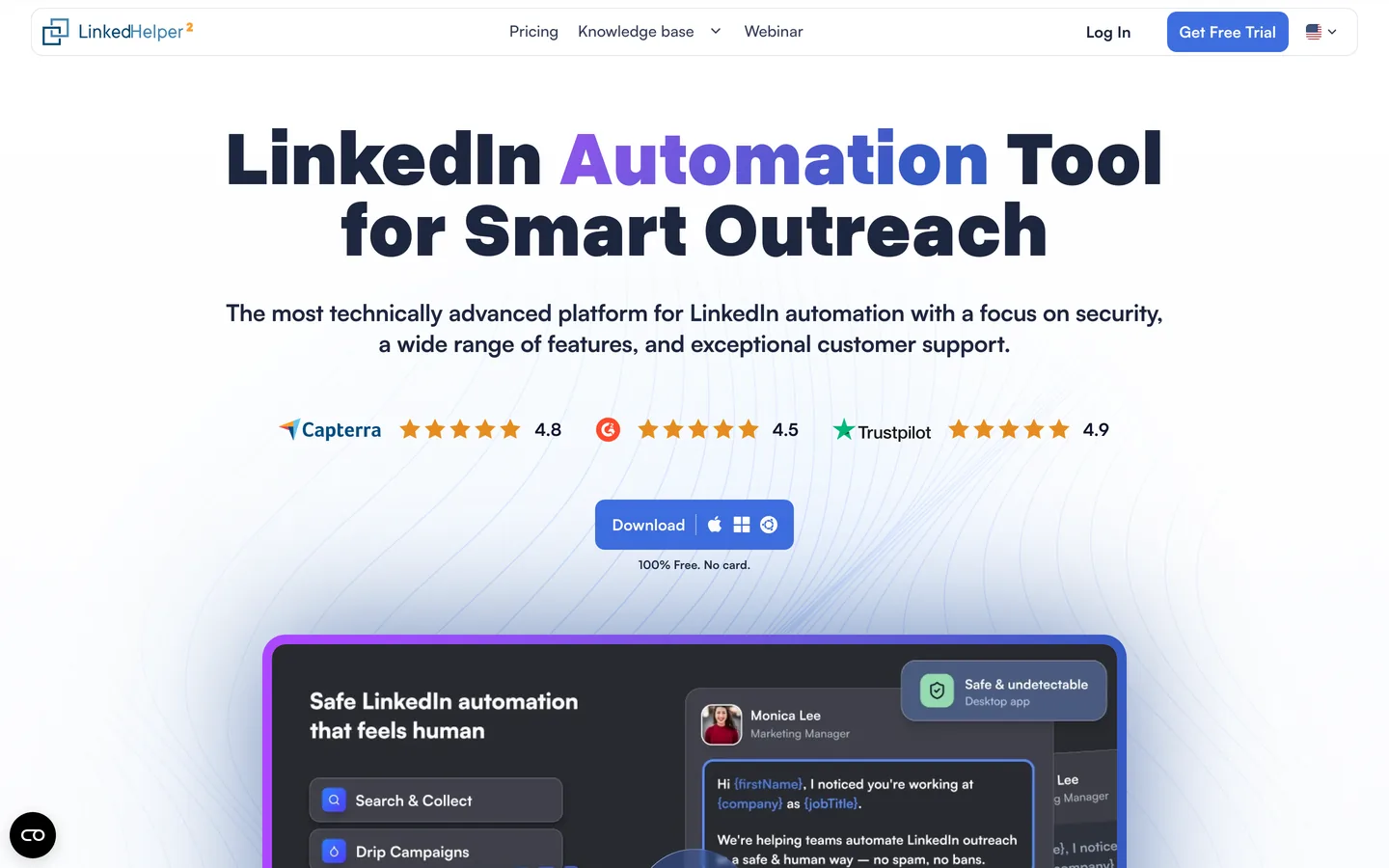
Linked Helper is a LinkedIn automation tool priced from $15/month (local desktop) or $29.90/month (cloud) for connection requests, messages, profile visits, and data scraping. Based on our hands-on research, it is a strong option for solo users on a tight budget but narrower on multichannel: no native email and no built-in AI personalization. Compared with alternatives like Overloop ($69/mo, cloud, LinkedIn + email + AI in one inbox), Linked Helper is cheaper but focuses on a single channel.
Full disclosure: We're Overloop, a direct competitor to Linked Helper. We build AI-powered outbound sales software that includes LinkedIn automation. This review is based on hands-on research of Linked Helper together with its public documentation and pricing, to give you an honest comparison. We'll be upfront about where they beat us and where we think we do better.
Linked Helper is a solid, affordable LinkedIn automation tool that starts at $15/month for the local desktop app, with a cloud version from $29.90/month. It's best for solo operators and small teams who only need LinkedIn outreach and want to keep costs low. It scores 4.5/5 on G2 (700+ reviews) and 4.9/5 on Capterra. The data scraping is best-in-class at this price point. The main drawbacks are that the local version only runs while your computer is on (the cloud plan removes this), it's limited to LinkedIn (no email channel), and, like any LinkedIn automation tool, it requires sensible daily limits to protect your account.
Linked Helper (also known as Linked Helper 2) has been around since 2016. It's one of the oldest LinkedIn automation tools on the market, with a large user base across 300,000+ users. If you're researching LinkedIn automation, it will show up on every list you read. We compared it directly against our own tool. Here's what we found.
- Pricing: $15/mo (Standard) and $45/mo (Pro), annual billing drops to $8.25 and $24.75. License-based, no auto-renew.
- Channel: LinkedIn only. No email, no phone, no Twitter, no unified inbox.
- Architecture: Desktop app. Campaigns stop when your computer sleeps or your internet drops.
- Safety: Real ban risk above 30 connection requests per day. Simulation approach is safer than browser extensions but riskier than cloud-based proxies.
- Best alternative: Overloop ($69/mo Starter) for teams that need LinkedIn plus email plus AI in one cloud platform, with multi-account support and a unified inbox.
- Verdict: 3.5/5. Best fit for solo operators on a tight budget who only run LinkedIn outreach.
What Linked Helper Does
Linked Helper is a desktop application (not a browser extension, despite what some people think) that automates LinkedIn actions. You download it to your computer, connect your LinkedIn account, and it runs campaigns from your machine. [LinkedIn]
The core functionality covers:
- Automated connection requests with personalized messages
- Follow-up message sequences triggered by acceptance, reply, or time delay
- Profile visits and skill endorsements to warm up prospects before outreach
- Data scraping and export from LinkedIn search results, groups, and events
- Built-in email finder that pulls emails from LinkedIn profiles (Pro plan only)
- Built-in CRM with pipeline views and tagging (Pro plan only)
- InMail and group messaging automation
The tool works with regular LinkedIn accounts, Sales Navigator, and Recruiter Lite. It's compatible with Windows, macOS, and Ubuntu. There's a 14-day free trial with all features unlocked, no credit card required.
Linked Helper Pricing (2026)
Linked Helper uses a license-based model. No subscriptions. You buy a license for a fixed period, and when it expires, you buy a new one manually. No auto-billing. [LinkedIn]
| Plan | 1 Month | 3 Months (-11%) | 6 Months (-33%) | 12 Months (-45%) |
|---|---|---|---|---|
| Standard | $15/mo | $13.33/mo | $10/mo | $8.25/mo |
| Pro | $45/mo | $40/mo | $30/mo | $24.75/mo |
That's genuinely cheap. At $15/month, it's one of the most affordable LinkedIn automation tools you can find. Even the Pro plan at $45/month undercuts most competitors by a wide margin. For comparison, Expandi costs $99/month and PhantomBuster starts at $69/month.
The Standard plan gives you basic automation with daily limits: 20 connection requests, 20 messages, 20 likes, and 620 email finder credits per month. The Pro plan removes daily action limits, bumps email finder credits to 3,100/month, and adds smart sequences, CRM features, webhook integrations, and priority support (20-minute response time).
Looking for a stack that does email AND LinkedIn?
Overloop's sales engagement platform runs both channels in one workflow with AI-assisted personalization. Review account permissions and LinkedIn's current platform rules before connecting any automation.
Book a demo →See featuresHidden Costs to Know About
The base price is low, but watch for these:
- Email finder credits reset monthly. They don't accumulate. If you need more than 3,100/month on Pro, you buy extra at roughly $0.01 per lead (1,000 credits for $15, up to 50,000 credits for $284).
- One license = one LinkedIn account. If you run a team of five, you need five licenses. That's $75/month on Standard or $225/month on Pro.
- Proxy costs. If you want to run Linked Helper while traveling or from different locations, you'll need residential or ISP proxies. Budget $5-15/month per proxy.
Setting It Up: Step by Step
Installation is straightforward. Download the app, log in, connect LinkedIn. The whole process took about 10 minutes. [LinkedIn]
Here's how a typical first campaign works:
- Choose a campaign template. Linked Helper offers pre-built templates for connection requests, follow-up sequences, group outreach, and event attendee messaging.
- Write your messages. You create message templates with variables like {first_name}, {company}, and {title}. You can add multiple variants for A/B rotation.
- Select your audience source. Pull profiles from LinkedIn search results, Sales Navigator lists, CSV imports, or existing LinkedIn connections.
- Set delays and conditions. Define wait times between steps and conditional branches (if accepted, do X; if no reply after 5 days, do Y).
- Launch and monitor. Hit start and watch the campaign queue process profiles one by one.
The interface, though, is where things get rough. Linked Helper looks and feels like it was designed in 2018, because it was. The campaign builder works, but it's not intuitive. We spent a good hour figuring out how to set up our first sequence properly. The documentation helps, but there's a real learning curve if you're used to modern SaaS interfaces.
Once you understand the logic (collect profiles first, then run actions on them), it makes sense. But don't expect to launch a campaign in your first 15 minutes.
How the Automation Works
Linked Helper runs campaigns as "smart sequences" (Pro plan). You define a chain of actions: visit profile, wait 1 day, send connection request, wait for acceptance, send follow-up message, and so on. [HBR]
The personalization is decent. You can insert first name, company name, job title, and other variables. You can also write different message variants and let it rotate them.
What we liked: the ability to set up conditional branches. If someone accepts your connection request, they get message A. If they don't after 5 days, they get an InMail instead. This kind of logic is useful for real outbound workflows. Pair those branches with proven connection request messages so acceptance is high before automation kicks in.
What we didn't like: everything runs on your local machine. If your laptop goes to sleep, campaigns stop. If your internet drops, campaigns stop. If you close the app, campaigns stop. For a team that needs campaigns running 24/7, this is a serious limitation.
Data Extraction and Scraping
This is where Linked Helper genuinely shines. The data extraction capabilities are extensive. You can scrape profiles from:
- LinkedIn search results (regular and Sales Navigator)
- LinkedIn groups
- Event attendee lists
- Post commenters and likers
- Company employee pages
The export gives you structured CSV files with name, title, company, location, LinkedIn URL, and (with Pro) email addresses. The email finder uses a credit system: 620 credits/month on Standard, 3,100 on Pro. For teams that need to build lead lists from LinkedIn, this scraping alone might justify the $15/month.
Is Linked Helper Safe? Ban Risk Explained
Let's talk about the elephant in the room. Every LinkedIn automation tool carries some risk of account restriction. LinkedIn's Terms of Service explicitly prohibit automated tools, and they actively detect and penalize them.
Linked Helper is a desktop app that simulates human actions (clicks, typing, scrolling) rather than injecting code into LinkedIn pages or making API calls. This is both good and bad. Good because your data stays on your machine and the simulation approach is harder to detect than browser extension injection. Bad because the automation patterns can still be flagged by LinkedIn's behavioral analysis algorithms.
Using conservative settings, we did not encounter account restrictions in our research: around 25 connection requests per day, randomized delays, and human-like activity patterns. Some users who push the limits (100+ requests/day, aggressive messaging) report account warnings and temporary restrictions. As with every LinkedIn automation tool, the level of risk depends heavily on how aggressively campaigns are configured.
The risk is real. Multiple G2 and Reddit reviews mention account suspensions. Linked Helper has published safe usage guides recommending you stay under 100-150 total daily actions and use their "Action Working Hours" and "Start Time Randomization" features. New accounts should start at 10-15 invites per day maximum and ramp up gradually.
Our honest assessment: if you stay within 20-30 connection requests per day, use realistic delays, and enable the randomization features, you'll probably be fine. Push beyond that, and you're gambling with your LinkedIn account. Desktop-based automation is inherently harder to mask than cloud-based tools that route through dedicated residential proxies, but Linked Helper's simulation approach is safer than crude browser extensions.
Honest Pros
- Price. At $15-45/month, it's hard to beat on cost. Most competitors charge $50-200/month.
- Mature product. 8+ years on the market. Most edge cases have been handled. The documentation is thorough.
- Large user base. 300,000+ users, active community, lots of tutorials and guides from real users.
- Strong data extraction. The scraping capabilities are best-in-class for a tool at this price point.
- Privacy. Desktop-based means your LinkedIn credentials never touch a third-party server.
- No daily limits on Pro. You can scale (though LinkedIn's own limits still apply).
- Flexible licensing. No auto-billing. Buy when you need it, stop when you don't.
- Good customer support. Multiple G2 reviewers praise fast response times. The Pro plan promises 20-minute support response.
- AI message generation (limited). Recent updates added basic AI-driven message writing, capped at 30 messages/day. It's not sophisticated, but it's there.
Honest Cons
- Local desktop app by default. On the local plans your computer must be on for campaigns to run. A paid cloud version (from $29.90/month) is available that removes this.
- LinkedIn-only. No email channel, no Twitter/X, no phone. If a prospect doesn't respond on LinkedIn, you're stuck.
- Dated interface. The UI is functional but far from modern. The learning curve is steeper than it should be.
- Ban risk. Desktop automation is inherently riskier than cloud-based approaches that can mimic human behavior more convincingly.
- Performance impact. Running it alongside other apps slows down your machine noticeably. Multiple users on our team complained about this.
- Minimal AI. The recently added AI message generation is capped at 30 messages/day and lacks the depth of purpose-built AI writing tools. Most of your templates will still be manual.
- No native CRM integrations. The Pro plan has webhooks, but there's no one-click HubSpot or Salesforce sync. You'll need Zapier or Make as middleware.
- No unified inbox. Replies show up in your regular LinkedIn inbox, not inside Linked Helper. Managing conversations across the tool and LinkedIn gets messy fast.
Who Is Linked Helper Best For?
Linked Helper is a good fit if you're a solo operator or small team that:
- Only prospects on LinkedIn (no need for email outreach)
- Wants to keep costs under $50/month
- Is comfortable with a desktop app and a learning curve
- Primarily needs lead list building and data extraction
- Doesn't mind leaving a computer running during business hours
It's not a good fit if you need multichannel outreach, AI-powered message writing, cloud-based reliability, or modern team collaboration features.
Linked Helper vs. Overloop: Direct Comparison
Here's where we stop pretending to be neutral. We're biased. But we'll try to be fair about it.
| Feature | Linked Helper | Overloop |
|---|---|---|
| Channels | LinkedIn only | LinkedIn + Email + AI |
| Deployment | Desktop app (cloud version available) | Cloud-based |
| AI writing | Basic (30 messages/day cap) | AI-native, unlimited, context-aware |
| Lead database | Scraping only | Built-in B2B database |
| CRM sync | Webhooks (Pro) | Native HubSpot, Salesforce, Pipedrive |
| Runs 24/7 | Only if computer is on | Yes, cloud-based |
| Starting price | $15/mo | $69/mo (Starter), $99/mo (Growth) |
| Multi-account support | One LinkedIn account per license | Multi-account, unified inbox across accounts |
| LinkedIn action coverage | Invite, Message, Visit, Like, Endorse, InMail | Invite, Message, Visit, Like, Follow, Endorse, Comment, Voice, Video, InMail |
| Safety architecture | Local desktop simulation | Cloud, dedicated residential IP per account |
| Support | Email, 20-min response (Pro) | Live chat, email, dedicated onboarding |
| Data extraction | Excellent | Good |
| Ease of use | Steep learning curve | Modern, intuitive UI |
Where Linked Helper wins: price and LinkedIn-specific scraping depth. If you only need LinkedIn and you're budget-conscious, Linked Helper delivers real value for $15/month. We can't match that price point.
Where Overloop wins: everything else. Multichannel outreach means your prospects hear from you on LinkedIn and email (which dramatically improves reply rates compared to the average LinkedIn reply rates single-channel campaigns see). AI-native message generation means you don't spend hours writing templates. Cloud deployment means campaigns run while you sleep. And native CRM integrations mean your pipeline stays clean without manual work.
The fundamental difference is scope. Linked Helper is a LinkedIn automation tool. Overloop is a full outbound sales platform. If LinkedIn is your only channel, Linked Helper might be enough. If you want to run real multichannel campaigns with AI-powered personalization, you'll outgrow it fast.
Linked Helper Alternatives Worth Considering
Linked Helper isn't the only option. Here are the main alternatives and where each one fits:
| Tool | Type | Starting Price | Best For |
|---|---|---|---|
 Overloop Overloop |
Cloud (LinkedIn + Email + AI) | $69/mo | Multichannel outbound with AI personalization, multi-account, unified inbox |
 Expandi Expandi |
Cloud (LinkedIn) | $99/mo | Cloud-based LinkedIn automation with safety focus |
 HeyReach HeyReach |
Cloud (LinkedIn) | $79/mo | Agencies managing multiple LinkedIn accounts |
| PhantomBuster |
Cloud (multi-platform) | $69/mo | Data scraping across LinkedIn, Twitter, Google Maps |
| Waalaxy |
Cloud (LinkedIn + Email) | $56/mo | Simple LinkedIn + email sequences for beginners |
 Dripify Dripify |
Cloud (LinkedIn) | $39/mo | Budget cloud alternative to Linked Helper |
The trend in 2026 is clear: cloud-based tools are pulling ahead on safety and convenience, while Linked Helper holds its ground on price and LinkedIn-specific scraping depth.
Want one tool instead of two?
Book a demo and see how Overloop replaces three separate tools.
Start with Overloop →See a demoIs Linked Helper Worth It? The Bottom Line
Our verdict: 3.5/5. Linked Helper is a solid, affordable, mature tool for LinkedIn-only automation. It does what it promises at a price that's hard to argue with. The data extraction alone is worth the Standard plan price. If you only need LinkedIn and you're watching your budget, it's a legitimate choice.
But it has real limitations that matter more every year. The desktop-first architecture (though a cloud version exists) can feel dated next to fully cloud-native tools. The lack of native email outreach means you're leaving conversations on the table. And the limited AI features mean you're doing more manual work than you might with newer tools in 2026.
If your budget is tight and LinkedIn is your only channel, start with Linked Helper's 14-day free trial. If you want to build a scalable outbound engine that combines LinkedIn, email, and AI in one cloud platform with multi-account support, start your free trial of Overloop at $69/month. No credit card required, no desktop app to babysit.
Linked Helper FAQ
What is Linked Helper?
Linked Helper (Linked Helper 2) is a desktop-based LinkedIn automation tool that automates connection requests, follow-up messages, profile visits, skill endorsements, and data scraping. It runs as a standalone application on Windows, macOS, and Ubuntu. It's been on the market since 2016 and has 300,000+ users.
How much does Linked Helper cost?
Linked Helper offers two plans: Standard at $15/month and Pro at $45/month. Annual billing drops those to $8.25/month and $24.75/month respectively. There's a 14-day free trial with all features, no credit card required. Each license covers one LinkedIn account.
Is Linked Helper safe to use?
Linked Helper simulates human behavior (clicks, typing, scrolling) rather than injecting code, which makes it safer than basic browser extensions. However, any LinkedIn automation carries account restriction risk. Staying under 20-30 connection requests per day with randomized delays keeps most accounts safe. Aggressive usage (100+ daily actions) significantly increases ban risk.
What is the difference between Linked Helper Standard and Pro?
Standard limits you to 20 actions per day per category (invites, messages, likes) and 620 email finder credits per month. Pro removes daily action limits, gives you 3,100 email finder credits per month, unlocks smart sequences with conditional branching, adds CRM features, and includes priority support with 20-minute response times.
Does Linked Helper work with Sales Navigator?
Yes. Linked Helper works with regular LinkedIn, Sales Navigator, and Recruiter Lite. You can import leads from Sales Navigator search results directly into Linked Helper campaigns.
Can I use Linked Helper on multiple devices?
One license works on one device at a time, but you can transfer it between devices. The transfer requires moving your local database manually. You cannot run the same license on two machines simultaneously.
What is the best alternative to Linked Helper in 2026?
For most B2B teams, Overloop is the best alternative. It runs LinkedIn outreach (invites, messages, visits, likes, follows, endorsements, comments, voice notes, video) plus email plus AI personalization in a single cloud platform, with multi-account support and a unified inbox. Starter is $69/month, Growth is $99/month, no desktop app to keep running, no per-license multi-account workaround. For agencies juggling many client accounts, HeyReach ($79/month) is a fair cloud-based alternative. For solo operators staying on LinkedIn only, Dripify ($39/month) is the closest cloud equivalent to Linked Helper at a similar price.
Does Linked Helper work on mobile?
No. Linked Helper is a desktop application that runs on Windows, macOS, and Ubuntu. There is no iOS or Android app, no mobile companion, and no way to monitor or pause campaigns from your phone. If you need mobile access to monitor outreach campaigns on the go, look at cloud-based platforms like Overloop, HeyReach, or Expandi, which run server-side and let you check campaign status from any browser, including mobile.
Can Linked Helper get my account banned?
Yes, any LinkedIn automation tool can trigger account restrictions or a permanent ban. LinkedIn's Terms of Service explicitly prohibit automation. In our research, staying under 25 connection requests per day with randomized delays and the built-in "Action Working Hours" feature kept accounts safe. Reddit and G2 reviews report account warnings and temporary restrictions when users push past 100 daily actions. New accounts should start at 10-15 invites per day and ramp up gradually. Cloud-based tools with dedicated residential IPs per account, like Overloop, tend to have lower flag rates than local desktop simulation because they avoid the "two clients on one IP" pattern LinkedIn watches for.
What is the Linked Helper pricing in 2026?
Linked Helper pricing in 2026 stays at two tiers: Standard $15/month and Pro $45/month on monthly billing. Annual billing drops Standard to $8.25/month and Pro to $24.75/month, a 45% discount. There is no auto-renew because Linked Helper sells licenses, not subscriptions. The 14-day free trial unlocks all features, no credit card required. Each license covers one LinkedIn account, so a five-person team needs five licenses ($75/month Standard, $225/month Pro). Email finder credits beyond the included quota cost roughly $0.01 per lead, sold in packs from 1,000 credits ($15) to 50,000 credits ($284).
Methodology & sources5 sources
How we reviewed it
This review is based on hands-on research of Linked Helper together with its official documentation, pricing, and public user feedback, so the comparison with Overloop is like-for-like.
- Hands-on with the product and its public documentation, at our own cost, with no vendor sponsorship.
- Pricing verified directly against linkedhelper.com, including add-ons and per-seat cost at 3, 10, and 25 seats.
- Feature claims cross-checked against Linked Helper's own help center and docs.
- User sentiment reviewed across G2, Capterra, and Reddit.
- Compared like-for-like with Overloop on channels, deployment, AI, and total cost.