





HeyReach is a cloud-based LinkedIn automation tool built around running many LinkedIn sender accounts from one workspace, with a unified inbox and a flat $79 per sender per month price. It is a strong fit for agencies and outbound teams whose main problem is sender volume. It is a weaker fit for teams that want email and LinkedIn in one sequence, or that want to source prospects inside the same tool. In March 2026 LinkedIn removed HeyReach's company page and restricted its founders' profiles; the software kept running. Everything below is checked against public documentation, with dates.







Disclosure first: we are Overloop, and we compete with HeyReach on LinkedIn outreach. This review is based on HeyReach's public pricing page, documentation, its own statements about the March 2026 LinkedIn action, and third-party review sites, all read on September 9, 2026. We did not run a paid HeyReach trial for this edition. Where HeyReach is the better tool, we say so.
The short version
- Price: $79 per LinkedIn sender per month, $999 for 25 senders, $2,999 unlimited (capped at 300), read September 9, 2026.
- Limits: 40 connection requests per day maximum, 25 by default, 200 per week.
- The ban: LinkedIn removed HeyReach's company page on March 25, 2026 and restricted 4 executive profiles. The software kept running.
- Best for: agencies and outbound teams running 5 or more LinkedIn accounts from one inbox.
- Weak for: teams that want LinkedIn and email in one sequence, or that want to build the prospect list in the same tool.
What HeyReach is, in one paragraph
HeyReach is a cloud-based LinkedIn automation platform that lets one team run outreach from many LinkedIn accounts at the same time. You connect several sender profiles to one workspace, assign them to a campaign, and HeyReach rotates connection requests, messages and profile visits across those senders while collecting every reply in a unified inbox. It is priced per connected sender, sells mainly to lead generation agencies and outbound teams, and treats email as an integration rather than a native channel.
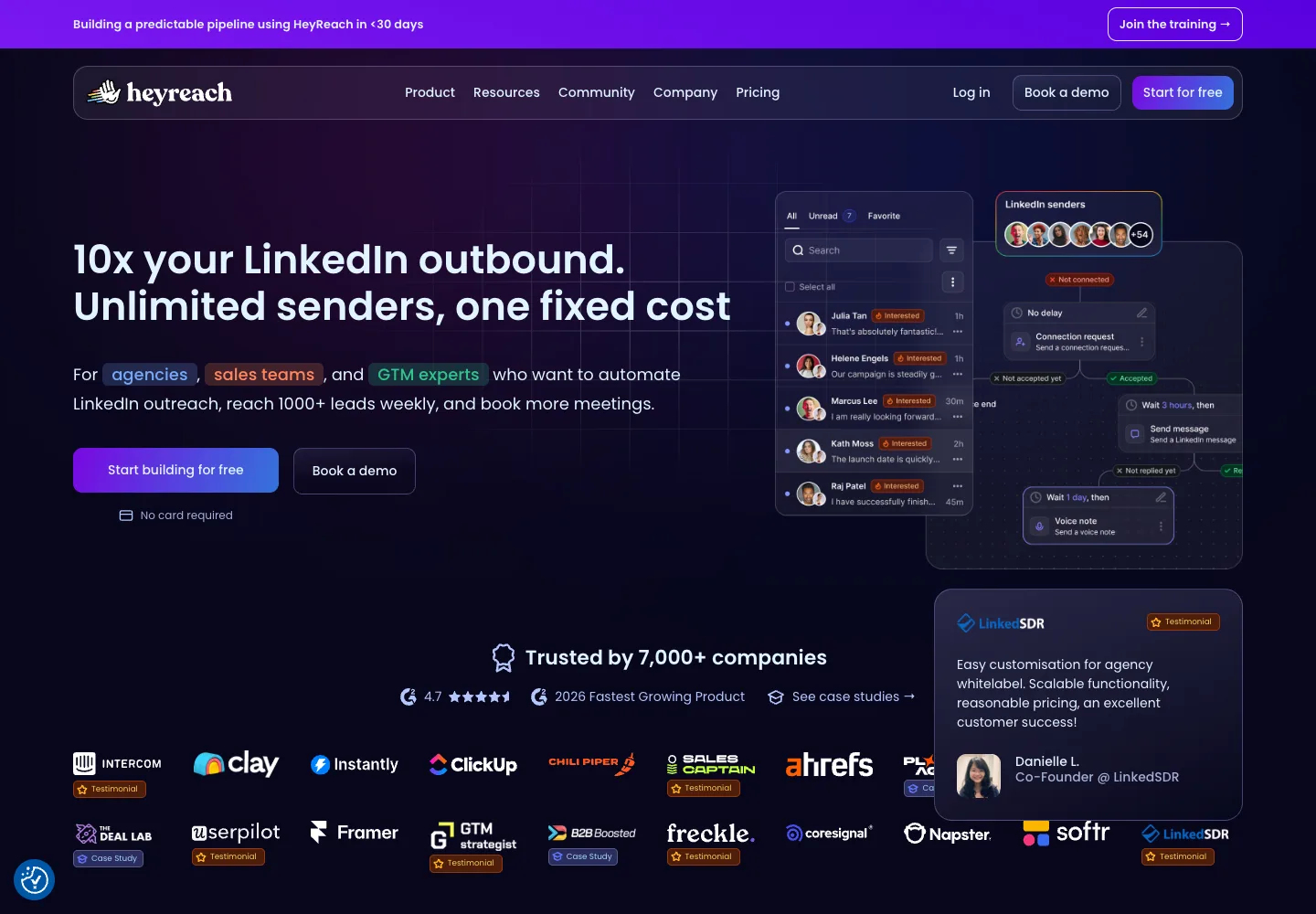
That positioning explains almost everything else in this review. Most LinkedIn tools started from one person's profile and added team features later. HeyReach started from the agency problem: ten client accounts, three campaigns each, one inbox to answer from. If that is your problem, HeyReach is built for you. If your problem is "one rep, one LinkedIn profile, plus email follow-ups", you are paying for architecture you will not use.
How this review was made
We read HeyReach's pricing page, product pages, help documentation and the company's own post about the LinkedIn action, then cross-checked with G2 and Trustpilot. Every price and limit in this article carries the date we read it. Screenshots are public-page captures with a recorded URL and timestamp, not screenshots of a paid account. We refresh this page when HeyReach changes its pricing or when LinkedIn changes the rules. If you spot a number that no longer matches the vendor's site, the vendor's site wins.
What we could and could not verify
Verified from public sources: the price list and plan contents (pricing page, September 9, 2026), the documented action limits of 40 connection requests a day, 25 by default and 200 a week (help centre, September 9, 2026), the vendor's own account of the March 25, 2026 LinkedIn action (blog post of August 7, 2026), 51 Trustpilot reviews and 2 Capterra reviews (September 9, 2026).
Not verified by us: in-product speed, campaign reliability over time, support response times beyond what reviewers report, and how the per-account proxies behave. Where we quote those, we say who said it.
What we see running LinkedIn sequences ourselves
Overloop runs LinkedIn steps inside its own sequences, so three things in this review come from operating the same category rather than from reading about it. Stalled campaigns are almost always a LinkedIn checkpoint or an expired session on one connected account, not a platform outage. Accounts that ramp slowly and stay under the documented daily ceilings rarely get restricted, and accounts that do not get restricted regardless of vendor. And reply rates track the quality of the list far more than the number of touches, which is why we treat volume as the risk variable, not the growth variable.
HeyReach pricing in 2026
HeyReach bills per LinkedIn sender, not per user seat. One sender is one connected LinkedIn account. A three-person team where each rep connects their own profile needs three senders. An agency that connects 25 client profiles needs 25. Here is the public price list as read on September 9, 2026.
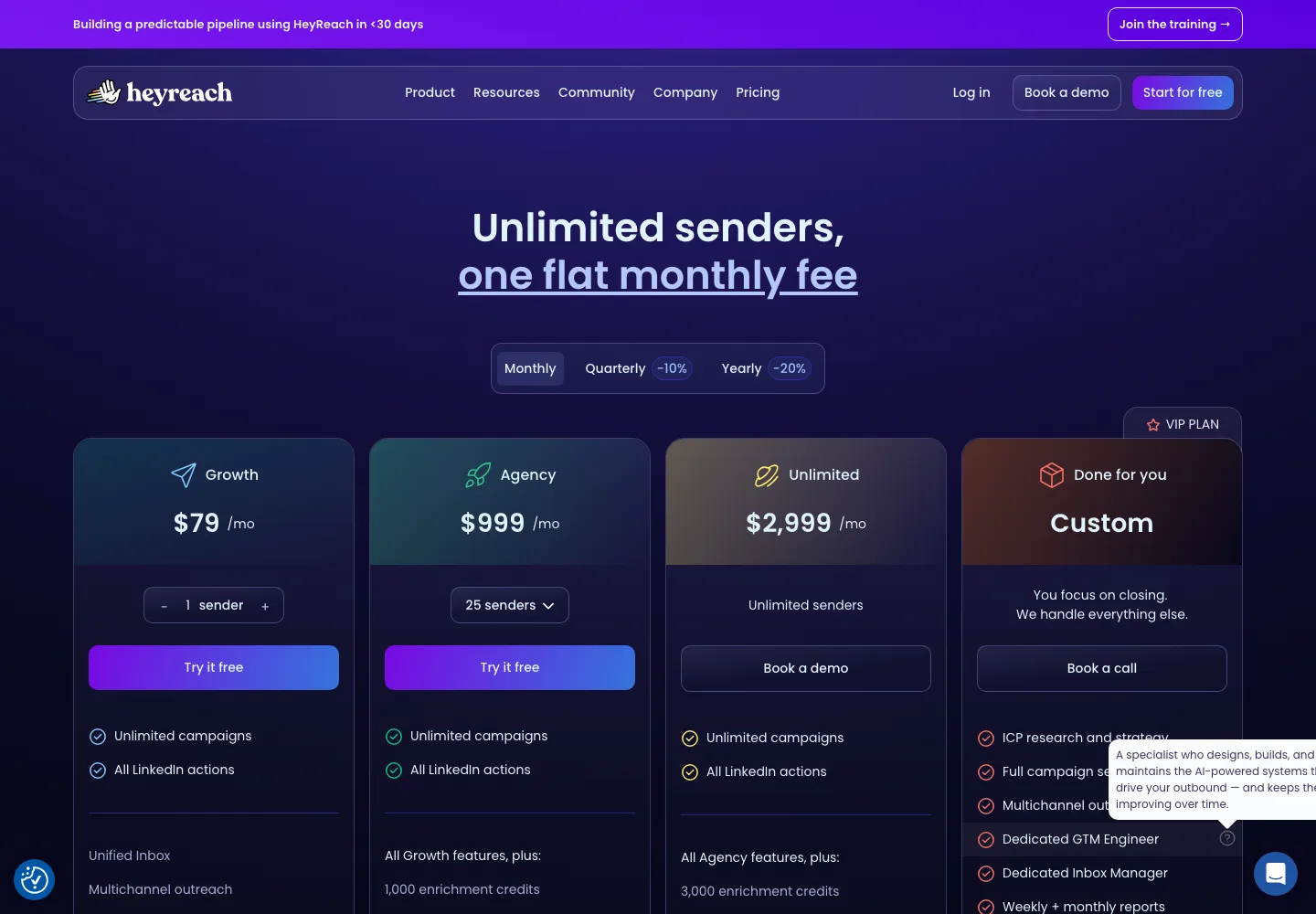
| Plan | Price (monthly billing) | Senders included | What the page lists |
|---|---|---|---|
| Growth | $79 per sender per month | 1 per $79, add senders with the selector | Unlimited campaigns, all LinkedIn actions, unified inbox, multichannel outreach through integrations, 100 enrichment credits per sender, API and webhooks, workspaces, MCP server |
| Agency | $999 per month | 25 senders | All Growth features plus 1,000 enrichment credits, white label, onboarding, bring your own proxies; a 50-sender tier is listed at $1,399 |
| Unlimited | $2,999 per month | Unlimited, capped at 300 under a fair-use policy | All Agency features plus 3,000 enrichment credits, multi-brand white label as a $500 add-on, migration done for you, priority support |
| Done for you | Custom | Managed service | ICP research, campaign setup, dedicated GTM engineer and inbox manager, weekly reports |
Quarterly billing is shown with a 10% discount and yearly billing with a 20% discount, which brings Growth to about $63 per sender per month on an annual commitment. The free trial is 14 days, no credit card, limited to 3 connected LinkedIn accounts on Growth; the help centre says Agency and Unlimited buyers can request a 30-day trial. There is also an Early Stage Program with discounted pricing for companies under $250K in annual revenue and fewer than 5 people, and volume pricing that drops Growth to about $47 per sender per month from 10 senders on a yearly plan.
Check the date on any other HeyReach review you read. Most articles ranking for HeyReach still list the Agency plan at 50 senders and the Unlimited plan at $1,999. The public pricing page on September 9, 2026 shows 25 senders on Agency and $2,999 on Unlimited. If you are comparing quotes against an older article, the vendor page wins.
The cost math is where buyers get surprised, in both directions.
- Small teams pay more than the headline suggests. Three reps on Growth is $237 per month before enrichment or any email tool. At that size, per-user tools with email included cost the same or less.
- Agencies pay less than most competitors. $999 for 25 senders is $40 per sender. Nobody in the single-account cloud category (Expandi at $99 per account, for example) gets close to that at 25 accounts. This is HeyReach's real pricing edge and the reason agencies choose it.
- Enrichment is metered. Growth includes 100 credits per sender, one credit per successful email lookup, then you buy one-time packs. If your plan is to move LinkedIn conversations to email, budget for a data source on top.
What you get for the money
The feature set is focused. HeyReach does LinkedIn, and it does the operational side of LinkedIn at scale well. Everything below comes from the vendor's pricing page, product pages and help centre as read on September 9, 2026.
- Multi-sender campaigns. Assign several LinkedIn accounts to one campaign and let HeyReach spread the daily actions across them. This is the core feature and the reason the product exists.
- Unified inbox. Replies from every connected account land in one place, with tags, assignment and templates, so an agency can answer for ten client profiles without logging into ten LinkedIn sessions.
- LinkedIn action set. Sequence steps cover connection requests with custom variables or a ChatGPT-assisted note, messages, InMails for accounts with Sales Navigator or Recruiter, profile views, follows and post likes, with a minimum delay of 3 hours between steps. A sequence branches once, on whether the connection request was accepted. Voice notes can be sent from the desktop inbox.
- Lead sources. Lists come in from Sales Navigator searches, CSV uploads, HubSpot, Clay and RB2B. A Find Email step spends one enrichment credit per successful lookup.
- Integrations and API. The integrations page lists HubSpot, Clay, Instantly, Smartlead, EmailBison, n8n, Slack, Attio, Trigify, RB2B and Breakcold among about 25 named tools, plus Zapier, Make, Pabbly and Albato for everything else. Pipedrive and Salesforce are not listed as native connectors. A public REST API with webhooks ships on every plan, and HeyReach publishes an MCP server so AI agents in Claude, ChatGPT, Cursor or n8n can drive campaigns.
- Reporting. Campaign and sender-level reporting on acceptance and reply rates, which matters when you are proving results to a client rather than to yourself.
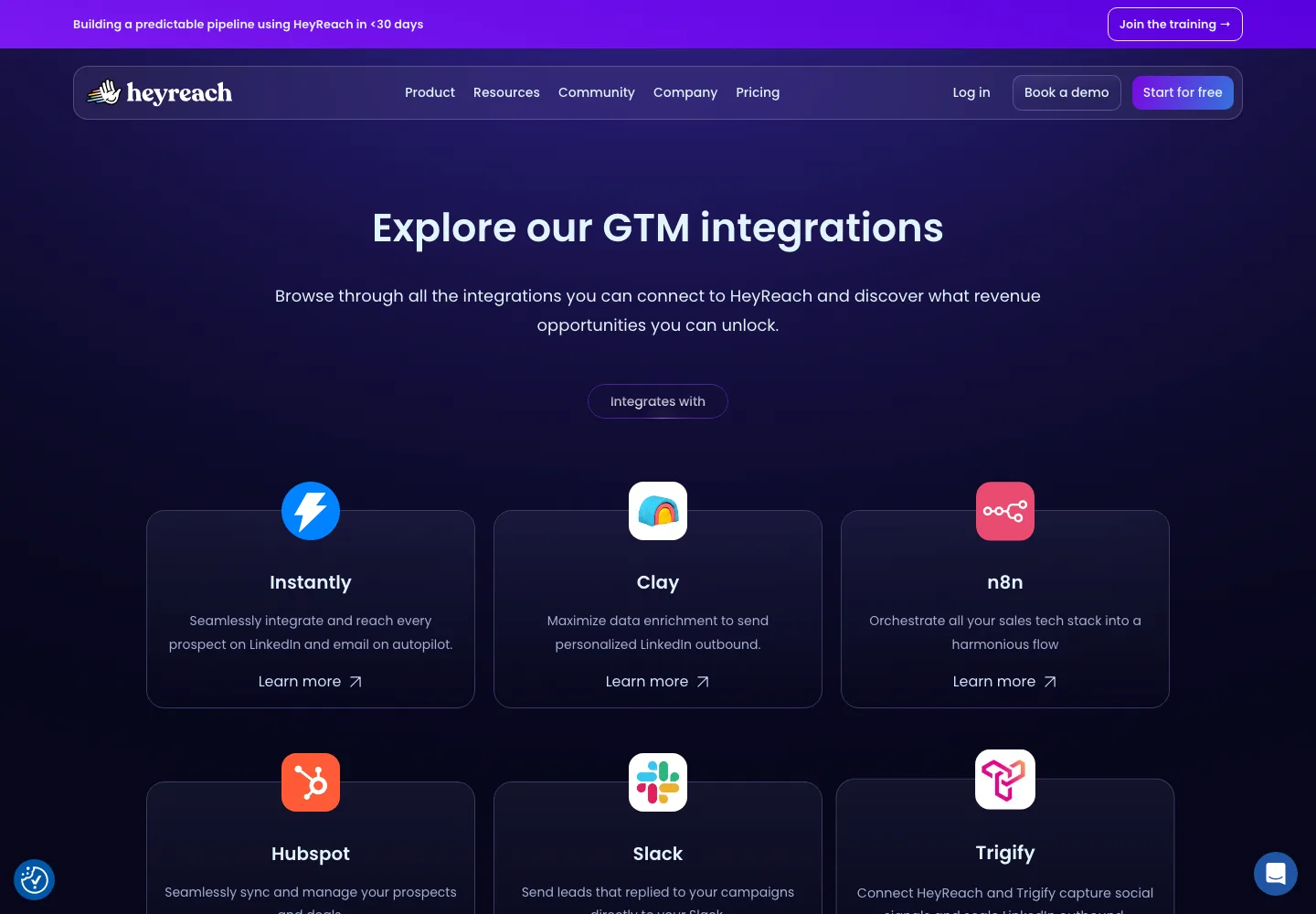
What is missing is just as clear. There is no native email sending: email steps depend on an integration with a separate sequencing tool or CRM. There is no built-in B2B contact database: you bring lists from Sales Navigator, a CSV or an enrichment tool. And beyond the single accepted-or-not branch, there is no general if-then builder of the La Growth Machine kind; sequences are otherwise linear with delays.
Is HeyReach safe for your LinkedIn account?
Short answer: as safe as any cloud LinkedIn automation can be, which is not the same as safe. LinkedIn's User Agreement prohibits third-party automation, so every tool in this category, including the LinkedIn steps in Overloop, operates against the platform's rules. The practical risk is a checkpoint or restriction on the connected account, and it depends on volume, pacing and account age far more than on the vendor.
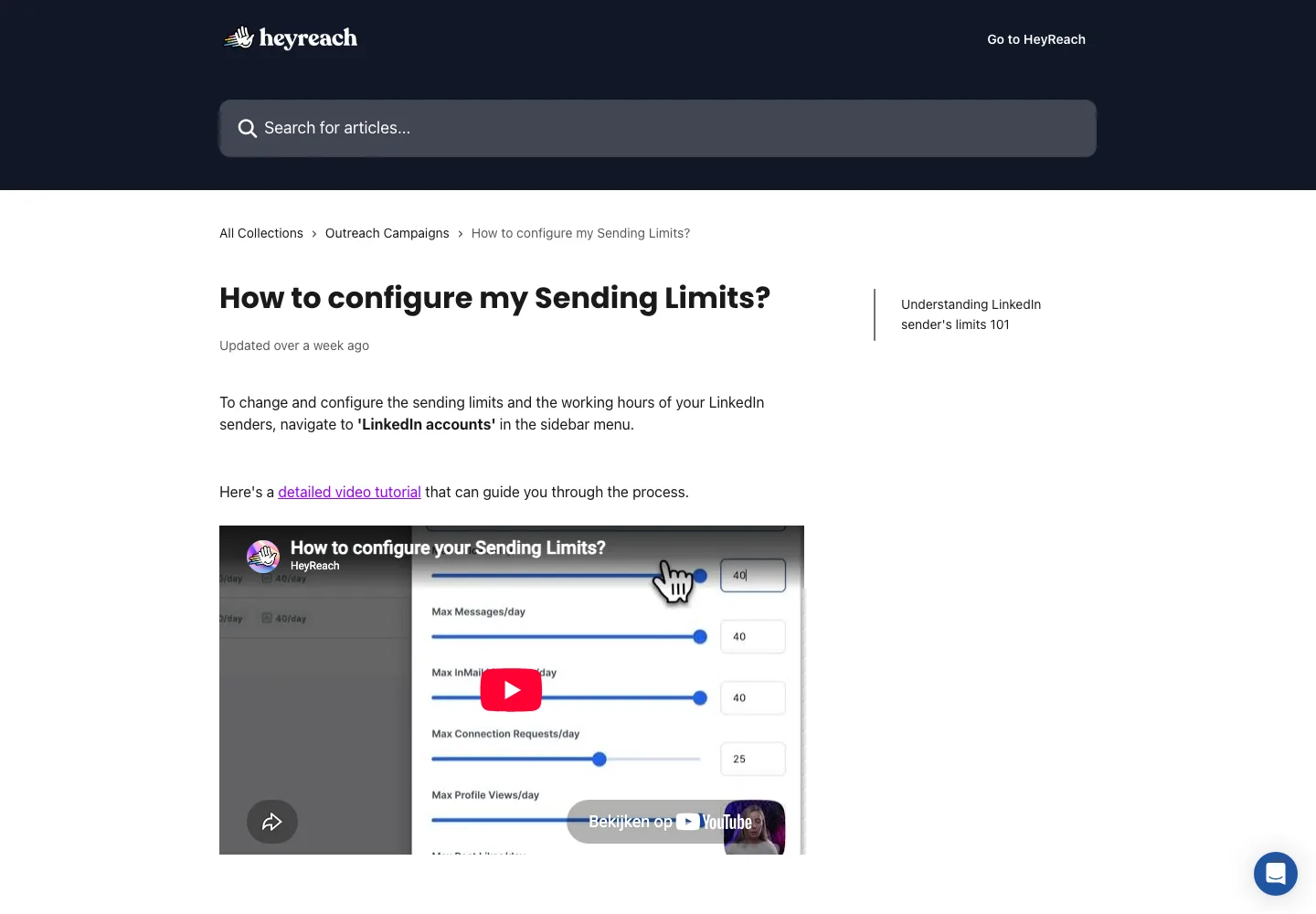
HeyReach handles this with hard limits. Its documentation sets a maximum of 40 connection requests per day per account, recommends 25 by default, and caps invitations at 200 per week, which mirrors LinkedIn's own weekly ceiling for most accounts. New accounts are ramped from 5 connection requests a day in week one to 10 in week two and 15 to 20 afterwards, with a ceiling of 20 to 25 a day once a profile passes 1,000 connections. HeyReach says each account runs behind a dedicated, non-rotating residential proxy matched to its location, and that it freezes an account automatically before it reaches LinkedIn's thresholds. Those last two are vendor claims we cannot verify from outside; a competitor's audit describes the same infrastructure as shared and moderate risk, and that is not independently verifiable either.
The March 2026 LinkedIn ban: what happened and what it means
On March 25, 2026, LinkedIn removed the HeyReach company page and restricted the personal profiles of its CEO, CTO, CRO and CMO. HeyReach did not receive advance notice. The company described the event in a post published on August 7, 2026, and the account is worth reading in full because it is unusually direct about what LinkedIn did and did not do.
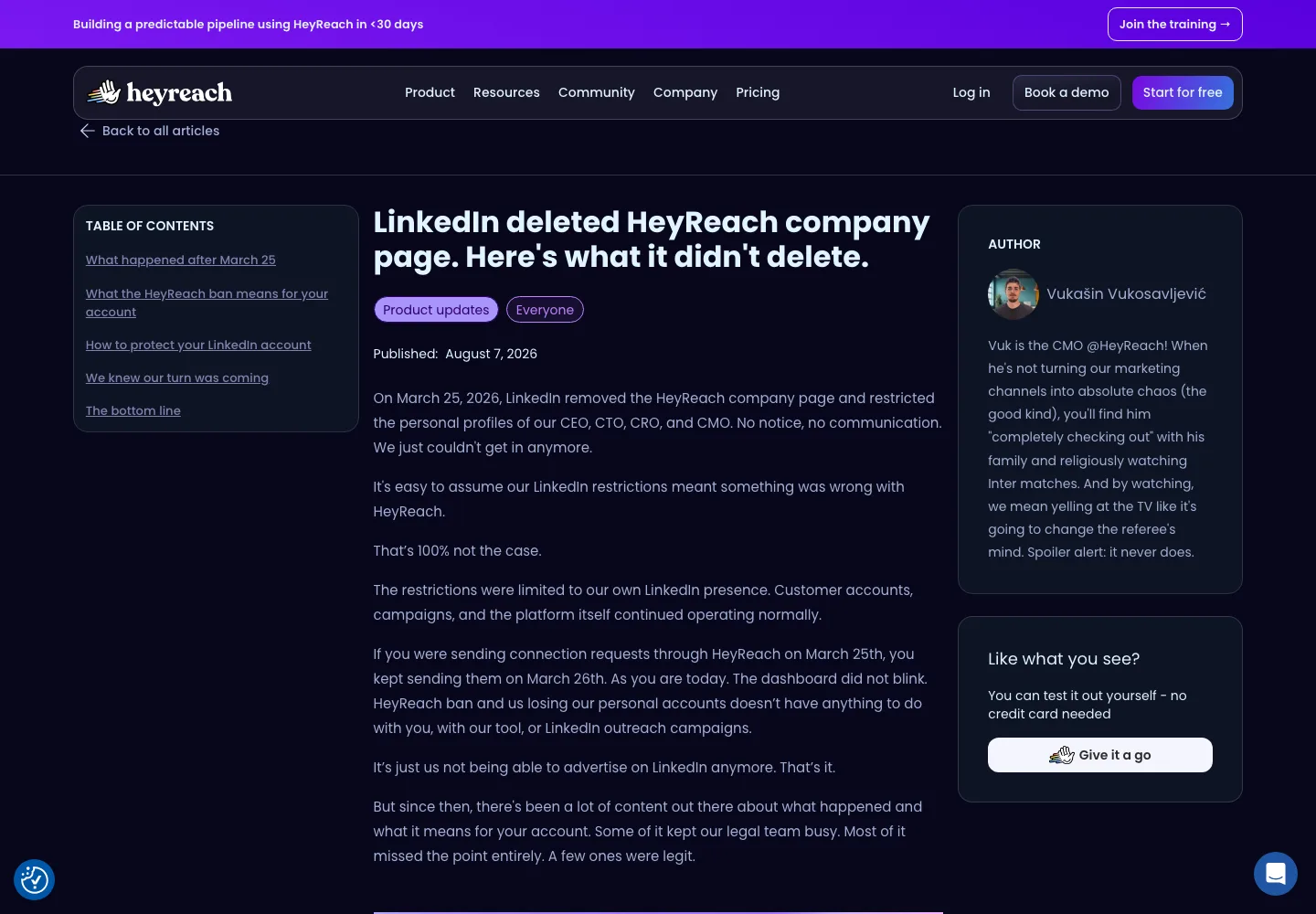
What LinkedIn removed: the company's marketing presence on LinkedIn. HeyReach can no longer run a company page, post as a brand or advertise on the platform, and its executives lost their personal profiles.
What LinkedIn did not remove: the software. According to HeyReach, customer accounts, campaigns and the platform kept operating normally. Someone sending connection requests through HeyReach on March 25 kept sending them on March 26. Third-party coverage agrees the software was not shut down, and LinkedIn never published a reason or a named violation. HeyReach's CEO wrote the same day that the company had just crossed $13M in annual recurring revenue, and by July the company claimed $16M, so the commercial damage was to its marketing channel, not its customer base. One competitor blog claimed HeyReach had cut its LinkedIn functionality within weeks; the pricing page still sells LinkedIn senders on September 9, 2026, so treat that claim as wrong.
Why it matters for a buyer: three reasons, one of them commercial.
- It is a signal about the category, not one vendor. LinkedIn went after the most visible cloud automation brand, and HeyReach itself points out that Apollo, Seamless, Evaboot, Lemlist and La Growth Machine have had their LinkedIn presence hit before. Every cloud tool that runs LinkedIn actions from a server, HeyReach, Expandi, Overloop's LinkedIn steps included, works on the same principle. Treat the ban as LinkedIn's clearest statement in years that automation is tolerated, not permitted.
- Your account is your responsibility. The vendor losing its page did not restrict a single customer profile, and the reverse is also true: a clean vendor brand would not have protected an account that sends 150 invitations a day.
- Roadmap risk is now real. A company that cannot market on the platform it automates will look for other channels and other products. HeyReach has already moved its community to X, ships an API, a CLI and an MCP server for AI agents, and sells a managed "Done for you" tier. Expect the product to keep moving toward agencies and integrations rather than toward the solo rep.
Is HeyReach down? How to tell
Because campaigns run in the cloud, a stalled campaign feels like an outage even when it is not. In our experience with LinkedIn tools, the order of likely causes is: a LinkedIn checkpoint or verification request on one connected sender, an expired LinkedIn session that needs reconnecting, daily limits already reached, and only then a platform incident. HeyReach's own account of the March 2026 event says its platform kept running throughout, and Trustpilot reviewers describe expired LinkedIn sessions that needed reconnecting far more often than outages. Check the sender account in a normal browser first; if LinkedIn asks you to verify, no automation tool will move until you do. HeyReach publishes a status page for genuine incidents.
What users say about HeyReach
Review sites disagree with each other, which is normal for a tool sold mostly to agencies. On September 9, 2026, Trustpilot shows a 4.0 out of 5 TrustScore from 51 reviews, with 74% five-star and 22% one-star and almost nothing in between, the signature of a product people either run their business on or bounce off. Capterra lists 5.0 from only 2 reviews. HeyReach's homepage displays a G2 badge of 4.7; the G2 listing itself blocked our crawler, and search snippets showed 4.6 from about 70 reviews, so treat the G2 figure as approximate. The homepage also claims 7,000+ companies as customers, up from the 5,300+ the CEO cited in March 2026.
What reviewers praise: running many accounts while staying inside LinkedIn's limits, the unified inbox, and one flat cost across profiles instead of a licence per rep.
What reviewers complain about: support response times, with one November 2025 review describing a shift from 30 minutes to 24 to 48 hours; a strict no-refund policy; and reliability issues such as LinkedIn sessions expiring and the MCP server returning inconsistent data. To HeyReach's credit, its CMO replies personally to the negative reviews.
Where HeyReach is genuinely good
- Agency economics. $999 for 25 senders is the best per-account price in the cloud category by a wide margin.
- Multi-account operations. Sender rotation, workspaces and one inbox for many profiles are native, not bolted on.
- Documented limits. The 40 per day maximum, 25 default and 200 per week caps are published and enforced, which is more transparent than most competitors.
- Integration-first stance. An open API and webhooks on every plan, a CLI and a free MCP server make it easy to plug HeyReach into Clay-style enrichment flows, n8n automations and AI agents.
- Transparency about the ban. The company published a detailed, non-defensive account of what LinkedIn did. That is rare in this category.
Where HeyReach falls short
- Per-sender pricing punishes small teams. Below roughly 8 senders, the Growth plan costs more per person than multichannel tools that include email, unless you qualify for the Early Stage Program.
- No native email. A LinkedIn-only sequence caps your reach at people who accept the connection. Moving to email means a second tool, a second invoice and a second inbox.
- No built-in prospect database. Every campaign starts with a list you built elsewhere, so the real stack is HeyReach plus Sales Navigator plus an enrichment tool.
- One branch only. Sequences split on connection accepted or not, and that is it. Fine for connection request, follow-up, follow-up; limiting for anything conditional on replies or profile data.
- Enrichment is metered. 100 credits per sender on Growth, then paid packs. Agencies that find emails for every lead will feel it.
- Brand exposure on LinkedIn is gone. No company page means fewer public updates and less social proof for buyers who check LinkedIn before they sign.
Who should buy HeyReach
Buy HeyReach if you are a lead generation agency running LinkedIn campaigns for several clients, or an outbound team of 8 or more reps that treats LinkedIn as its primary channel and already has email handled in another tool. In both cases the per-sender model and the unified inbox pay for themselves quickly, and no competitor prices 25 accounts as aggressively.
Look elsewhere if you are a founder or a small sales team that wants one tool for prospect sourcing, LinkedIn and email, or if your outbound depends on conditional sequences and manager review before messages go out. For those teams, the LinkedIn-first architecture becomes a constraint within a quarter.
HeyReach vs Overloop
Cards on the table. Overloop is our product. It is a multichannel outbound platform: you find prospects in a 450M+ contact B2B database or add them from LinkedIn with a Chrome extension, then run email and LinkedIn steps in the same sequence. Pricing is per user, from $69 per month on Starter and $99 on Growth, with a 14-day free trial. Here is where each tool wins.
| Criterion | HeyReach | Overloop |
|---|---|---|
| Built for | Agencies and teams running many LinkedIn senders | Sales teams running email and LinkedIn in one campaign |
| Channels | LinkedIn natively; email through integrations | Email and LinkedIn sequences natively |
| Prospect sourcing | Bring your own lists (Sales Navigator, CSV, enrichment) | Advertised 450M+ B2B contact database plus Chrome extension |
| Pricing unit | Per LinkedIn sender, $79 per month; 25 senders for $999 | Per user, $69 (Starter) or $99 (Growth) per month |
| Email accounts | Not applicable | 1 on Starter, 3 on Growth |
| Credits | 100 enrichment credits per sender on Growth, 1,000 on Agency, 3,000 on Unlimited | 250 credits per month on Starter, 500 on Growth |
| Multi-account LinkedIn | Core strength, sender rotation and unified inbox | Per-user LinkedIn, not built for rotating client accounts |
| CRM | HubSpot native; Pipedrive and Salesforce through Zapier or Make; API on every plan | HubSpot and Pipedrive on Growth, Salesforce on Enterprise |
| Free trial | 14 days, no credit card, up to 3 LinkedIn accounts | 14 days, no credit card |
HeyReach wins when the problem is operating many LinkedIn accounts at the lowest cost per account. We do not try to compete there. Overloop wins when a team wants to source the list, write the sequence and run LinkedIn and email steps from one place, at one price per rep. Read the full Overloop vs HeyReach comparison if you are choosing between the two.
Want LinkedIn and email in the same sequence?
Overloop runs both channels natively and includes the prospect database, from $69 per user per month.
Book a demoSee featuresHeyReach alternatives worth a look
If HeyReach's shape does not match your team, the market has clear substitutes, each with a different trade-off.
- Overloop for LinkedIn and email in one campaign with a built-in database, per user from $69 per month.
- Expandi for a cloud LinkedIn tool priced per account at $99 per month, with optional email follow-ups. Closest like-for-like for a single account.
- Waalaxy for the cheapest credible LinkedIn sequences, from €19 per month billed annually, with email on the Business plan.
- Dripify for solo reps who want LinkedIn plus Gmail follow-ups at $59 per user per month, or $39 billed annually.
- Linked Helper for the lowest price, $29.90 per month Standard, as a desktop application with one license per LinkedIn account.
- Lemlist for the widest channel mix, email, LinkedIn, calls and SMS, at $109 per user per month.
Prices above were read from each vendor's public page on September 7, 2026 for our LinkedIn outreach tools comparison. The full HeyReach alternatives guide ranks them by use case.
Verdict
HeyReach is the best LinkedIn automation tool for agencies and large outbound teams that need to run many LinkedIn accounts cheaply from one inbox, and it is honest about its limits in a way most of the category is not. It is the wrong tool for a small team that wants prospecting, LinkedIn and email in one place, because every one of those jobs requires another product and another invoice. The March 2026 LinkedIn action against its company page did not stop the software, but it should reset every buyer's expectations: LinkedIn automation is tolerated until it is not, whichever logo is on the invoice.
If you fit the agency profile, start a HeyReach trial and connect real client accounts before you commit to Agency pricing. If you fit the small-team profile, try Overloop free for 14 days and run one campaign with LinkedIn and email steps side by side.
Frequently asked questions
How much does HeyReach cost?
HeyReach's public pricing page on September 9, 2026 lists Growth at $79 per LinkedIn sender per month, Agency at $999 per month for 25 senders, Unlimited at $2,999 per month for unlimited senders, and a custom Done for you plan. Quarterly billing is shown with a 10% discount and yearly billing with a 20% discount. Prices are in US dollars.
Is HeyReach safe to use?
HeyReach is a cloud-based tool that performs LinkedIn actions on your behalf, which LinkedIn's User Agreement prohibits for any third-party automation. HeyReach documents a maximum of 40 connection requests per day, a default of 25 and a weekly cap of 200 to keep accounts under LinkedIn's radar. In March 2026 LinkedIn removed HeyReach's own company page and restricted its founders' profiles; according to HeyReach, customer accounts kept running. The risk sits with each connected account and depends on volume and behaviour, not on the vendor's brand presence.
Was HeyReach banned by LinkedIn?
Partly. On March 25, 2026, LinkedIn removed the HeyReach company page and restricted the personal profiles of its CEO, CTO, CRO and CMO, according to HeyReach's own account published on August 7, 2026. The software itself was not shut down and campaigns continued to run for customers. HeyReach can no longer advertise or post on LinkedIn as a company.
Is HeyReach down?
HeyReach's platform kept operating through the March 2026 LinkedIn action against its company page, according to the vendor and third-party coverage. If your campaigns stop, the most common causes are a LinkedIn checkpoint or verification request on one of your connected sender accounts, an expired LinkedIn session that needs reconnecting, or daily limits already reached. Check the connected account in a normal browser first, then contact HeyReach support.
What is HeyReach used for?
HeyReach is used to run LinkedIn outreach campaigns from several LinkedIn accounts at once: connection requests, messages, InMails, profile views, follows and post likes, with replies collected in one unified inbox. Its typical customers are lead generation agencies managing client accounts and outbound teams that want several reps to work one campaign.
Does HeyReach send email?
Not natively. HeyReach is LinkedIn-first. Email steps are sent through integrations with Instantly, Smartlead or EmailBison rather than a built-in email sender, and a Find Email step spends enrichment credits. Teams that want LinkedIn and email steps in one sequence usually compare Overloop, Lemlist or La Growth Machine instead.
What is the best HeyReach alternative?
It depends on the job. Overloop fits teams that want LinkedIn and email in one campaign with a built-in prospect database, from $69 per user per month. Expandi is the closest single-account cloud alternative. Waalaxy and Dripify are cheaper for solo users. Linked Helper is the lowest-priced desktop option. Our HeyReach alternatives guide compares all of them.
What is the best LinkedIn automation tool?
For agencies running many LinkedIn accounts, HeyReach is the strongest option in 2026 because it charges per sender rather than per seat and puts every reply in one inbox. For a small team that wants LinkedIn and email in the same sequence and the prospect list in the same tool, Overloop fits better, from $69 per user per month. For a solo user on a budget, Waalaxy and Dripify cost less. There is no single best tool, only the right pricing unit for your account count.
Methodology & sources6 sources
How this edition was evaluated
Every price, limit and review figure in this article was read on the date stated and is tied to one of the six sources below. We did not run a paid HeyReach trial for this edition, and no screenshot shows a logged-in account.
- HeyReach pricing page, read September 9, 2026 (plans, prices, trial, credits).
- HeyReach help centre, sending limits, read September 9, 2026 (daily and weekly action limits, warm-up guidance).
- HeyReach blog, "LinkedIn deleted HeyReach company page", published August 7, 2026, read September 9, 2026.
- Trustpilot, HeyReach profile, 51 reviews, read September 9, 2026.
- Capterra, HeyReach profile, 2 reviews, read September 9, 2026.
- G2, HeyReach listing, crawler blocked on September 9, 2026; the rating quoted comes from the homepage badge and search snippets and is marked approximate in the text.
Competitor prices in the alternatives section were read on September 7, 2026 for our LinkedIn outreach tools comparison. Overloop is our product; recommendations are labelled as judgment.