





Dripify is a per-user, cloud-based LinkedIn automation tool with conditional drip campaigns and native Gmail email steps, from $59 per user per month or $39 billed annually. HeyReach is a per-sender platform built for agencies and multi-sender teams, at $79 per LinkedIn sender per month or $999 for 25 senders, with sender rotation and a unified inbox. Below about 8 LinkedIn accounts Dripify is the cheaper, simpler buy; above that HeyReach wins on price and operations. In March 2026 LinkedIn removed HeyReach's company page; the software kept running. Everything below is checked against public pages, with dates.



Disclosure first: we are Overloop, and we compete with both Dripify and HeyReach on LinkedIn outreach. This comparison is based on each vendor's public pricing page, product pages and help documentation, all read on September 9, 2026, plus HeyReach's own account of the March 2026 LinkedIn action. We did not run a paid trial of either tool for this edition. Where one of them is the better buy, we say so, including where it beats Overloop.
Dripify vs HeyReach: the short answer
Dripify vs HeyReach: which is better? Dripify is better for solo reps and small sales teams. It costs $59 per user per month, or $39 billed annually, runs conditional LinkedIn and Gmail drip campaigns, and connects 1 LinkedIn account per seat. HeyReach is better for agencies and multi-sender teams. It costs $79 per LinkedIn sender per month, or $999 for 25 senders, with sender rotation and one unified inbox. Below about 8 accounts, buy Dripify. Above that, buy HeyReach.
The rest of this article shows the numbers behind that verdict, because the two tools look similar on a feature list and behave very differently on an invoice.
How this comparison was made
We read Dripify's pricing page, homepage, features pages, integrations page and FAQ on dripify.com on September 9, 2026. Note that dripify.io now redirects to dripify.com. We read HeyReach's pricing page, product pages and help center the same day, and we relied on our own HeyReach review for the review-site data. Every price and limit below carries the date we read it. Screenshots are public-page captures with a recorded URL and timestamp, not screenshots of a paid account. If a number here no longer matches the vendor's site, the vendor's site wins.
What each tool is built for
Dripify: one rep, one LinkedIn account, one drip campaign
Dripify is a cloud-based LinkedIn automation tool sold per user. Its FAQ, read on September 9, 2026, describes it as "a web application that operates in a cloud and does not require downloading files or adding chrome extensions". Each seat connects 1 LinkedIn account. You build a drip campaign in a drag-and-drop builder that mixes LinkedIn actions, email steps, delays and conditions, then let it run. The homepage claims 40,000+ companies as customers, a vendor figure we cannot verify.
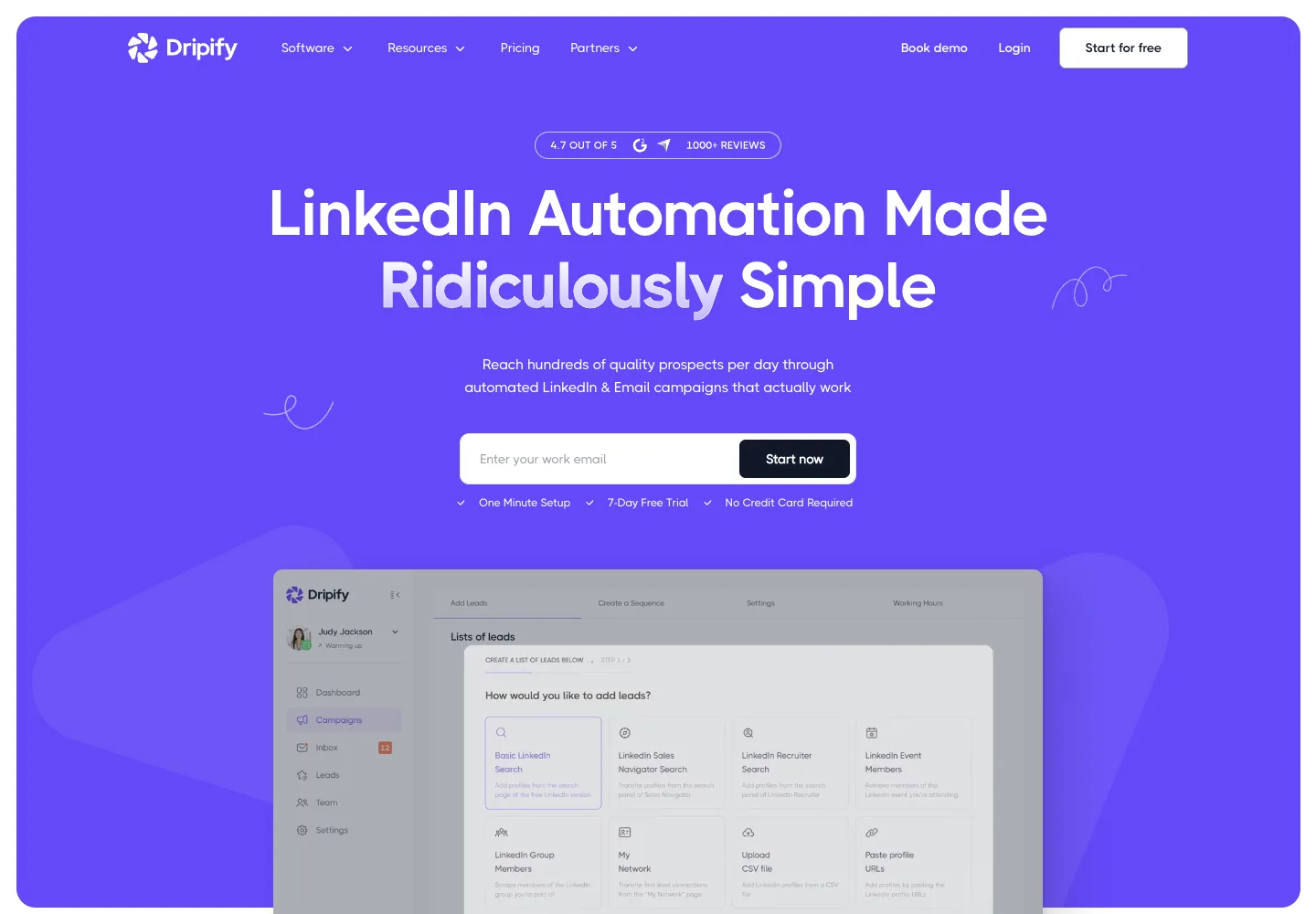
Team features exist, with User, Manager and Owner roles and a multi-team view for agencies on the Advanced plan, but they sit on top of a per-user product rather than defining it.
HeyReach: many senders, one campaign, one inbox
HeyReach is also cloud-based, but it starts from the opposite problem. You connect several LinkedIn accounts to one workspace, assign them to a campaign, and HeyReach rotates connection requests and messages across those senders while collecting every reply in a unified inbox. It bills per connected LinkedIn sender, not per user; team members, virtual assistants and clients are free. Its pricing page on September 9, 2026 says so in as many words.
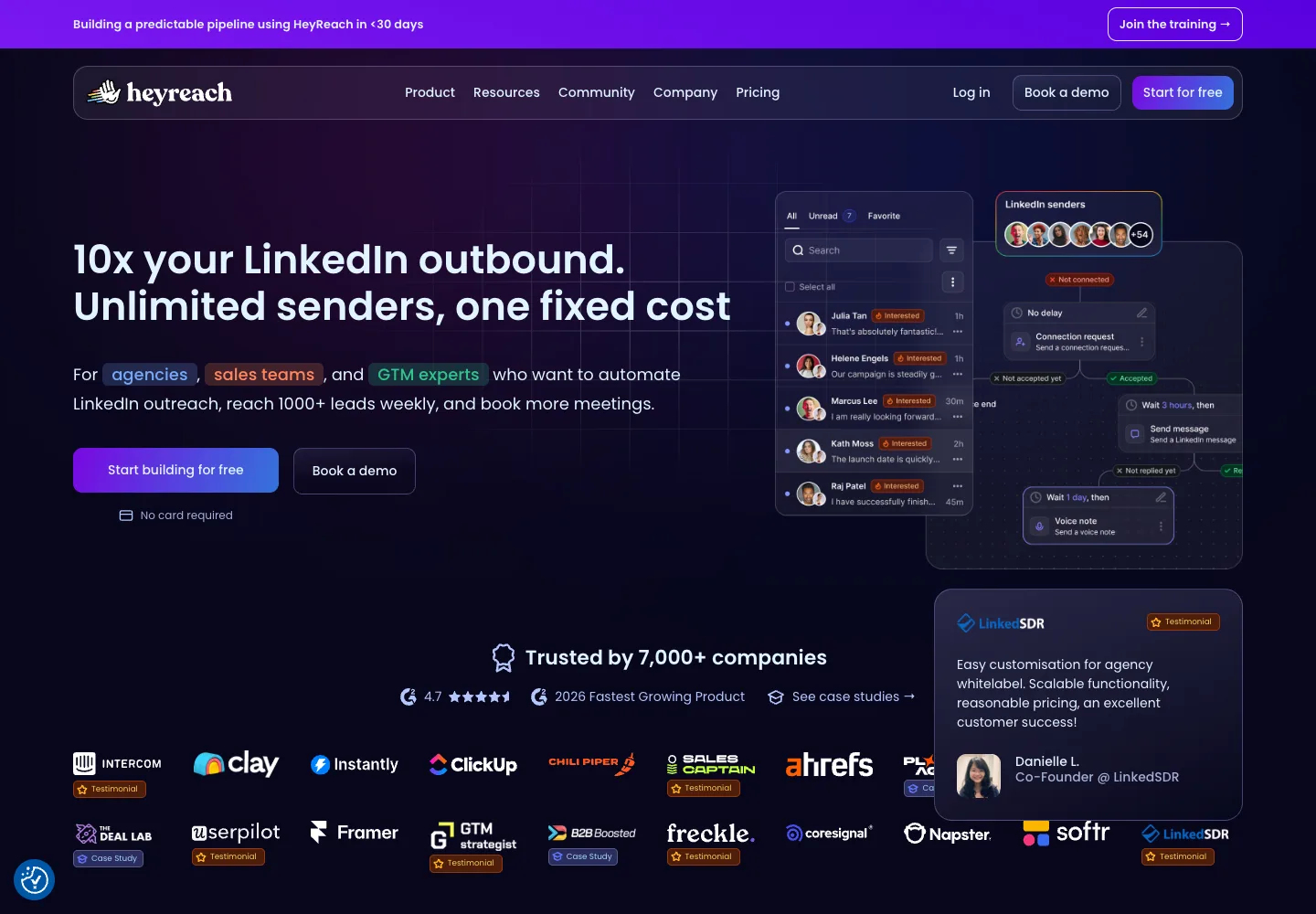
That makes HeyReach an agency tool first. If your problem is your own profile plus email follow-ups, you are paying for architecture you will not use.
Pricing: per user vs per sender
Both price lists as read on September 9, 2026, in US dollars.
| Plan | Monthly billing | Annual billing | What the pricing page lists |
|---|---|---|---|
| Dripify Basic | $59 per user per month | $39 per user per month | 1 drip campaign, limited daily quotas (20 connection requests, 30 messages, 10 InMails per day), LinkedIn and email sequences, 100 email finder credits per month |
| Dripify Pro | $79 per user per month | $59 per user per month | Unlimited campaigns, full daily quotas (75 connection requests, 100+ messages, 30 InMails per day), dedicated inbox, CSV export, webhooks, HubSpot integration |
| Dripify Advanced | $99 per user per month | $79 per user per month | Everything in Pro plus multi-team management, advanced LinkedIn protection, activity control, lead tagging, step analytics, team analytics, A/B testing, evergreen leads |
| Dripify Enterprise | Custom | Custom | Premium onboarding, dedicated technical support, customer success manager |
| HeyReach Growth | $79 per sender per month | $63 per sender per month (20% off); about $47 from 10 senders on a yearly plan | Unlimited campaigns, all LinkedIn actions, unified inbox, 100 enrichment credits per sender, API and webhooks, workspaces, MCP server |
| HeyReach Agency | $999 per month for 25 senders | $799 per month for 25 senders | All Growth features plus 1,000 enrichment credits, white label, onboarding, bring your own proxies; a 50-sender tier is listed at $1,399 monthly |
| HeyReach Unlimited | $2,999 per month | $2,399 per month | Unlimited senders under a 300-account fair-use cap, 3,000 enrichment credits, priority support |
Dripify's free trial is 7 days, no credit card, with Advanced plan features; nothing is charged when it ends. HeyReach's trial is 14 days, no credit card, limited to 3 connected LinkedIn accounts on Growth. Dripify's annual discount is advertised as "up to 35% off"; HeyReach's is 10% on quarterly billing and 20% on yearly billing.
What each team size actually pays
The table assumes each user connects 1 LinkedIn account, so 1 Dripify user equals 1 HeyReach sender. Basic is shown for completeness; its single campaign and 20 requests a day rarely suit a team. Prices as read on September 9, 2026.
| Users or senders | Dripify Basic (monthly / annual) | Dripify Pro (monthly / annual) | HeyReach (monthly / yearly) |
|---|---|---|---|
| 1 | $59 / $39 | $79 / $59 | $79 / $63 (Growth) |
| 3 | $177 / $117 | $237 / $177 | $237 / $189 (Growth) |
| 10 | $590 / $390 | $790 / $590 | $790 / $630 (Growth); about $470 with the 10-sender yearly volume price |
| 25 | $1,475 / $975 | $1,975 / $1,475 | $999 / $799 (Agency, 25 senders) |
Three things jump out.
- At 1 to 3 seats the two match on monthly billing. $79 vs $79. Dripify wins on annual billing, and by more if the Basic quotas are enough for you.
- At 10 seats HeyReach's volume pricing starts to bite. The help center's $47 per sender on a yearly plan undercuts Dripify Pro's $59 annual price, at the cost of a 12-month commitment.
- At 25 seats HeyReach is roughly half the price. $999 for 25 senders is $40 per sender. Dripify Pro at 25 users is $1,975. This is the number that sends agencies to HeyReach.
Feature comparison
Everything below comes from the vendors' pricing pages, feature pages and help documentation as read on September 9, 2026.
| Criterion | Dripify | HeyReach |
|---|---|---|
| Built for | Solo reps and small teams, 1 LinkedIn account per seat | Agencies and multi-sender teams |
| Pricing unit | Per user: $59, $79 or $99 monthly | Per LinkedIn sender: $79 monthly; 25 for $999 |
| Free trial | 7 days, no card, Advanced features | 14 days, no card, up to 3 accounts |
| LinkedIn actions | Connect, message, view, endorse, follow, like, Sales Navigator InMails | Connect, message, InMail, view, follow, like, voice notes from the inbox |
| Sequence logic | Drag-and-drop builder with actions, delays and conditions (10+ per the homepage, 15+ per the features page) | Linear steps, 3-hour minimum delay, 1 branch on connection accepted |
| Native, through a connected Gmail or Google Workspace account, on every plan | Not native; hands off to Instantly, Smartlead or EmailBison | |
| Email finder | 100 credits per month on every plan; packs from $29 for 1,000 | 100 credits per sender on Growth, 1,000 on Agency, 3,000 on Unlimited |
| Inbox | LinkedIn and email inbox, Pro and above | Unified inbox across all senders, every plan |
| Multi-account operations | Multi-team view on Advanced; no sender rotation | Sender rotation and workspaces, the core of the product |
| Team management | User, Manager and Owner roles; team analytics on Advanced | Workspaces and permissions; team members free |
| Lead sources | LinkedIn searches, events, groups, My Network, CSV | Sales Navigator, CSV, HubSpot, Clay, RB2B |
| Integrations | Zapier, Make, Google Sheets, HubSpot, Pipedrive, Salesforce and others; webhooks and HubSpot on Pro and above; API | About 25 named tools plus Zapier and Make; API and webhooks on every plan; MCP server and CLI |
| Safety architecture | Cloud, unique local IP per account, random delays, activity control on Advanced | Cloud, dedicated residential proxy per account (vendor claim), published caps, auto-freeze (vendor claim) |
| Reporting | Campaign reports on all plans; step, team and A/B analytics on Advanced | Campaign and sender-level reporting |
Two rows matter most. Dripify's conditions serve a seller who wants "if accepted, message; if not, view the profile again and try email". HeyReach's single branch covers the common case and nothing else. In the other direction, HeyReach's inbox and rotation are built for a person answering on behalf of 10 profiles; Dripify's inbox is built for a person answering as themselves.
LinkedIn safety and limits
Both tools run in the cloud, and both operate against LinkedIn's User Agreement, which prohibits third-party automation. So does every LinkedIn step in Overloop. The practical risk is a checkpoint or restriction on the connected account, and it depends on volume, pacing and account age far more than on the logo.
Dripify publishes its limits on the pricing page: 20 connection requests and 30 messages a day on Basic, 75 connection requests and 100+ messages a day on Pro and Advanced. Its FAQ, read the same day, gives 75 connection requests and 150 messages a day as ceilings, so treat the message cap as between 100 and 150. The safety page says each account gets "a unique IP address from your local region" and that actions are made of page views and clicks with random delays. Activity control, on Advanced, adjusts daily limits to the account's behavior. The FAQ states the tool works with free LinkedIn, Premium, Sales Navigator and Recruiter Lite accounts.
HeyReach documents a maximum of 40 connection requests a day per account, recommends 25, and caps invitations at 200 a week, LinkedIn's own weekly ceiling. New accounts ramp from 5 a day in week 1 to 15 to 20 after week 2. HeyReach says each account sits behind a dedicated residential proxy and is frozen before it reaches LinkedIn's thresholds; both are vendor claims we cannot verify from outside.
Dripify's 75 requests a day is nearly double HeyReach's 40. That is a ceiling, not a recommendation, and a seller who runs at it on a young account takes a bigger risk than a HeyReach user spreading 100 daily requests over 5 senders. HeyReach's model lowers per-account exposure by design. Dripify gives the individual more room and leaves the judgment to them.
The March 2026 LinkedIn action against HeyReach
On March 25, 2026, LinkedIn removed the HeyReach company page and restricted the personal profiles of its CEO, CTO, CRO and CMO, without advance notice. HeyReach described the event in a post published on August 7, 2026. LinkedIn never published a reason or a named violation.
LinkedIn removed HeyReach's marketing presence. It did not remove the software. According to HeyReach, customer accounts, campaigns and the platform kept operating normally, and its CEO wrote that day that the company had just crossed $13M in annual recurring revenue. Third-party coverage agrees the tool was not shut down. On September 9, 2026, the pricing page still sells LinkedIn senders, so a competitor blog's claim that HeyReach dropped its LinkedIn functionality is wrong.
For a Dripify vs HeyReach buyer, this cuts 3 ways.
- It is not a Dripify advantage on safety. LinkedIn hit HeyReach's brand, not its customers' accounts. A clean vendor page would not protect an account sending 150 invitations a day.
- It is a category warning. Every cloud tool that performs LinkedIn actions from a server, Dripify, HeyReach and Overloop's LinkedIn steps included, works on the same principle. Automation is tolerated, not permitted.
- It raises roadmap risk for HeyReach. A company that cannot market on the platform it automates will keep moving toward agencies, its API and MCP server, and managed services. Fine for an agency; a reason for a solo rep to prefer a tool whose roadmap points at them.
Email and multichannel
This is the cleanest difference between the two products, and the one buyers most often miss.
Dripify sends email natively. Its integrations page, read on September 9, 2026, says you "connect your Gmail or Google Workspace to send automated emails", and the pricing page lists "LinkedIn and email sequences" on every paid plan with 100 email finder credits a month. An email step sits inside the same drip campaign as your LinkedIn steps, under the same conditions and delays. The limitation is the provider: Google only, as read on that date. Teams on Outlook or a dedicated sending domain are out.
HeyReach does not send email. Its multichannel page describes email as a hand-off: "if ignored, email follow-up via Instantly or Smartlead after X days". That means a second tool, a second invoice and a second inbox, and a Find Email step that spends enrichment credits. For an agency already running Instantly or Smartlead, this is a sensible division of labor. For a 3-person team it is a hidden cost and one more login.
Neither tool includes a B2B contact database. Dripify pulls leads from LinkedIn searches, events, groups, your network or a CSV. HeyReach pulls from Sales Navigator, CSV, HubSpot, Clay or RB2B. In both cases the list is your job.
Integrations
Dripify's integrations page names Zapier, Make, Google Sheets, HubSpot, Pipedrive, Salesforce, Zoho CRM, ActiveCampaign, Asana, Intercom, Zendesk and ClickUp, plus a Dripify API. The pricing page places webhooks and the HubSpot integration on Pro and above, so Basic is a closed box. The page says two-way syncing "is supported through Zapier and Make workflows", so read the native CRM connectors as one-way event pushes until you test them.
HeyReach ships a REST API and webhooks on every plan, including Growth, and publishes an MCP server and a CLI so AI agents in Claude, ChatGPT, Cursor or n8n can drive campaigns. Its integrations page lists HubSpot, Clay, Instantly, Smartlead, EmailBison, n8n, Slack, Attio and RB2B among about 25 named tools, with Zapier, Make, Pabbly and Albato for the rest. Pipedrive and Salesforce are not listed as native connectors.
Net: Dripify has the broader CRM list on paper. HeyReach has the deeper developer surface and no API upsell. If your outbound runs through Clay tables and n8n flows, HeyReach fits better. If it runs through a CRM and a Zap, either works.
Verdict by team type
- Solo founder or 1 rep: Dripify. $59 a month, or $39 annually, with email steps and conditions included. HeyReach at $79 gives you multi-sender features you will never touch.
- Sales team of 2 to 7, each on their own profile: Dripify Pro on annual billing, at $59 per user, unless you already pay for Instantly or Smartlead and want HeyReach's inbox. Reps on Outlook need a separate email tool with either product.
- Outbound team of 8 or more, LinkedIn as the main channel: HeyReach. The $47 per sender yearly volume price, the shared inbox and free team seats beat per-user pricing at this size.
- Lead generation agency with client accounts: HeyReach, without much debate. $999 for 25 senders, white label, workspaces and one inbox for every client profile is the package Dripify's multi-team view does not match.
- Anyone whose outbound depends on if-then logic: Dripify, because HeyReach branches once and stops.
If neither shape fits, our HeyReach alternatives guide and the LinkedIn outreach tools comparison cover Expandi, Waalaxy, Linked Helper, Lemlist and La Growth Machine.
Where Overloop fits
Cards on the table. Overloop is our product, and it sits in the gap both tools leave open: the prospect list. Overloop runs email and LinkedIn steps in one sequence, like Dripify, but sources prospects from an advertised 450M+ B2B contact database or from LinkedIn through a Chrome extension. Pricing is per user: $69 per month on Starter with 250 credits and 1 email account, $99 on Growth with 500 credits and 3 email accounts. HubSpot and Pipedrive integrations are on Growth, Salesforce on Enterprise. The trial is 14 days, no credit card.
Against Dripify, Overloop's Starter plan is $69 per user against Dripify's $59 on monthly billing, and it adds the database; Dripify keeps the edge on annual price and on the count of LinkedIn action types. Against HeyReach, Overloop is the wrong tool for rotating 25 client accounts, and we do not compete there; it is the better tool for a team that wants to find the list, write the sequence and run both channels from one place. The full Overloop vs HeyReach comparison goes deeper on that pairing.
Want the prospect list, LinkedIn and email in one tool?
Overloop runs both channels in one sequence and includes a 450M+ contact database, from $69 per user per month.
Book a demoSee featuresFrequently asked questions
Is Dripify or HeyReach cheaper?
It depends on how many LinkedIn accounts you connect. On September 9, 2026, Dripify listed Basic at $59 per user per month ($39 billed annually) and Pro at $79 ($59 annually). HeyReach listed Growth at $79 per LinkedIn sender per month ($63 yearly) and Agency at $999 per month for 25 senders. For 1 to 3 accounts Dripify is cheaper or equal. From about 10 accounts HeyReach's volume and Agency pricing is cheaper, and at 25 accounts it is roughly half the price of Dripify Pro.
Which is better for agencies, Dripify or HeyReach?
HeyReach. It bills per connected LinkedIn sender with free team seats, rotates campaigns across many accounts, collects every reply in one unified inbox, and sells 25 senders for $999 per month with white label included on the Agency plan. Dripify's Advanced plan adds multi-team management for agency owners, but each seat still connects 1 LinkedIn account at $99 per user per month on monthly billing.
Does Dripify or HeyReach send email?
Dripify does, natively, through a connected Gmail or Google Workspace account, with LinkedIn and email steps in the same drip campaign and 100 email finder credits per month on every paid plan, as read on September 9, 2026. HeyReach does not send email itself; its email steps hand off to Instantly, Smartlead or EmailBison through integrations. Overloop runs email and LinkedIn steps natively in one sequence and is not limited to Google accounts.
Is Dripify safer than HeyReach for a LinkedIn account?
Neither is safe in LinkedIn's terms, because LinkedIn's User Agreement prohibits third-party automation. Both run in the cloud with an IP tied to the account. Dripify allows up to 75 connection requests a day on Pro and Advanced, with activity control on Advanced. HeyReach caps accounts at 40 connection requests a day, recommends 25 and enforces 200 a week. The risk sits with each connected account's volume and age far more than with the vendor.
Was HeyReach banned by LinkedIn, and does it still work?
Partly. On March 25, 2026, LinkedIn removed the HeyReach company page and restricted the personal profiles of its CEO, CTO, CRO and CMO, according to HeyReach's own account published on August 7, 2026. The software was not shut down. Customer campaigns continued, and on September 9, 2026 HeyReach's pricing page still sells LinkedIn senders. The company can no longer post or advertise on LinkedIn as a brand.
Is there a tool that does LinkedIn, email and prospect sourcing together?
Overloop does. It runs email and LinkedIn steps in one sequence, sources prospects from an advertised 450M+ B2B contact database or from LinkedIn through a Chrome extension, and is priced per user at $69 per month on Starter and $99 on Growth, with a 14-day free trial and no credit card. Neither Dripify nor HeyReach includes a contact database; both expect you to bring the list.
Methodology & sources6 sources
How this edition was evaluated
For this edition, we reviewed the product criteria and sources discussed on the page. Use the article date and linked primary sources to verify current details.
- Product scope: current vendor documentation and the capabilities relevant to this edition.
- Available access: public pages, trial behavior, or hands-on access only where the article identifies it.
- Deliverability claims: vendor-reported figures kept separate from cited independent evidence.
- Pricing snapshot: public prices and disclosed add-ons tied to the article date.
- Privacy review: DPA, subprocessors, processing regions, and safeguards where documentation is available.
- Editorial fit: recommendations labeled as judgment, with Overloop ownership disclosed.
Read the methodology for this edition, and check the article date plus linked primary sources before relying on current pricing or product details.