


Compare RocketReach alternatives and competitors by the job they replace and by what one phone number costs: lookup plus built-in outreach, European mobile data, budget email finding, enrichment orchestration, enterprise data, or SDR workflow. Every price was read on the official vendor page on September 28, 2026.
TL;DR: The best RocketReach alternatives in 2026 are Overloop for contact lookup, phone reveal and email plus LinkedIn sequences in one subscription, Apollo for a low price per phone number on an entry plan (about $0.16 on Basic), and Lusha or Kaspr for a lighter browser extension. RocketReach Pro costs $619 a year for 3,600 exports, about $0.17 per exported contact, or $79 a month for 250 lookups, about $0.32 each.
RocketReach is a lookup tool: it finds a verified email or phone number, refunds the lookup when it finds nothing, and does not send the email or the LinkedIn message. Pick Hunter or Snov.io if you only need emails, Clay to orchestrate several providers, ZoomInfo or Cognism for enterprise data on a quote, and UpLead, Seamless.AI or LeadIQ for volume lookups or Salesforce-first SDR work.
Quick picks
- Lookup plus built-in outreach: Overloop, or Apollo for a broader all-in-one suite.
- Low price per phone number on an entry plan: Apollo Basic, about $0.16 a number if every credit goes to phones.
- Lightweight lookup with a browser extension: Lusha or Kaspr.
- Budget email finding: Hunter or Snov.io.
- Data orchestration across providers: Clay.
- Enterprise data and intent: ZoomInfo, or Cognism for phone-verified European coverage.
- High-volume lookups: UpLead or Seamless.AI. SDR workflow inside Salesforce: LeadIQ.
- Best reason to stay with RocketReach: you only need occasional lookups, you like the refund on empty lookups, and a sender is already paid for.
Quick comparison: RocketReach and 12 alternatives
| Platform | Best fit | Outreach channels | Public entry price | Phone data |
|---|---|---|---|---|
| RocketReach | Contact lookup database | Light email sequences | Essentials $19/mo annual, email only; Pro $52/mo annual | From Pro: 3,600 exports a year on annual, 250 lookups a month on monthly |
 Overloop Overloop | Data + email and LinkedIn sequences | Email, LinkedIn | $69/user/mo | 5 credits per revealed number |
 Apollo.io Apollo.io | Broad data + engagement suite | Email, calls, tasks | Free; Basic $49/seat/mo annual | 8 credits per number |
 Lusha Lusha | Browser-based contact lookup | Email sequences listed on the plans | Free; Starter $37.45/mo annual | 5 credits per number |
 Kaspr Kaspr | LinkedIn-native European mobile data | None native | Free; Starter $49/mo annual | 100 phone credits a month on Starter |
 Hunter Hunter | Email finding and verification | Free; Starter €34/mo annual | None | |
 Snov.io Snov.io | Budget email finding + drip campaigns | Email; LinkedIn at $69 per account slot | Free trial; Starter $39/mo | Separate token packages |
 Clay Clay | Data orchestration and enrichment | Email sequencer + integrations | Free; Launch $185/mo, $167/mo annual | Through third-party providers, not on Free |
 ZoomInfo ZoomInfo | Enterprise intelligence and intent | Varies by package | Quote | Not published |
 Cognism Cognism | Phone-verified European data | Data only | Quote, 5 seats per package | 1 credit per revealed contact |
 UpLead UpLead | Flat-credit volume lookup | Data only | Essentials $74/mo annual, $99 monthly | Included in each 1-credit contact |
 Seamless.AI Seamless.AI | Real-time, volume-first search | Emailing, calls and tasks listed | Free; paid tiers on a quote | Included in credits |
| LeadIQ | SDR workflow + Salesforce sync | Data only; Salesforce, Outreach sync | Free; Pro $15/mo annual | 10 credits per number |
Entry prices as listed on each vendor's official pricing page on September 28, 2026. Annual prices require annual billing. Taxes, seat minimums, add-ons and currency shown to your region change the total.
Price per phone number found: RocketReach vs alternatives
Seat prices hide the number that matters for calling: what one phone number costs. The math below is the plan price divided by the phone numbers it includes, or the price per credit multiplied by the credits one number consumes. It assumes you spend the whole allowance on phone numbers, so it is the best case per number. Every figure was read on the vendor's official pricing page on September 28, 2026.
| Tool | Plan used for the math | Price | Phone numbers included | Cost per number found | Charged on a miss? |
|---|---|---|---|---|---|
| RocketReach | Pro | $619 a year billed annually, or $79 monthly | Annual: unlimited lookups, 3,600 exports a year. Monthly: 250 lookups a month. Email and phone | About $0.17 per exported contact on annual billing, $0.32 per lookup on monthly | No, a lookup without a verified email or phone is refunded |
| Overloop | Starter or Growth | $69 or $99 per user per month | Shared pool of 250 or 500 credits | 5 credits, only on a match (see pricing) | No, credits are spent only when a number is found |
| Apollo.io | Basic | $49 per seat a month billed annually | 30,000 credits a year at 8 credits per number: 3,750 numbers | $0.16 annual | Not stated on the pricing page |
| Lusha | Starter / Pro | $37.45 / $52.45 a month billed annually, $49.90 / $69.90 monthly | 400 / 600 credits a month at 5 credits per number: 80 / 120 numbers | $0.47 / $0.44 annual, $0.62 / $0.58 monthly | Credits are deducted per data point revealed; bulk reveals charge every selected contact (help center) |
| Kaspr | Starter / Business | $49 / $79 a month billed annually, $65 / $99 monthly | 100 / 200 phone credits a month | $0.49 / $0.40 annual, $0.65 / $0.50 monthly; add-on packs $0.36 down to $0.21 | In bulk workflows, only with the "Phone numbers Required" setting on (help center) |
| FullEnrich | Pro, 1,000 credits | $55 a month; $49 a month billed annually for 12,000 credits a year | 10 credits per mobile: 100 mobiles a month | $0.55 monthly, $0.49 annual | No, only found and verified data is charged |
| UpLead | Essentials | $74 a month billed annually, $99 monthly | 2,040 credits a year or 170 a month; 1 credit unlocks a contact with email and mobile | $0.44 annual, $0.58 monthly, per unlocked contact | Charged per contact, not per number |
| LeadIQ | Pro | $15 a month billed annually, $20 monthly | 200 credits a month at 10 credits per number: 20 numbers | $0.75 annual, $1.00 monthly | Not stated on the pricing page |
| Hunter | Any | From €34 a month billed annually | No phone data | Not applicable | Not applicable |
| Snov.io | Phone and Data Enrichment | Token packages sold separately from the Sales Suite | Tokens per number not stated | Not computable from the page | The page says only successful results are charged |
| Clay | Launch | $185 a month, or $167 a month billed annually | Phone lookups run through third-party providers; the free plan excludes phone enrichment | Depends on the provider in your waterfall | Depends on the provider |
| ZoomInfo | Custom editions | Not published | Not published | Not computable without a quote | Not published |
| Cognism | Standard / Pro | Not published | 1 credit reveals a full contact | Not computable without a quote | Not published |
| Seamless.AI | Pro / Enterprise | Not published past the free plan | Credit packages sold by sales | Not computable without a quote | Not published |
How to read it: RocketReach meters exports on annual billing and lookups on monthly billing, Kaspr seats also include email credits, and UpLead meters contacts rather than numbers, so their figures are not strictly comparable with a pure per-number price. A number you pay for but cannot use still costs money, so check the miss column and run a test on your own list. Overloop charges 5 credits per revealed number and nothing when no number is found; see Overloop pricing for the plan that fits your volume. Prices exclude tax and change often; open the vendor page before buying.
RocketReach pricing and why teams leave
RocketReach is a contact search and lookup platform. Its pricing page describes a database of 700 million professionals and 60 million companies, with email and phone lookups through a web search, a Chrome extension, bulk lookups and an API. On September 28, 2026 the page listed these individual plans:
| RocketReach plan | Annual billing | Monthly billing | Annual allowance | Monthly allowance | Lookup type |
|---|---|---|---|---|---|
| Free | $0 | $0 | 5 lookups in total | Not stated | |
| Essentials | $19 a month, $229 billed yearly | $39 | Unlimited lookups, 1,200 exports a year | 100 lookups and 100 exports | Email only |
| Pro | $52 a month, $619 billed yearly | $79 | Unlimited lookups, 3,600 exports a year | 250 lookups and 250 exports | Email and phone |
| Ultimate | $115 a month, $1,379 billed yearly | $169 | Unlimited lookups, 20,000 exports a year | 1,000 lookups and 1,000 exports | Email and phone |
| Team | Quoted, the page says plans start at $6,000 a year | Custom, pooled credits | Email and phone | ||
Source: RocketReach pricing, read September 28, 2026. On annual billing the plan grid lists unlimited lookups and caps paid annual exports; on monthly billing both lookups and exports are capped per month. The page states a lookup is only used when a verified email or phone is found, otherwise it is refunded, and lists a 500-per-day email send limit and light sequences on every paid tier.
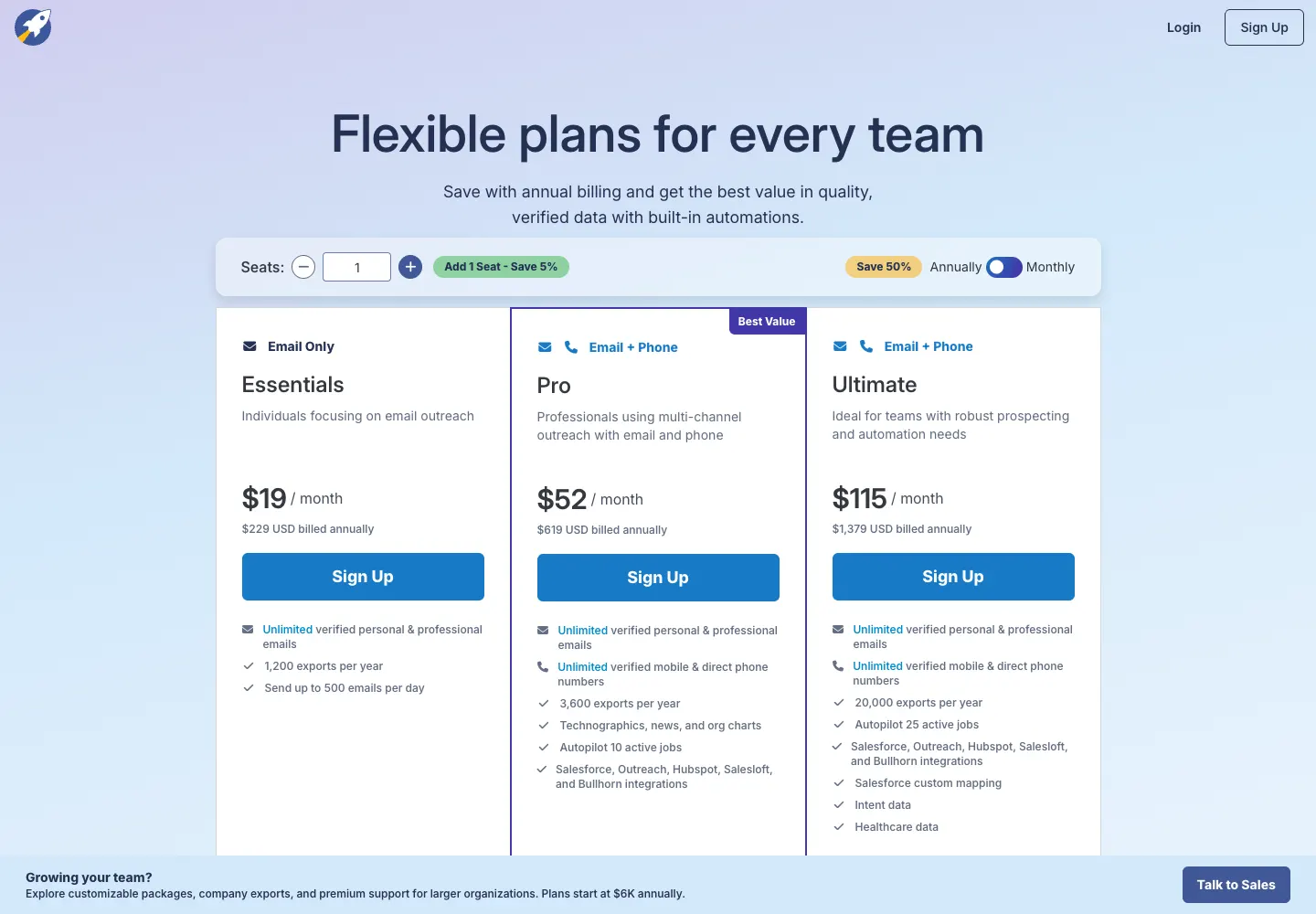
So an alternative has to replace 3 things: a lookup that returns email and phone together, a refund when nothing is found, and an allowance of 3,600 to 20,000 exported contacts a year on annual billing, or 250 to 1,000 lookups a month on monthly billing. Phone data starts on Pro, so the real entry price for calling is $619 a year or $79 a month, not $19.
Stay with RocketReach if a fast, browser-based lookup against a broad professional database is the actual job, and outreach already runs in another tool.
Why people actually leave RocketReach
Data accuracy, not missing features, is the switching driver that shows up most often. RocketReach's own pricing page claims 98 percent accuracy with real-time verification; treat that as a vendor claim. On G2, RocketReach's listing shows roughly 4.4 out of 5 stars across a four-figure review count. G2 blocks automated fetching, so confirm the live number at g2.com/products/rocketreach/reviews. The recurring complaint in visible reviews: contacts who changed companies since the record was last verified, and personal Gmail, Yahoo or Microsoft addresses labeled as business contacts.
Stale data is a budget problem, not just an annoyance
- Wasted lookups: RocketReach refunds a lookup that finds nothing, but not one that finds an address that later bounces.
- Bounce rate: a bounce against a stale address can trip sender-reputation thresholds at volume.
- Wrong-person risk: a personal inbox mislabeled as a business contact reaches the wrong audience.
- Re-verification cost: the fix is to re-verify before a large send, which adds a second tool and a second cost.
None of this is unique to RocketReach. Every contact database decays as people change jobs. Treat "database accuracy" as a question you test on your own segment during a pilot, not a number a homepage can settle.
The 12 best RocketReach alternatives
Ranked by how cleanly each tool replaces a specific RocketReach job, with the price per phone number from the table above where the vendor publishes one.
1. Overloop: best for contact sourcing plus email, LinkedIn, and phone reveal
Overloop combines a B2B contact database of 450 million-plus records, email finding and verification, phone number reveal, AI-assisted list building, email and LinkedIn campaigns, a conversations inbox, warmup, and integrations. The Starter plan is $69 per user per month with 250 credits, one connected email account, and three active campaigns. Growth is $99 with 500 credits, three email accounts, ten campaigns, HubSpot and Pipedrive integrations, and REST API access. Enterprise is custom-priced with 1,000 credits, unlimited email accounts and campaigns, Salesforce integration, and dedicated onboarding. Sourcing a prospect from the database costs 1 credit and finding a valid email costs 1 credit.
Overloop's phone number reveal, added September 15, 2026, queries several phone data providers in sequence and stops at the first match. It costs 5 credits per revealed number, charged only when a number is found, and you can run it on one prospect or a whole list. The number exports to CSV and sits on the prospect record next to the email and LinkedIn steps. The Overloop phone number finder shows how the reveal works.
Choose it over RocketReach when: you want the lookup and the send in the same subscription instead of pairing a data tool with a separate sender, and that now includes phone numbers as well as email. Credits are used when sourcing a prospect, finding a valid email, and revealing a phone number, so model all three actions in your budget.
Stay with RocketReach when: your workflow is lookup-only, you already own a sender, and you just need a browser-extension or API lookup. Overloop has no built-in dialer, so revealed numbers feed call tasks, exports, and your CRM rather than an in-app call, and coverage varies by country and seniority. We do not publish a phone match rate.
Source: Overloop pricing and feature matrix. You can also review the product scope on our features page.
2. Apollo: best for a broader all-in-one data and engagement suite
Apollo combines contact and account data, enrichment, sequences, workflows, CRM integrations, intent signals, AI research, and calling in one product. On September 28, 2026 its pricing page listed Free at $0 with 900 credits per seat per year, Basic at $49 per seat per month billed annually with 30,000 credits per seat per year, Professional at $79 with 48,000 credits, and Organization at $119 with a 3-seat minimum and 72,000 credits. The page shows a 14-day trial on Basic and Professional and a 24 percent saving on annual billing. An email costs 1 credit and a phone number costs 8 credits. Basic's $588 a year buys 3,750 phone numbers at 8 credits each, about $0.16 a number, among the lowest per-number figures in this guide. The US dialer consumes credits.
Choose it over RocketReach when: you want data and a full outbound workflow, including calling, in a single self-service product.
Stay with RocketReach when: you want a lighter, lookup-first tool with a refund on empty lookups and no sequencing surface to manage.
Source: Apollo pricing, read September 28, 2026.
3. Lusha: best for a lightweight browser-based contact lookup
Lusha is close to a direct RocketReach substitute: a browser extension and web platform for finding verified emails and phone numbers, plus CRM integrations. On September 28, 2026 the pricing page listed Free at $0 with 40 credits a month, Starter at $49.90 a month or $37.45 billed yearly with 400 credits a month, Pro at $69.90 or $52.45 billed yearly with 600 credits, and Premium at $399.90 or $299.95 billed yearly with 3,400 credits. A verified email costs 1 credit and a phone number 5 credits, from the same pool. Starter's 400 credits are 80 phone numbers, about $0.47 each on annual billing. Unused monthly credits roll over up to twice the plan limit.
Choose it over RocketReach when: you want a similarly lightweight lookup with a free tier and a transparent email versus phone credit split.
Stay with RocketReach when: you want email and phone returned in one lookup, with a refund when nothing is found.
Source: Lusha pricing, read September 28, 2026.
4. Kaspr: best for LinkedIn-native European mobile data
Kaspr is a LinkedIn and Sales Navigator extension that reveals mobile numbers alongside emails, which makes it a common pick for European outbound teams. On September 28, 2026 the pricing page listed Free with 5 phone credits a month, Starter at $49 a month billed annually or $65 monthly with 100 phone credits a month and unlimited B2B email credits, Business at $79 billed annually or $99 monthly with 200 phone credits, and a custom Enterprise plan. Extra phone credits are sold from $0.36 each for 250 down to $0.21 each for 10,000. Starter works out to $0.49 a number on annual billing.
Choose it over RocketReach when: your prospecting happens on LinkedIn and Sales Navigator first, and you want mobile numbers surfaced inside that workflow.
Stay with RocketReach when: you need a standalone search-by-name-or-company database rather than a LinkedIn-attached extension.
Source: Kaspr pricing, read September 28, 2026.
5. Hunter: best for lightweight email finding and verification
Hunter focuses on domain search, email finding, email verification, a B2B database, and light email sequences, with unlimited team members sharing the plan quota. On September 28, 2026 the page, shown to a European visitor, listed Free with 50 credits a month and Starter at €49 a month or €34 billed yearly with 2,000 credits a month, then Growth and Scale tiers. A verification costs half a credit. Hunter does not document phone data or LinkedIn sequences.
Choose it over RocketReach when: email is the only channel you need to source and verify.
Stay with RocketReach when: you also need phone lookups.
Source: Hunter pricing, read September 28, 2026.
6. Snov.io: best for budget email finding plus drip campaigns
Snov.io pairs an email finder and verifier with drip campaigns and unlimited team seats on every paid tier. On September 28, 2026 its page listed Starter at $39 a month with 1,000 credits, with 25 percent off on annual billing, and higher Pro tiers above it. LinkedIn automation is a separate $69 a month per account slot. Phone and data enrichment is sold as separate token packages, and the page says only successful results are charged; it does not state how many tokens one phone number costs.
Choose it over RocketReach when: budget matters more than database breadth and you want email finding bundled with drip-sequence sending.
Stay with RocketReach when: you need a phone number price you can read before buying.
Source: Snov.io pricing, read September 28, 2026.
7. Clay: best for orchestrating enrichment and GTM data
Clay is not a one-for-one RocketReach replacement. It is strongest when you want to combine several data providers in a waterfall, research accounts with Claygent, and push enriched records into a sender. On September 28, 2026 the pricing page listed a Free plan, Launch at $185 a month on monthly billing, or $167 a month on annual billing, with 15,000 actions and 2,500 data credits a month, and Growth at $495 a month, or $446 a month annually. The Free plan does not include phone number enrichment, and the cost of one phone number depends on the provider in your waterfall.
Choose it over RocketReach when: you want to orchestrate multiple data providers and build custom enrichment logic.
Stay with RocketReach when: you want a ready-to-use lookup without designing tables and waterfalls first.
Source: Clay pricing, read September 28, 2026.
8. ZoomInfo: best for enterprise intelligence and intent programs
ZoomInfo offers contact and company data, intent and signals, scoring, CRM enrichment, automation, and engagement across several product packages. It publishes no standard price; plans are quoted based on features, users, and records under management, typically on a one- to three-year term.
Choose it over RocketReach when: data governance, intent signals, and procurement support outweigh self-service simplicity.
Stay with RocketReach when: you need a self-service start without a sales-led buying process.
Source: ZoomInfo pricing request.
9. Cognism: best for enterprise-grade, phone-verified EU data
Cognism positions itself as a compliance-first data provider for European prospecting, with phone-verified mobile numbers. On September 28, 2026 its pricing page listed Standard and Pro packages of its Sales Prospecting product, each with 5 seats included, plus CRM Enrichment and Data-as-a-Service add-ons. 1 credit reveals, enriches or exports 1 contact, and viewing a contact you already revealed is free. No dollar figure appears on the page; every plan goes through a sales conversation.
Choose it over RocketReach when: verified European mobile coverage matters more than self-service signup, and your team can commit to a sales-led purchase.
Stay with RocketReach when: you want a price you can buy today.
Source: Cognism pricing, read September 28, 2026.
10. UpLead: best for pay-as-you-go volume with a published accuracy claim
UpLead charges one credit per contact, and each credit includes the email and the mobile direct dial. On September 28, 2026 its pricing page listed Essentials at $99 a month, or $74 a month billed annually with 2,040 credits a year, and Plus at $199 a month, or $149 billed annually with 4,800 credits a year. Professional is quote-based. Extra credits cost $0.60 on Essentials and $0.50 on Plus. The page states "We verify email addresses with a data accuracy rate of 95%"; treat that as a vendor claim. Essentials annual works out to $0.44 per unlocked contact.
Choose it over RocketReach when: you want phone and email priced as one flat credit.
Stay with RocketReach when: you want the refund on empty lookups; UpLead charges per unlocked contact.
Source: UpLead pricing, read September 28, 2026.
11. Seamless.AI: best for real-time, volume-first contact search
Seamless.AI markets a real-time search engine that looks up contact data when you ask. On September 28, 2026 the Free plan listed 1 user and 50 credits. Pro is sold through sales, and the page's FAQ says Pro plans start at 10,000 annual credits. Enterprise is custom. No paid price is published, so a per-number cost cannot be calculated without a quote.
Choose it over RocketReach when: your team expects a high lookup volume and will negotiate a package.
Stay with RocketReach when: you want to buy a plan without a sales call.
Source: Seamless.AI pricing, read September 28, 2026.
12. LeadIQ: best for SDR workflow and Salesforce-native prospecting
LeadIQ is built around the SDR workflow, with prospecting, job-change tracking and sync into Salesforce and Outreach. On September 28, 2026 the pricing page listed Free with 1 user and 50 credits, and Pro from $15 a month billed annually, or $20 monthly, for 200 credits a month with 5 users included. An email costs 1 credit and a phone number 10 credits, so the entry Pro tier covers 20 numbers a month, $0.75 each on annual billing. Enterprise is custom and adds Salesforce duplicate detection and governance controls.
Choose it over RocketReach when: your SDR team lives in Salesforce and wants prospecting built into that workflow.
Stay with RocketReach when: you want more phone lookups per dollar and do not need Salesforce-native tooling.
Source: LeadIQ pricing, read September 28, 2026.
How to choose the right RocketReach competitor
| If your priority is... | Shortlist | What to verify before buying |
|---|---|---|
| Lookup plus built-in email and LinkedIn sending | Overloop, Apollo | Channel coverage, credits per number, CRM sync, sender limits |
| Lowest cost per phone number | Apollo, RocketReach Ultimate annual, Kaspr add-on packs | Credit rules, export caps, refund on a miss, annual commitment |
| A close, lightweight lookup replacement | Lusha, Kaspr | Email vs phone credit cost, extension fit, export limits |
| Budget email finding | Hunter, Snov.io | Credit math, connected inboxes, whether phone data is needed |
| Custom enrichment waterfalls | Clay | Actions vs data credits, provider costs, workflow ownership |
| Enterprise data and intent | ZoomInfo, Cognism | Coverage for your markets, seats, contract term, add-ons |
| High-volume lookups | UpLead, Seamless.AI | Cost per contact at your volume, accuracy on a test sample |
| SDR workflow inside Salesforce | LeadIQ | Credits per phone, seat count, admin controls |
| Occasional lookup only, sender already owned | RocketReach | Phone data starts on Pro; annual caps exports, monthly caps lookups |
Run the arithmetic on 100 phone numbers a month. At RocketReach Pro that is 1,200 of the 3,600 annual exports, or 100 of the 250 monthly lookups. At Apollo it is 800 credits against a 30,000 annual pool. At Lusha it is 500 credits, more than Starter holds. At Kaspr it is exactly Starter's allowance. At Overloop it is 500 credits, a full Growth seat, charged only for numbers found, and the seat also runs your sequences.
RocketReach migration checklist
- Inventory the workflow: list every RocketReach feature your team uses, including saved searches, bulk lookups, the Chrome extension, and any API or CRM integration.
- Export only what you are allowed to retain: check your agreement, applicable data law, suppression lists, and opt-out obligations before moving contact data.
- Price the full stack: seats, credits, phone-data tiers, any separate sender, warmup, CRM or API access, and annual minimums.
- Run a limited pilot: use a representative segment and compare coverage, bounce handling, replies, and CRM data quality. Do not infer vendor-wide accuracy from a tiny sample.
- Protect sending reputation: if you are adding outreach for the first time, keep authentication, suppression lists, unsubscribe handling, and a conservative ramp-up.
- Plan rollback: document owners, exports, integration mappings, and the point at which the team keeps, changes, or abandons the migration.
Frequently asked questions
What is the best RocketReach alternative?
There is no universal best replacement. Overloop fits teams that want contact sourcing, phone reveal and built-in email and LinkedIn outreach in one workflow. Apollo is a broader all-in-one suite with one of the lowest prices per phone number in this guide. Lusha and Kaspr are lighter browser-based lookup tools, Hunter and Snov.io are budget email finders, Clay orchestrates several providers, ZoomInfo and Cognism serve enterprise data needs on a quote, UpLead and Seamless.AI target volume lookups, and LeadIQ is built for Salesforce-native SDR work.
What is the best free alternative to RocketReach?
Apollo's free plan gives 900 credits per seat per year, Lusha's 40 credits a month, Kaspr's 5 phone credits a month, Hunter's 50 credits a month, LeadIQ's and Seamless.AI's 50 credits, and Clay has a free plan without phone enrichment. Snov.io offers a free trial. RocketReach itself gives 5 free lookups. A free plan only helps if its allowance matches your volume, so compare limits before you migrate.
How much does RocketReach cost per month?
On September 28, 2026 RocketReach listed Essentials at $229 a year (shown as $19 a month) or $39 monthly, email only; Pro at $619 a year (shown as $52 a month) or $79 monthly, email and phone; and Ultimate at $1,379 a year (shown as $115 a month) or $169 monthly. On annual billing the grid lists unlimited lookups and caps exports at 1,200, 3,600 and 20,000 contacts a year. On monthly billing you get 100, 250 and 1,000 lookups a month. Team plans are quoted and start at $6,000 a year. A lookup that finds no verified email or phone is refunded.
How much does a phone number cost on RocketReach compared with alternatives?
RocketReach Pro works out to about $0.17 per exported contact on annual billing ($619 for 3,600 exports) and $0.32 per lookup on monthly billing ($79 for 250). Ultimate comes to about $0.07 per exported contact on annual billing and $0.17 per lookup monthly. For comparison, on September 28, 2026 Apollo Basic came to about $0.16 per number, Lusha Starter $0.47, Kaspr Starter $0.49 and FullEnrich Pro $0.55, each assuming every credit goes to phone numbers. Overloop charges 5 credits per revealed number, only when a number is found.
Is RocketReach better than Apollo?
They do different jobs. RocketReach is a lookup tool that returns email and phone in one lookup and refunds empty lookups. Apollo is a database plus sequences, a US dialer and CRM workflows, and on annual billing the two are close: about $0.16 per phone number on Apollo Basic against about $0.17 per exported contact on RocketReach Pro. On monthly billing RocketReach Pro rises to $0.32 per lookup. Pick RocketReach for occasional lookups next to an existing sender, Apollo if you want the whole outbound workflow in one login.
Which is better, ZoomInfo or RocketReach?
They serve different buyers. RocketReach publishes its prices, from $229 a year for email-only Essentials to $1,379 a year for Ultimate, and sells single seats to recruiters and small sales teams. ZoomInfo sells custom editions on a quote, adds intent data, org charts and CRM data operations, and suits an enterprise revenue team with a budget and an annual contract. If you need a number today on a card, RocketReach is the simpler buy; if you need account intelligence across a large team, ZoomInfo is the fuller platform.
How accurate is RocketReach's data?
RocketReach's pricing page claims 98 percent accuracy with real-time verification, which is a vendor claim. Its G2 listing shows roughly 4.4 out of 5 stars across a four-figure review count; confirm the live number at g2.com/products/rocketreach/reviews. The recurring theme in visible reviews is data going stale between refreshes, including personal addresses labeled as business contacts. Test any vendor on your own segment before a large send.
Which RocketReach alternative includes email and LinkedIn outreach?
Overloop documents contact sourcing plus email and LinkedIn campaigns in one product. Apollo documents email sequences, calls, and tasks. Snov.io runs email drip campaigns and sells LinkedIn automation per account slot. RocketReach itself lists light email sequences with a 500-per-day send limit, so most teams that need real outreach pair it with a separate sender.
What are the best RocketReach alternatives for small businesses?
Small teams usually want a price they can read and no seat minimum. Lusha, Kaspr, Apollo, Hunter and LeadIQ all publish prices. Overloop fits a small team that wants data and outreach in one seat from $69 per user per month. Cognism, ZoomInfo and Seamless.AI's paid tiers are sold through sales, which rarely suits a two-person team.
Does Overloop find phone numbers?
Yes. Overloop's phone number reveal queries several phone data providers in sequence and stops at the first match, per prospect or across a whole list. It costs 5 credits per revealed number, charged only when a number is found, and the number exports to CSV. Overloop has no built-in dialer, so revealed numbers feed call tasks, exports, and your CRM, and coverage varies by country and seniority.
How we evaluated RocketReach alternatives
This is a desk-research comparison. On September 28, 2026 we opened each vendor's official pricing page as a logged-out visitor, including RocketReach's own page rendered in a browser, and recorded the entry price, the plan allowance and the credit cost of a phone number. The price per phone number is the plan price divided by the phone numbers it includes, or the price per credit multiplied by the credits one number consumes. We evaluated six questions:
- Replacement scope: does the product replace RocketReach's lookup, add outreach on top of it, or both?
- Channels: does it document email, LinkedIn, calling, or is it data-only?
- Cost structure: per user, per credit, per lookup, or per export, and what does one phone number cost?
- Operational fit: self-service, enterprise-led, or designed to sit beside another sender or data provider?
- Documented limits: what do the vendor's own pages say about credits, exports, add-ons, or commitments?
- Data-quality positioning: what does the vendor claim about accuracy, and what do public reviews say?
We excluded unsourced accuracy percentages, anonymous testimonials, and modelled ROI. Where we cite an accuracy claim, it is attributed to the vendor. G2 blocks automated fetching, so the RocketReach rating is search-indexed rather than a direct pull. Prices change; use the source link in each section before purchasing.
Bottom line
RocketReach is not a bad default for a pure lookup job. It returns email and phone in one lookup, refunds empty lookups, and costs about $0.17 per exported contact on Pro with annual billing, or $0.32 per lookup on monthly billing. The recurring complaint, stale contacts and mislabeled personal addresses, is real, and it is not unique to RocketReach. The strongest alternatives win a specific job: more numbers per dollar with Apollo, a lighter extension with Lusha or Kaspr, enterprise coverage with Cognism or ZoomInfo, or data plus outreach in one tool.
Shortlist two or three products, price 100 phone numbers a month on each, then run a documented pilot. If your priority is sourcing contacts, revealing phone numbers and running email plus LinkedIn outreach in one workflow, compare Overloop's current plans and see how the Overloop phone number finder charges only for numbers it finds. If another platform fits the requirement better, choose it.