


ZoomInfo competitors are B2B contact data tools that sell emails and phone numbers without ZoomInfo's quote and multi-year contract. The main ones are Overloop, Apollo.io, Cognism, Lusha, Kaspr, RocketReach, Seamless.AI, UpLead, FullEnrich, Clay and ContactOut. This guide ranks all 11 by the dollar cost of one phone number, read on each vendor's pricing page.
ZoomInfo is the reference point for B2B contact data, and it is also the vendor most buyers cannot price without a sales call. This guide lists 11 alternatives, from full platforms to single-purpose phone finders, and compares them on the number that decides most purchases: what one phone number costs you in dollars.
Publisher disclosure: Overloop publishes this guide and ranks itself first for SMB sales teams that want contact data and outreach in one tool. Several tools below beat Overloop on raw data volume per dollar, and we say where. Every price was read on the vendor's own pricing page on September 28, 2026; we did not run a comparative accuracy test. Method and sources.
What changes when you leave ZoomInfo
- ZoomInfo publishes no price. Its 2025 annual report says subscriptions run 1 to 3 years and about 53 percent of contract value sits in multi-year agreements.
- 9 of the 11 alternatives below publish a self-serve price, so you can compute a cost per phone number before talking to anyone.
- Phone numbers are the expensive field everywhere: 5 credits at Lusha and Overloop, 8 at Apollo, 10 at FullEnrich, against 1 credit for an email.
- Cognism and Seamless.AI are, like ZoomInfo, sold on a quote.
- Only Overloop and Apollo put the contact data and multichannel sequences under one subscription; RocketReach, Seamless.AI and ContactOut document lighter email sending.
- Prices move. Every figure here was read on September 28, 2026; open the source link before you buy.
ZoomInfo alternatives by price per phone number
We divided the price of each entry plan by the number of phone numbers it can buy if every credit goes to phones. That is a ceiling, not a promise: a tool only returns a number when it has one.
| Tool | Plan used | Price | Phone numbers included | Cost per number |
|---|---|---|---|---|
| ZoomInfo | Quote only | Not published | Not published | Not published |
| Overloop | Starter or Growth | $69 or $99 per user per month | 250 or 500 credits a month, shared with email and sourcing | 5 credits, only on a match (see pricing) |
| Apollo.io | Basic, annual | $588 a year per seat | 30,000 credits a year at 8 per number = 3,750 | About $0.16 |
| Cognism | Standard or Pro | Not published | 1 credit reveals a full contact | Not published |
| Lusha | Starter, annual | $449.40 a year | 4,800 credits a year at 5 per number = 960 | About $0.47 |
| Kaspr | Starter | $588 a year, or $65 a month | 1,200 phone credits a year, or 100 a month | About $0.49 annual, $0.65 monthly |
| RocketReach | Pro, annual | $619 a year | Unlimited lookups, 3,600 exports a year | About $0.17 per export |
| Seamless.AI | Pro | Not published | Annual packages from 10,000 credits | Not published |
| UpLead | Essentials, annual | $888 a year | 2,040 contact credits a year | About $0.44 per contact |
| FullEnrich | Pro, monthly | $55 a month | 1,000 credits at 10 per mobile = 100 | About $0.55 |
| Clay | Launch | $185 a month, or $167 on annual | 2,500 data credits a month | Depends on the provider used |
| ContactOut | Email + Phone | $99 a month with US/UK data, $49 without (promotional) | Unlimited phones, 600 exports a month | About $0.17 per export ($0.08 without US/UK data) |
Prices and allowances read on each vendor's pricing page on September 28, 2026. Cost per number = plan price ÷ the maximum count of numbers the plan buys. Annual prices require an annual commitment. RocketReach (exports on annual plans) and UpLead (contacts) meter a contact, which can come with an email but no phone. FullEnrich shows €55 to European visitors; its USD pricing file lists $55, which we use. Taxes and add-ons are excluded.
Published cost of one phone number or contact, entry plans, September 28, 2026
Bars are drawn to scale from the table above: plan price divided by the most numbers or contacts the plan can buy. Cognism, Seamless.AI and Clay are left out because their price is not published or depends on the provider used.
ZoomInfo benchmark: what an alternative has to replace
ZoomInfo sells a contact and company database with intent data, enrichment and engagement tools on top. Its pricing page routes visitors to a sales conversation and publishes no plan price; it also blocked our automated read on September 28, 2026, so the most reliable public description of how ZoomInfo charges is its own annual report on Form 10-K for 2025.
| What ZoomInfo states | Detail from the 2025 10-K |
|---|---|
| How it prices | By the functionality, users and records under management included in each product edition |
| Core paid products | ZoomInfo Copilot, Sales, Marketing, Operations and Talent, with add-ons for some |
| Contract length | Subscriptions generally run 1 to 3 years; about 53 percent of contract value is in multi-year agreements |
| Billing | Typically at the start of each annual, semi-annual or quarterly period |
| Free option | ZoomInfo Lite, a freemium edition with a set amount of monthly credits |
| Scale | 1,921 customers above $100,000 in annual contract value at December 31, 2025 |
Source: ZoomInfo Technologies Form 10-K for fiscal 2025, read September 28, 2026. ZoomInfo pricing page checked the same day.
So a ZoomInfo alternative has to replace 3 things: a large searchable database, enrichment that keeps CRM records current, and a place for sellers to act on the data. Most tools below replace one or two of these at a published price. None replaces all of ZoomInfo's intent and governance features for an enterprise buyer, and we do not pretend otherwise.
Quick comparison: 11 ZoomInfo competitors
| Tool | Data approach | Buying model | Best for |
|---|---|---|---|
| Overloop | 450M+ advertised database, phone waterfall across several sources | Self-serve, per user | SMB teams that want data and email plus LinkedIn sequences in one tool |
| Apollo.io | Proprietary database plus waterfall enrichment | Self-serve, per seat | Volume prospecting with sequences and a US dialer |
| Cognism | Proprietary database, on-demand mobile verification on Pro | Quote, 5 seats included | Mid-market teams prospecting in Europe |
| Lusha | Proprietary database, extension and platform | Self-serve up to 5 users | Small teams that reveal contacts one at a time |
| Kaspr | LinkedIn extension reveal | Self-serve, per user | Sellers who live in LinkedIn |
| RocketReach | Proprietary database, lookups | Self-serve; teams from $6K a year | Searching people by name and company |
| Seamless.AI | Real-time search engine, extension | Quote for paid plans | Teams buying a large annual credit pool |
| UpLead | Proprietary database with verification | Self-serve, single user | Small US-focused teams that want email and mobile in one credit |
| FullEnrich | Waterfall across 25+ sources | Self-serve, unlimited users | Enriching lists you already own |
| Clay | Marketplace of 150+ data providers in waterfalls | Self-serve, unlimited seats | Ops teams building custom enrichment workflows |
| ContactOut | Proprietary database, extension | Self-serve, 1 user | Recruiter-style research on a small budget |
1. Overloop: best for SMB teams that want contact data and outreach in one tool
Best for: SMB sales teams that want to find emails, reveal phone numbers and run email plus LinkedIn sequences from one subscription, at a published per-seat price.
We publish this guide and rank Overloop first, so weigh that. The argument is about workflow, not data size. ZoomInfo gives you a record; you then move it to a sequencer, a CRM and a dialer. In Overloop, you source prospects from an advertised 450M+ B2B contact database, find and verify emails, and click Find phone on a prospect or a whole list. Overloop checks several phone data sources in turn and stops at the first match. A number found costs 5 credits; a search with no result costs no phone-search credits. The number is saved on the prospect record that is already in your sequence, and it exports to CSV. The phone number finder page shows the flow.
Pricing is per user and published: Starter is $69 per user per month with 250 credits and 1 connected email account, Growth is $99 per user per month with 500 credits and 3 email accounts, and Enterprise is custom. Credits are one meter shared by sourcing, email finding and phone reveal. See Overloop pricing for the current credit table.
Limits to know: there is no built-in dialer, so numbers feed call tasks and exports. There is no intent-data layer comparable to ZoomInfo's, and the database is smaller than ZoomInfo advertises. CRM integration scope varies by plan. We publish no phone match rate for Overloop, because a rate measured on our lists would not predict yours.
Choose it over ZoomInfo when: you want to buy without a sales cycle and the number has to end up in an email and LinkedIn sequence the same day. Stay with ZoomInfo when: intent data, governance and CRM-wide enrichment for a large org are the job.
How to test it against ZoomInfo: create an Overloop account, import 20 prospects whose numbers you already know, click Find phone on the list, and count the numbers that come back right. Only the numbers found use credits, and the same list is ready for an email and LinkedIn sequence.
2. Apollo.io: best for the most phone numbers per dollar
Best for: teams that want a large database, email sequences and calling in one login, and value credit volume over European depth.
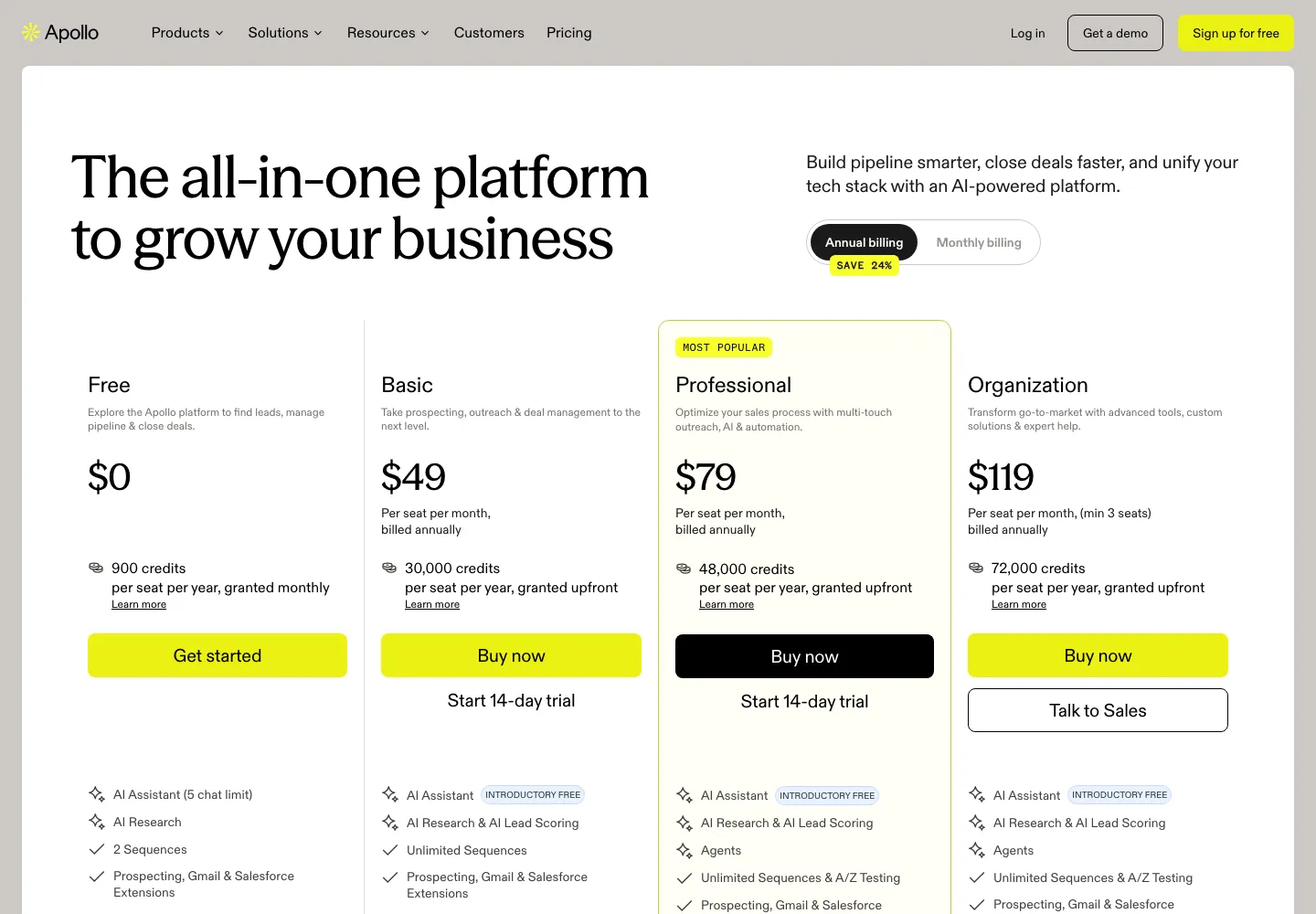
Apollo is the most direct self-serve ZoomInfo competitor. On September 28, 2026 its pricing page listed Free at $0 with 900 credits per seat per year, Basic at $49 per seat per month billed annually with 30,000 credits per seat per year, Professional at $79 with 48,000 credits, and Organization at $119 with a 3-seat minimum and 72,000 credits. An email costs 1 credit and a phone number 8 credits, and data enrichment uses up to 9 credits per record. Basic's 30,000 credits are 3,750 phone numbers a year, about $0.16 each. Basic and Professional show a 14-day trial, and annual billing is marked as a 24 percent saving.
Limits to know: the dialer is US-only on the base plans and an Advanced Dialer add-on is priced separately; LinkedIn is not a native sequence channel. Our Apollo alternatives guide covers the trade-offs.
Choose it over ZoomInfo when: credit volume per dollar and a card-and-go purchase matter more than intent depth. Source: Apollo pricing, read September 28, 2026.
3. Cognism: best for mid-market teams prospecting in Europe
Best for: teams of 5 or more sellers with a procurement process and European mobile coverage as the priority.
Cognism is the competitor ZoomInfo buyers most often shortlist for Europe. It sells 2 Sales Prospecting packages, Standard and Pro, each with 5 seats included. Pro adds what the page calls higher-quality mobile data, on-demand mobile verification and intent-based account priority. The credit model is clean: 1 credit reveals, enriches or exports 1 contact, viewing a contact you already revealed is free, and a credit is only used again if that contact changes jobs. The page publishes no price and says pricing is tailored to product, team setup and usage.
Limits to know: no self-serve signup, no native sequencer, and a 5-seat package that does not fit a 2-person team. See our Cognism alternatives if the quote is too high.
Choose it over ZoomInfo when: your territory is Europe and you still want a quoted, supported contract. Source: Cognism pricing, read September 28, 2026.
4. Lusha: best for small teams that reveal contacts one at a time
Best for: sellers who want a browser extension, a free tier and a published annual price.
On September 28, 2026 Lusha's pricing page listed Free at $0 with 40 credits a month, Starter at $37.45 per month billed yearly with 4,800 credits a year, Pro at $52.45 billed yearly with 7,200 credits, and Premium at $299.95 billed yearly with 40,800 credits. A verified email costs 1 credit and a phone number 5 credits. Starter's 4,800 credits buy up to 960 numbers a year, about $0.47 each. Teams larger than 5 users are routed to sales, and on annual plans unused credits reset at the end of the cycle.
Limits to know: emails and phones share one meter, so heavy email use eats the phone budget. Our Lusha alternatives page compares the options.
Choose it over ZoomInfo when: you reveal a handful of contacts a day and want to start free. Source: Lusha pricing, read September 28, 2026.
5. Kaspr: best for sellers who live in LinkedIn
Best for: individual sellers who want a phone number to appear while they browse LinkedIn or Sales Navigator.
Kaspr is owned by Cognism and sold self-serve. On September 28, 2026 it listed Free at $0 with 5 phone credits a month, Starter at $49 per user per month on annual billing or $65 monthly with 100 phone credits a month, Business at $79 annual or $99 monthly with 200 phone credits, and custom Enterprise. Paid plans include unlimited B2B email credits. Starter works out at about $0.49 per phone credit on annual billing and $0.65 monthly. Add-on phone credits cost $0.36 each for 250, falling to $0.21 each for 10,000.
Limits to know: no database search comparable to ZoomInfo, and no outreach layer. See Kaspr alternatives.
Choose it over ZoomInfo when: LinkedIn is where your sellers prospect. Source: Kaspr pricing, read September 28, 2026.
6. RocketReach: best for searching people by name and company
Best for: individuals who look people up one by one, outside LinkedIn, and export a few hundred contacts a month.
RocketReach's meter depends on the billing period. On September 28, 2026 the annual view listed Essentials at $19 per month billed $229 a year, email only; Pro at $52 per month billed $619 a year with email and phone; and Ultimate at $115 per month billed $1,379 a year. Annual plans list unlimited lookups with 1,200, 3,600 or 20,000 exports a year. Monthly billing is $39, $79 and $169 for 100, 250 or 1,000 lookups a month, and a lookup is only used if RocketReach finds and verifies an email or a phone. Pro costs about $0.17 per exported contact on annual billing. Team plans start at $6,000 a year. Our RocketReach pricing breakdown covers every plan and trap.
Limits to know: the entry plan has no phone data, and on monthly billing a lookup that returns only an email still counts.
Choose it over ZoomInfo when: you search named people rather than build large lists. Source: RocketReach pricing, read September 28, 2026.
7. Seamless.AI: best for teams that want a large annual credit pool
Best for: sales teams that prefer to negotiate a yearly credit package with a vendor, like ZoomInfo, but at a different scale.
Seamless.AI positions itself as a real-time search engine for B2B emails, cell phones and direct dials, with a Chrome extension. A banner on the page says all plans now include Connect for email, calls and tasks, marked limited time. On September 28, 2026 the pricing page showed a Free plan for 1 user with 50 credits, a Pro plan sold per user with annual credit packages behind a contact-sales button, and an Enterprise plan with unlimited users. Its FAQ says a credit is used when Seamless.AI researches a contact and that Pro plans start at 10,000 annual credits. No price is published.
Limits to know: you cannot compute a cost per number without a quote, and the buying process looks more like ZoomInfo's than Apollo's.
Choose it over ZoomInfo when: you want a quoted annual pool; the page also advertises a Switch and Save program with discounts of up to 50 percent against what you pay your current provider. Source: Seamless.AI pricing, read September 28, 2026.
8. UpLead: best for small US-focused teams that want email and mobile in one credit
Best for: single users who want each credit to unlock a full contact, mobile direct dial included.
UpLead charges one credit per contact. On September 28, 2026 the pricing page listed a 7-day free trial with 5 credits, Essentials at $99 per month for 170 credits or $74 per month billed yearly for 2,040 credits a year, Plus at $199 per month for 400 credits or $149 billed yearly for 4,800 a year, and a custom annual Professional plan for teams. Extra credits cost $0.60 on Essentials and $0.50 on Plus. Essentials on annual billing is about $0.44 per contact, $0.58 on monthly. The vendor states a 95 percent email accuracy rate; that is its claim, not our test.
Limits to know: Essentials and Plus are single-user accounts, and one credit is spent per contact unlocked, whether you need the email, the mobile or both.
Choose it over ZoomInfo when: you want a small, predictable monthly bill. Source: UpLead pricing, read September 28, 2026.
9. FullEnrich: best for enriching lists you already own
Best for: ops-minded teams that upload CSVs or call an API and want many providers checked per contact.
FullEnrich is a waterfall engine that says it queries 25+ sources and charges only for data it finds. On September 28, 2026 it listed a free trial with 50 credits, a Pro plan from $29 a month for 500 credits, $55 for 1,000 credits ($0.055 per credit; the page shows €55 to European visitors), and custom Enterprise. A work email costs 1 credit and a mobile phone 10 credits, so the 1,000-credit tier buys up to 100 mobiles a month, about $0.55 each. Users are unlimited, and credits roll over for 3 months on monthly billing and 12 months on yearly billing. Our waterfall enrichment guide explains why several sources beat one for mobiles.
Limits to know: there is no prospect database comparable to ZoomInfo's search, and no outreach.
Choose it over ZoomInfo when: you already know who to contact and only need the numbers. Source: FullEnrich pricing, read September 28, 2026.
10. Clay: best for ops teams building custom enrichment workflows
Best for: GTM engineers who want to chain providers, AI research and CRM updates in a spreadsheet-like table.
Clay is not a database; it is a workflow tool with a marketplace of 150+ data providers. On September 28, 2026 its pricing page listed a Free plan with 100 data credits and 500 actions a month, without phone enrichment; Launch at $185 per month, or $167 on annual billing, with 2,500 data credits and 15,000 actions a month and phone enrichment included; and Growth at $495 per month, or $446 on annual billing. Data credits pay for emails, phone numbers and company data bought from partners, so the cost of one phone number depends on which provider in your waterfall returns it. Read our Clay alternatives for simpler options.
Limits to know: two meters, actions and data credits, and a learning curve that is real for sellers.
Choose it over ZoomInfo when: you want to own the logic and mix providers. Source: Clay pricing, read September 28, 2026.
11. ContactOut: best for recruiter-style research on a small budget
Best for: one user who reveals many profiles but exports few.
ContactOut is a LinkedIn extension and search portal. On September 28, 2026 its pricing page listed Free with 5 emails, 5 phones and 5 exports a day; with US and UK data included, an Email plan at $49 per month against a struck-through $99, and an Email + Phone plan at $99 per month against $199, with unlimited emails, unlimited phones and 600 exports a month. Both paid plans are limited to 1 user per company and marked limited time. That is about $0.17 per exported contact. The page opens on a view that excludes US and UK data, where the same plans cost $25 and $49, about $0.08 per export.
Limits to know: the promotional price may not hold, the export cap is the real meter, and teams need a quote.
Choose it over ZoomInfo when: you are one person and cost is the constraint. Source: ContactOut pricing, read September 28, 2026.
How to choose a ZoomInfo alternative
| If your priority is... | Shortlist | What to verify before buying |
|---|---|---|
| A published price and no sales call | Apollo, Lusha, Kaspr, RocketReach, UpLead | Cost per number on the plan you will actually buy, monthly versus annual |
| Data and outreach in one tool | Overloop, Apollo | Credits per number, sequence channels, CRM scope by plan |
| European mobile coverage | Cognism, Kaspr | Coverage in your own countries on a test list, seat minimums |
| Enriching lists you already have | FullEnrich, Clay | Pay-on-success rules, number of sources, credit rollover |
| A negotiated annual pool | Seamless.AI, Cognism | Contract length, auto-renewal, credit expiry |
| Lowest cost for one user | ContactOut, UpLead | Promotional price duration, export caps, user limits |
Run the arithmetic on 100 phone numbers a month per seller. At Apollo that is 800 credits against a 2,500-a-month average on Basic. At Lusha it is 500 credits, more than Starter's 400 a month. At Kaspr it is exactly Starter's allowance. At FullEnrich it is the whole Pro plan. At Overloop it is 500 credits, charged only on numbers found and drawn from the same pool that sources prospects and finds emails. Then add the tool you would still need to send, and read our B2B data enrichment guide before you sign.
How we compared ZoomInfo competitors
This is desk research, not a lab test. On September 28, 2026 we opened each vendor's official pricing page as a logged-out visitor and recorded the entry plan, its price on the billing period shown, and its phone or contact allowance. Where the page was rendered by JavaScript, we read the rendered page. Where a vendor publishes no price, we say "not published" rather than repeat third-party estimates. ZoomInfo's pricing page refused our automated visit, so its benchmark comes from its 10-K. We excluded star ratings and match-rate claims we cannot verify, and we name vendor claims as vendor claims. Cost per number is the plan price divided by the maximum number of phone numbers the plan's credits can buy.
Frequently asked questions
Who is ZoomInfo's biggest competitor?
There is no single one. The closest full-platform competitors are Apollo.io, Cognism and Seamless.AI. For contact data at a published price, Lusha, Kaspr, RocketReach, UpLead and ContactOut compete on cost per record. FullEnrich and Clay compete on waterfall enrichment. Overloop competes for SMB teams that want the data and email plus LinkedIn sequences in one tool.
What is cheaper than ZoomInfo?
ZoomInfo publishes no price, so any self-serve plan is easier to budget. On September 28, 2026 the lowest published cost per phone number we computed was Apollo Basic at about $0.16 on annual billing, then RocketReach Pro at about $0.17 per exported contact, UpLead at about $0.44 per contact, Lusha at about $0.47 and Kaspr at about $0.49 per phone credit on annual plans.
Is there a free alternative to ZoomInfo?
Several vendors have a free tier: Apollo grants 900 credits per seat per year, Lusha 40 credits a month, Seamless.AI 50 credits, Kaspr 5 phone credits a month, ContactOut 5 phones a day and RocketReach 5 lookups. ZoomInfo itself offers ZoomInfo Lite, a freemium edition with monthly credits. Free tiers are for testing, not for a team's pipeline.
How much does ZoomInfo cost?
ZoomInfo does not publish prices. Its 2025 annual report says it prices by functionality, users and records under management, that subscriptions generally run 1 to 3 years, and that about 53 percent of contract value is in multi-year agreements. You need a quote to know your number.
Is Apollo better than ZoomInfo?
Apollo is better on published price and credit volume: its Basic plan lists 30,000 credits per seat per year for $49 a month on annual billing, and a phone number costs 8 credits. ZoomInfo is stronger on intent data, governance and enterprise support. The better tool is the one whose cost per usable number is lower on a test list from your own market.
Is Lusha or ZoomInfo better?
Lusha is better for small teams that want a published price: on September 28, 2026 Starter cost $37.45 a month billed yearly for 4,800 credits a year, with 5 credits per phone number and 40 free credits a month. ZoomInfo is better for enterprises that need intent data, governance and a supported contract, and it sells only on a quote. Teams larger than 5 users are routed to sales at Lusha too.
Is Cognism better than ZoomInfo?
Cognism is the stronger shortlist for teams prospecting in Europe. Both sell on a quote. Cognism's packages include 5 seats, 1 credit reveals a full contact, re-viewing a revealed contact is free, and its Pro package adds on-demand mobile verification. ZoomInfo is broader on intent data and enterprise tooling. Test both on a list from your own countries before you sign.
Which ZoomInfo alternative also runs the outreach?
Overloop and Apollo both combine contact data with sequences in one subscription. Overloop runs email and LinkedIn sequences and reveals phone numbers for 5 credits each, charged only when a number is found. Apollo runs email sequences and includes a US dialer. RocketReach, Seamless.AI and ContactOut document lighter email sending.
Bottom line
ZoomInfo's competitors split into three groups. Quoted platforms, Cognism and Seamless.AI, replace ZoomInfo's contract model with a different vendor. Self-serve databases, Apollo, Lusha, Kaspr, RocketReach, UpLead and ContactOut, let you compute a cost per number before you buy, from about $0.16 to $0.65 on the plans we read. Waterfall tools, FullEnrich and Clay, find numbers for lists you already hold.
Overloop sits in a fourth place: the data and the outreach in one seat. It reveals a phone number for 5 credits, only when one is found, inside the prospect record that is already in your email and LinkedIn sequence. Compare Overloop's plans and the phone number finder, and price 100 numbers a month on your 2 finalists before you sign anything.