



FullEnrich and Lusha both find work emails and mobile numbers, but they are built differently. FullEnrich queries 25+ providers in a waterfall, stores no contact database, and charges only for data it finds and verifies: 10 credits per mobile. Lusha runs its own database with a browser extension and charges 5 credits per revealed number. Per number, the two land in the same range at list price. Every number below was read on September 28, 2026.


Disclosure first: we are Overloop, and we sell contact data and outreach, so we compete with both FullEnrich and Lusha. Every price and figure below was read on the vendors' official pages on September 28, 2026. Where one of them is the better choice for your team, we say so.
FullEnrich vs Lusha: the short answer
Choose FullEnrich if you already have the list (a CSV, a CRM segment, an API feed) and want the most mobiles filled from it, paying only for numbers found. Unlimited users, credits that roll over, about $0.35 to $0.58 per mobile depending on volume.
Choose Lusha if you also need to find the people: search a database, reveal from a browser extension on a profile, push to the CRM. Per-seat plans, about $0.44 to $0.62 per number at list price.
Choose Overloop if the number has to go straight into outreach. Overloop, our product, reveals a phone number for 5 credits, charged only when one is found, and runs the email and LinkedIn sequence from the same prospect record. Plans start at $69 per user per month with 250 credits.
FullEnrich vs Lusha side by side
| Criterion | FullEnrich | Lusha | Overloop (our product) |
|---|---|---|---|
| How it gets data | Waterfall across 25+ providers; no stored contact database | Own database, browser extension and web app | Own advertised 450M+ database for sourcing; phone reveal queries several sources in turn and stops at the first match |
| Entry price | Free trial with 50 credits; Pro from $29 a month for 500 credits | Free plan with 40 credits a month; Starter $49.90 monthly or $37.45 a month billed annually | Starter $69 per user per month with 250 credits; Growth $99 with 500 credits |
| Credits per mobile number | 10 | 5 | 5 |
| Price per mobile number | About $0.35 to $0.58 | About $0.44 to $0.62 | 5 credits, only on a match (see pricing) |
| When a number is charged | Only when found and verified; landlines returned free | 5 credits per revealed number | 5 credits, only when a number is found; an empty search uses no phone-search credits |
| Coverage the vendor declares | People search across 800M people and 50M companies; average find rate around 80% | 290M+ verified contacts, 29M+ companies, 239 countries | Own B2B prospect database for sourcing; phone reveal queries several sources in turn |
| Users | Unlimited on every plan | 1 seat on Starter; Pro includes 2 free seats, Premium 5 | Priced per user |
| Unused credits | Roll over 3 months on monthly plans, 12 months on annual | Monthly plans roll over up to 2x; annual credits reset at year end | Credit rules on the pricing page |
| Integrations named | HubSpot, Clay, Zapier, Make, n8n, Slack, API, MCP server | Salesforce, HubSpot, Pipedrive, Zoho, Outreach, Salesloft, Gong, Clay, Zapier, Make, n8n | CRM integrations whose scope varies by plan; Chrome extension for LinkedIn |
Pricing
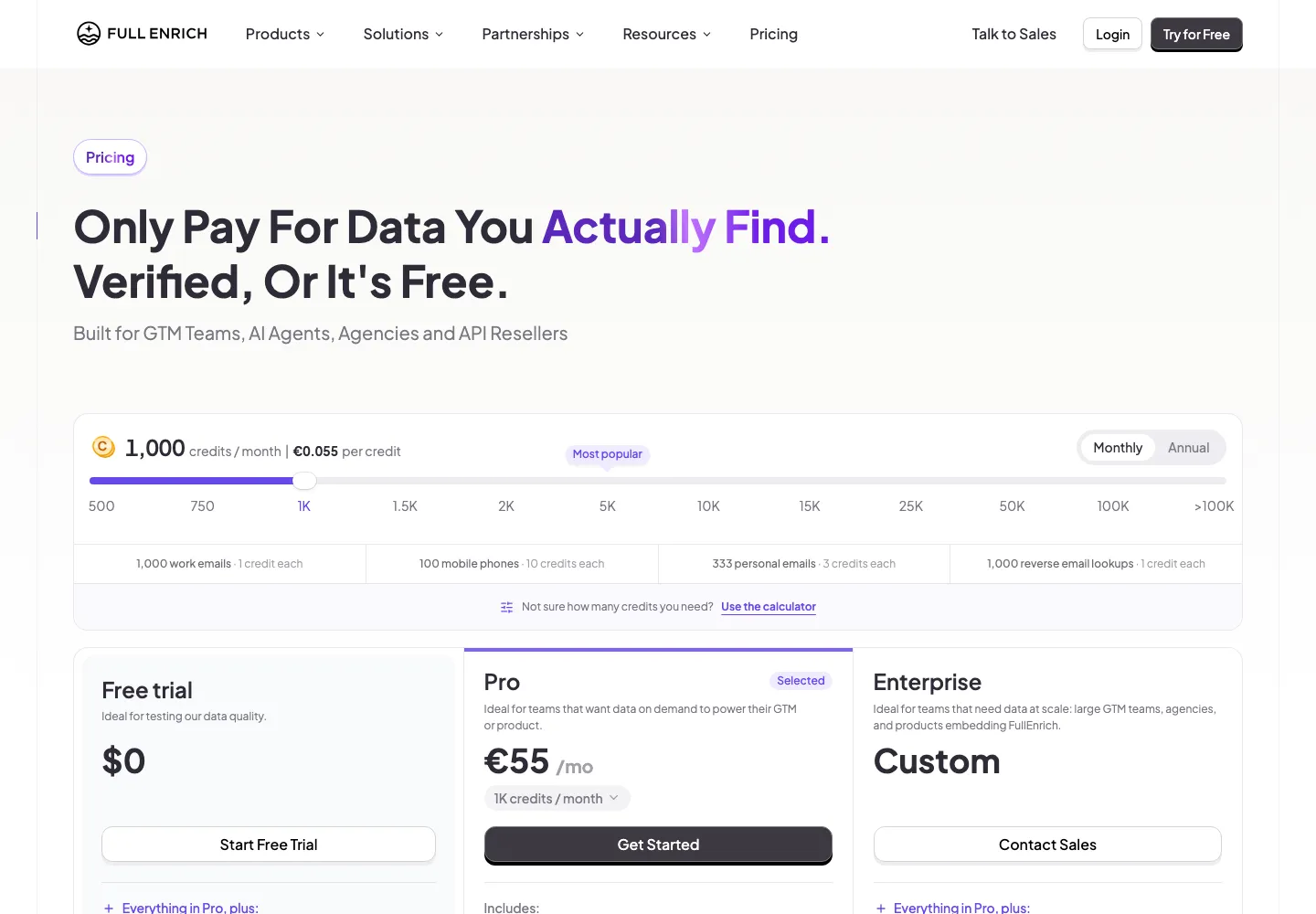
FullEnrich (FullEnrich pricing and its FullEnrich machine-readable pricing, September 28, 2026) sells one Pro plan in volume tiers. Monthly: 500 credits for $29, 1,000 for $55, 10,000 for $499, 100,000 for $3,500. Annual: from $26 a month for 6,000 credits a year; 12,000 credits a year cost $588. A work email costs 1 credit, a personal email 3, a mobile 10. The pricing page showed euros to our European browser (€55 for 1,000 credits, €0.055 a credit); the machine-readable file lists US dollars, which we use here.
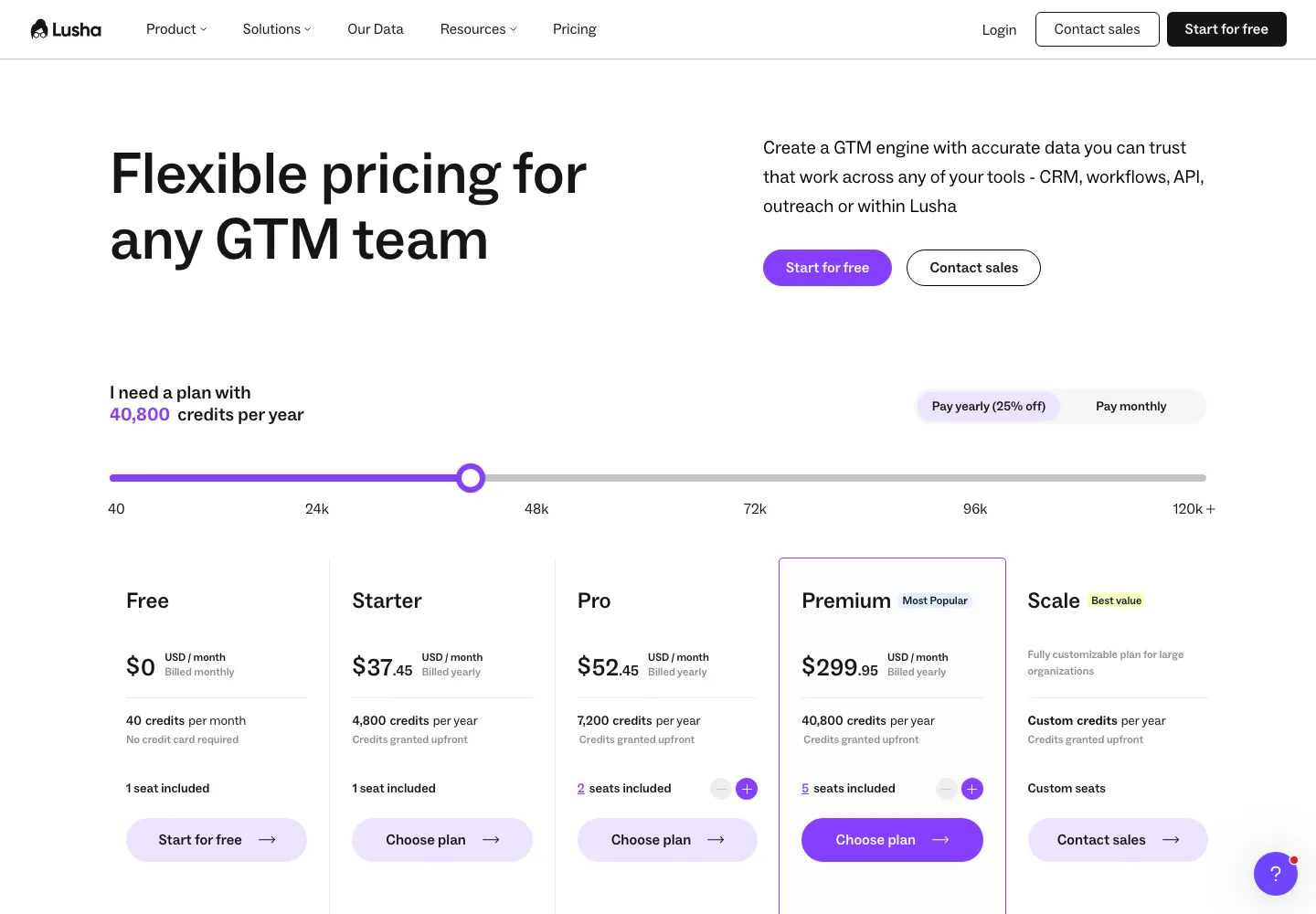
Lusha (Lusha pricing, September 28, 2026): Free at $0 with 40 credits a month; Starter $49.90 monthly with 400 credits or $37.45 a month billed yearly; Pro $69.90 monthly with 600 credits or $52.45 yearly; Premium $399.90 monthly with 3,400 credits or $299.95 yearly; Scale custom. Email 1 credit, phone number 5.
Cost per mobile number
| Tool | Plan | How we computed it | Price per phone number |
|---|---|---|---|
| FullEnrich | Pro, 500 credits a month | $29, 10 credits per mobile = 50 mobiles | about $0.58 |
| FullEnrich | Pro, 1,000 credits a month | $55 = 100 mobiles | $0.55 |
| FullEnrich | Pro, 10,000 credits a month | $499 = 1,000 mobiles | about $0.50 |
| FullEnrich | Pro, 12,000 credits a year | $588 a year ($49 a month) = 1,200 mobiles | $0.49 |
| FullEnrich | Pro, 100,000 credits a month | $3,500 = 10,000 mobiles | $0.35 |
| Lusha | Starter, monthly | $49.90, 400 credits a month, 5 credits per number = 80 numbers | about $0.62 |
| Lusha | Starter, annual | $37.45 a month, 4,800 credits a year (400 a month) = 80 numbers a month | about $0.47 |
| Lusha | Pro, monthly | $69.90, 600 credits a month = 120 numbers | about $0.58 |
| Lusha | Pro, annual | $52.45 a month, 7,200 credits a year = 120 numbers a month | about $0.44 |
| Overloop | Starter or Growth | Phone reveal draws on the plan's shared credits | 5 credits, only on a match (see pricing) |
FullEnrich's price per credit falls with volume and it charges nothing on a miss, so its effective cost per filled row can differ from the list math. Lusha's ceilings assume no credits go to emails.
Data and coverage
The two are not measuring the same thing. FullEnrich does not keep a contact database; it sends each lookup through 25+ providers in turn and returns what passes its verification, which it says removes about 30% of raw data. Its pricing FAQ puts the average find rate at around 80%, varying by industry and geography. That is FullEnrich's figure. Lusha declares 290M+ verified contacts and 29M+ companies across 239 countries in its own database (Lusha data page).
A waterfall usually fills more rows on a mixed list because a miss at one provider passes to the next; a single database is faster to search and browse. Neither publishes an audit that covers both, so we do not call one more accurate. Send the same 200 rows through FullEnrich's 50 free credits and Lusha's free plan and compare connected calls.
Workflow
FullEnrich is list-in, list-out: upload a CSV, call the API or the MCP server, or run it from HubSpot or Clay, and get enriched rows back. It also offers people and company search. Lusha is seller-first: reveal from the extension while on a profile, build lists in the web app, sync to the CRM, and use the email sequences listed on its plans.
Integrations
FullEnrich's FullEnrich integrations names HubSpot, Clay, Zapier, Make, n8n and Slack, plus a REST API and an MCP server on every plan. Lusha's Lusha integrations names Salesforce, HubSpot, Pipedrive, Zoho, Outreach, Salesloft, Gong, Clay, Zapier, Make and n8n; its API starts on Pro. If your CRM is Salesforce or Pipedrive, Lusha has the native connector on its list; FullEnrich goes through the API or no-code tools.
Verdict by team type
- Ops or agency enriching lists in bulk: FullEnrich. Unlimited users, pay on success, credits that roll over.
- Seller prospecting from LinkedIn profiles: Lusha, for the extension and the database search.
- Salesforce or Pipedrive shop: Lusha, on native connectors.
- Team that wants the mobile inside a sequence the same day: see the third option below.
- Team that wants the number on the sequence record: Overloop, if you want the revealed phone number and the email and LinkedIn sequence on one prospect record. 5 credits per revealed number, only on a match. Overloop has no built-in dialer.
Our guide to waterfall enrichment explains why multi-provider lookups change fill rates on phone data.
A third option: Overloop
Overloop is our product, so weigh this section with that in mind. It is not a pure data vendor. Overloop finds the work email and the phone number of a prospect and runs the email and LinkedIn sequence from the same record, so the number does not have to travel through a CSV before anyone uses it.
For phone data, the Overloop phone number finder queries several data sources in turn and stops at the first match. A revealed number costs 5 credits, charged only when a number is found; an empty search uses no phone-search credits. Overloop finds emails with its email finder and sources new prospects from an advertised 450M+ B2B contact database. Credits are one shared meter across sourcing, email finding and phone reveal. Starter is $69 per user per month with 250 credits and Growth is $99 per user per month with 500 credits; the credit rules sit on the pricing page.
Where we lose: for bulk enrichment of large CSVs with unlimited users, FullEnrich's model is built for that job; for extension reveals, Lusha is lighter. Overloop has no built-in dialer, so revealed numbers feed call tasks and CSV exports. We do not publish a phone match rate, because a rate measured on our lists would not predict yours. Run the reveal on 50 prospects you already know before you decide.
Want the mobile inside the sequence?
Overloop reveals phone numbers for 5 credits each, only when one is found, and sends the email and LinkedIn sequence from the same prospect record.
See the phone number finderSee plans and creditsHow this comparison was made
This is desk research, not a lab test. On September 28, 2026 we opened each vendor's official pricing page and the data pages linked below as a logged-out visitor, rendered them in a browser, and recorded plan prices, credits and the credit cost of a phone number. Price per number assumes every credit on the plan goes to phone numbers, which is the ceiling, not a typical month: emails, exports and other features draw on the same credits at most vendors. Coverage figures are what each vendor declares about its own data. We did not run a paid trial of either tool and we do not rank data accuracy, because no independent audit covering both was available. Methodology notes for the blog sit on our methodology page.
- FullEnrich pricing
- FullEnrich machine-readable pricing
- FullEnrich integrations
- Lusha pricing
- Lusha data page
- Lusha integrations
Frequently asked questions
Is FullEnrich better than Lusha?
For enriching lists you already have, FullEnrich fits better: a waterfall across 25+ providers, unlimited users and credits charged only on data found and verified. For finding people and revealing from a browser extension, Lusha fits better. Prices and rules read September 28, 2026.
Which is cheaper per mobile number, FullEnrich or Lusha?
They overlap at list price. FullEnrich charges 10 credits per mobile: $0.55 on the 1,000-credit plan, $0.50 at 10,000 credits, $0.35 at 100,000. Lusha charges 5 credits per number: about $0.47 to $0.62 on Starter and $0.44 to $0.58 on Pro. FullEnrich charges nothing when no mobile is found.
Does FullEnrich charge if it finds nothing?
No. FullEnrich's pricing page says credits are used only when it finds verified data; a failed lookup costs 0 credits and a landline found instead of a mobile is returned free.
What is FullEnrich's find rate?
FullEnrich's pricing FAQ states an average of around 80%, varying by industry, geography and seniority. It is the vendor's own figure. Test it with the 50 free trial credits on a list you know.
Does Lusha use a waterfall?
Lusha sells its own database of 290M+ verified contacts, according to its data page. FullEnrich, by contrast, stores no contact database and queries 25+ providers in turn for each lookup.
Can I use FullEnrich and Lusha together?
Yes. A common setup is Lusha for search and extension reveals, FullEnrich to fill the mobiles Lusha misses on a list. Watch for paying twice for the same contact: enrich only the empty rows.
Which tool puts the mobile number straight into an outreach sequence?
Neither FullEnrich nor Lusha is built around sequences: FullEnrich returns enriched rows and Lusha lists basic email sequences. Overloop reveals a phone number for 5 credits, charged only when one is found, and runs the email and LinkedIn sequence from the same prospect record. Plans start at $69 per user per month with 250 credits.